“Robot Olympics” 2026: Tiangong Ultra drops to 8.86 seconds over 100m
The clearest Tiangong progression is 21.50 seconds in 2025 → 9.39 seconds at the opening of this year’s Games → 8.86 seconds in the semifinal. That is a dramatic locomotion improvement in one year. It is still not a one-to-one athletics comparison with a human record: robot biomechanics, start procedure and stopping method differ, and Tiangong was stopped by a thick mat beyond the finish line.
Reuters says the 2026 World Humanoid Robot Games include more than 2,000 robots from 666 teams competing in 51 events. The 8.86-second sprint is technologically interesting, but RoboMorrow remains more interested in whether the same generation is improving manipulation, task autonomy and reliability. Our broader humanoid-market methodology is here.
23 Aug evening update: the World Humanoid Robot Games now have a result that has spread rapidly across global media. Tiangong Ultra ran 100 metres in 9.39 seconds in an official preliminary heat in Beijing. That is 0.19 seconds faster than Usain Bolt’s 9.58-second human world record from 2009. Honor’s Lightning finished the heat in 9.47 seconds. Earlier, Lightning was reported at 9.32 seconds in a preparatory test.
This is an important milestone for humanoid locomotion, but it should not be described as a new World Athletics record. The machines are not competing under human athletics rules, their mechanics are different and — as the footage makes very clear — they still do not decelerate like elite human sprinters after the finish. The precise formulation is that Tiangong Ultra recorded a time faster than the human 100-metre world record.
9.39 seconds for 100 m is spectacular. The autonomy tests matter more.
During the World Humanoid Robot Games, Tiangong Ultra completed a 100 m run in 9.39 seconds. That number is lower than Usain Bolt's 9.58-second human world record, but RoboMorrow does not treat the two as directly comparable athletics records: the event, athlete and homologation methodology are different. A separate HONOR Lightning trial also produced a faster robot time. For this article, the more consequential part of the Games remains manipulation, cable handling, warehouse work, charging and fully autonomous task execution.
Editorial note: a robot race time is not proof of general-purpose autonomy or factory readiness. The video is useful as evidence of locomotion progress; the harder benchmark is whether the same platform can complete real tasks reliably and autonomously.
Sources: BBC News video · Reuters, 23 Aug 2026 · official Beijing event data.
Video: 9.39 seconds over 100 metres — and the limit of control
The race footage captures both the progress and the limitation of current humanoids. Tiangong Ultra accelerates to a level that would have looked implausible only a year ago, yet the robots still rely on prepared safety barriers after the finish. Reuters/CCTV footage is available via The Guardian, while CCTV+ publishes the official video item and shot list.
That is not a trivial footnote. Maximum speed matters in a general-purpose robot only if the system can also brake reliably, recover balance, avoid people and transition from fast locomotion into precise manipulation. That is why the 2026 “Robot Olympics” are more interesting than the Bolt headline alone.
From 21.50 seconds to 9.39 in one year
The rate of progress is unusually large. At the inaugural World Humanoid Robot Games in 2025, Tiangong Ultra won the 100 metres in 21.50 seconds. In 2026, the same platform family is down to 9.39 seconds. That jump illustrates how quickly actuators, whole-body control, gait planning and high-speed stabilization are improving.
Honor’s Lightning provides a second reference point. Reuters reports 9.47 seconds in the preliminary heat and 9.32 seconds in an earlier test, with a reported peak speed of 14.5 m/s. Those numbers should remain separate: 9.47 seconds is the competition result, while 9.32 seconds comes from a preparatory test. RoboMorrow does not merge the two into a single “record”.
The loudest result is not the most important humanoid test
The second World Humanoid Robot Games run in Beijing from August 22 to 26. Organizers scheduled 51 events and 1,301 contests for 666 teams and 2,056 robots from 16 countries. Sprinting makes excellent video, but for commercial robotics the more important tests involve hands, precision, repeatability and work in environments resembling factories, warehouses, hotels, restaurants and homes.
Reuters describes this year’s shift as a move from speed-and-agility spectacle toward testing whether humanoids can perform tasks that matter outside the arena. RoboMorrow therefore treats the Games as a technology proving ground rather than a standardized industrial benchmark. Results depend on rules, hardware configuration, autonomy level and operator involvement.
More than 40% of the programme requires full autonomy
The most important clarification in Reuters’ 23 August reporting concerns autonomy. Huawei, a technology partner of the Games, says more than 40% of the 51 events require full autonomy. That does not mean more than 40% of all robots or all individual runs are operator-free; it describes the programme structure. The official rules still distinguish autonomous execution from teleoperation, and some scenario events allow both modes.
Reuters confirms tasks including cable connection, warehouse operations, EV charging, restaurant work, emergency response, industrial assembly and material loading. These less glamorous trials are a better signal of system maturity than a single maximum-speed result.
What does a sprint like this actually measure?
A 9.39-second 100-metre run does not answer whether a humanoid is ready for a warehouse or factory, but it does reveal something specific about the motion stack. At this speed, loads on joints and transmissions rise, coordination between the legs and torso becomes harder, and small state-estimation errors turn into balance failures much more quickly. The result therefore points to progress not only in actuator power, but also in whole-body control and dynamic stabilization.
At the same time, sprinting is a narrow and predictable task: a straight track, known distance, prepared surface and one clear objective. A robot operating around people must do much more. It needs to reduce speed before a person, stop without contact, recover after a disturbance and transition into manipulation without an operator resetting the system. For RoboMorrow, the more interesting capability is therefore the control range between maximum sprint speed and millimetre-scale precision.
If future editions publish fall counts, braking distance, recovery success and human-intervention frequency, the Games will become much more valuable as a humanoid-development benchmark. Today, 9.39 seconds is an excellent signal of the pace of progress, but it does not replace reliability and safety data.
2,056 robots and 51 events, but the work scenarios matter most
According to Beijing authorities, the second edition has attracted 666 teams and 2,056 humanoid robots, up from 280 teams at the inaugural event. The program has expanded to 51 events and 1,301 contests across five days. Organizers divide them into 30 competitive or sports-oriented events and 21 scenario-based events.
Running, football, martial arts, weightlifting and table tennis remain part of the spectacle. For the market, the scenario program is more revealing. Robots are expected to perform in environments modeled on factories, hotels, homes, retail, libraries, logistics, emergency response and EV charging. Official event materials explicitly say the goal is to move humanoids from demonstrations toward systems that can produce tangible output in real-world environments.
Eight hand tests show where the real bottleneck is moving
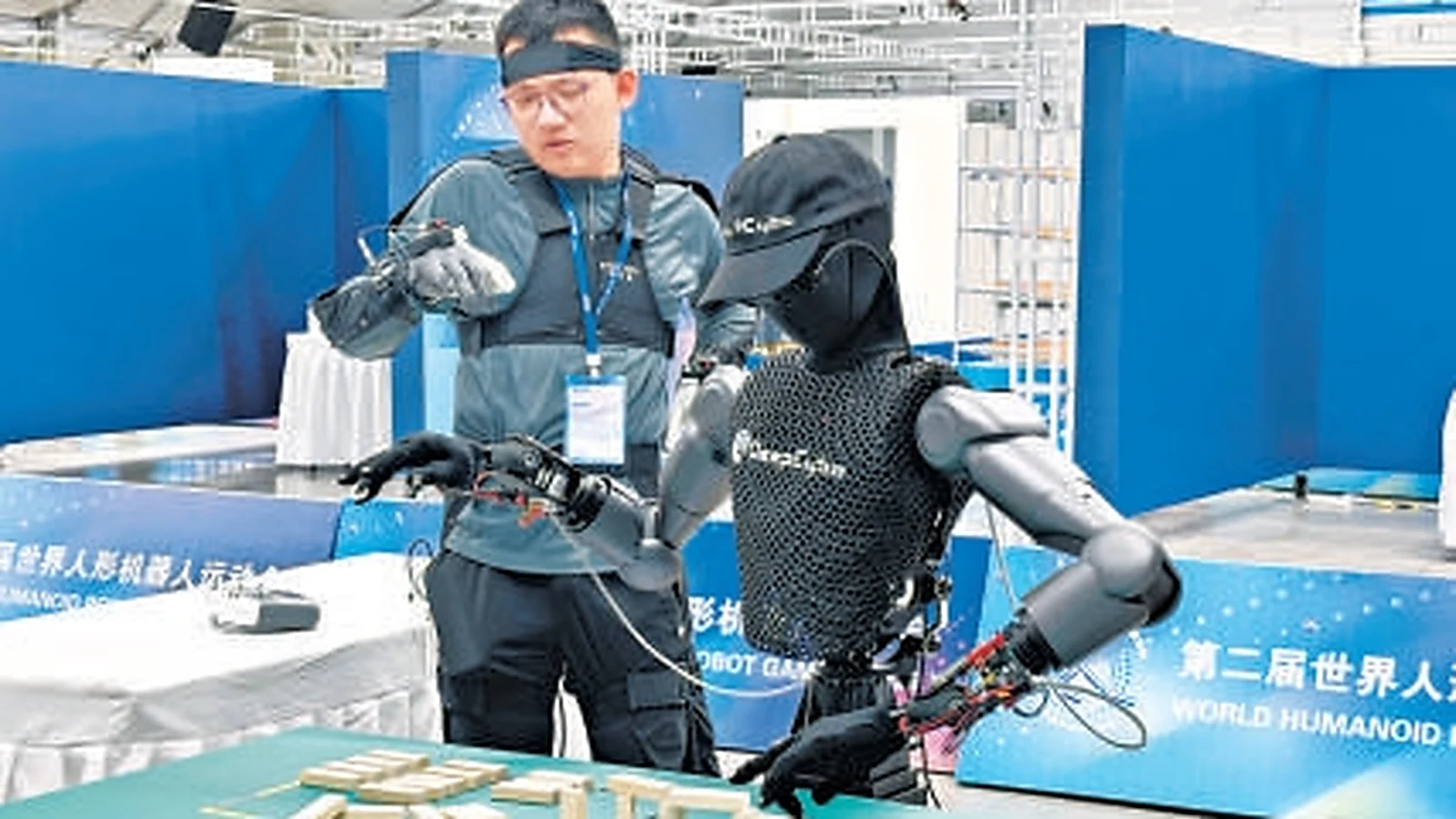
The most meaningful addition is a dedicated dexterous-hands category. Official rules list eight tasks: power-tool assembly, powder weighing, block building, fastening, bottle opening, unpacking, picking up small items with tweezers and cable connection. These sound simple because humans perform them without thinking, but each one combines perception, motion planning, force control, positional accuracy and recovery from imperfect contact.
A fresh Beijing Daily report shows a Beijing University of Civil Engineering and Architecture team training precisely this kind of manipulation. The humanoid in RoboMorrow's featured image is working with objects on a table while a human operator uses inertial motion capture for teleoperation. That detail matters. Good mechanical motion is not automatically proof of autonomy. The team is mapping human motion onto more than 50 actuators across the hands and arms, and the report says part of the system is being developed without tactile sensing.
Full autonomy is weighted above teleoperation
The organizers do not hide the distinction between autonomous execution and remote control. In the scenario-event rules, a fully autonomous approach receives a weighting coefficient of 1.0, while teleoperation receives 0.5. That is a more useful structure than treating every impressive demo as equivalent because it separates two very different engineering problems.
A teleoperated robot can prove that the hardware has sufficient range of motion, precision and grip control. An autonomous robot must also identify the object, interpret the situation, choose an action strategy, respond when contact goes wrong and complete the task without a human making the decisions. For an industrial buyer, that difference determines whether the robot actually removes operator labor or simply moves that labor from the factory floor to a remote-control station.
Why hands are harder than a spectacular sprint
Humanoid locomotion has improved rapidly over the past two years. Reuters notes that 47 of more than 100 robot teams finished Beijing's 2026 robot half-marathon, a major improvement from the previous year when falls and early failures were much more common. Walking and running are not solved problems, but the generational progress is visible.
Manipulation is different. A hand must cope with small tolerances, variable friction, deformable objects, uncertain geometry, self-occlusion and contact that cameras cannot always observe. Inserting a connector, using a screwdriver or grasping a tiny object with tweezers requires more than moving the end of an arm to a point in space. Orientation, force, torque and reaction to millimeter-scale errors all matter.
This complements the point from the Booster T1 perception-action study covered by RoboMorrow: a fast humanoid needs a closed perception-action loop. With dexterous hands, that loop becomes even more demanding because a few millimeters of error can determine whether the task succeeds or fails.
The Games are closer to market reality, but they are not a factory-readiness test
The new program is more commercially relevant than another sprint record, but it should not be over-interpreted. Competition tasks last minutes; an industrial robot must survive thousands of cycles. The Games do not provide one standardized figure for MTBF, intervention cost, changeover time, operator cost, hand wear or reliability after hours of continuous work.
A medal for opening a bottle or connecting a cable therefore does not prove that a platform is ready for a production line. It shows something else that is genuinely useful: which engineering problems the industry now considers important enough to measure publicly. The same transition is visible in market data. In RoboMorrow's analysis of H1 2026 humanoid shipments, a large share of volume still goes to entertainment, research and data production rather than sustained productive work.
What the shift means for Poland and Europe
For Europe, the useful lesson is not to copy China's “Robot Olympics” as a spectacle. It is to develop comparable, open deployment tests. Industrial buyers need benchmarks for task success rate, autonomy level, intervention frequency, cycle time, safety and cost per completed task. Those metrics are far more valuable than a video showing one perfect run.
That aligns with VDMA's position in RoboMorrow's recent article on Europe's humanoid robotics value chain. Europe has deep capabilities in automation, machinery safety, sensing, drives and integration. If it can turn those strengths into repeatable test criteria for robots working around people, standards could become a commercialization tool rather than only a regulatory burden.
What to watch during the 2026 World Humanoid Robot Games
The most useful results will not be the total medal count. Watch how many tasks are completed autonomously, how often a human intervention is required, whether robots can recover from errors without a reset, and how much success drops when the object or its position changes. Tool use, connectors, fragile objects and longer multi-step sequences will be especially revealing.
If the second edition begins reporting those factors in a comparable way, the Games could become more than a technology show. For the humanoid market, “can the robot run?” is becoming a less interesting question. The important question is increasingly: can it perform useful work, repeat it hundreds of times and do it without a hidden operator? The 2026 World Humanoid Robot Games are moving decisively toward that test.