HUMAIN and Applied Intuition Plan Thousands of Autonomous Trucks in Saudi Arabia
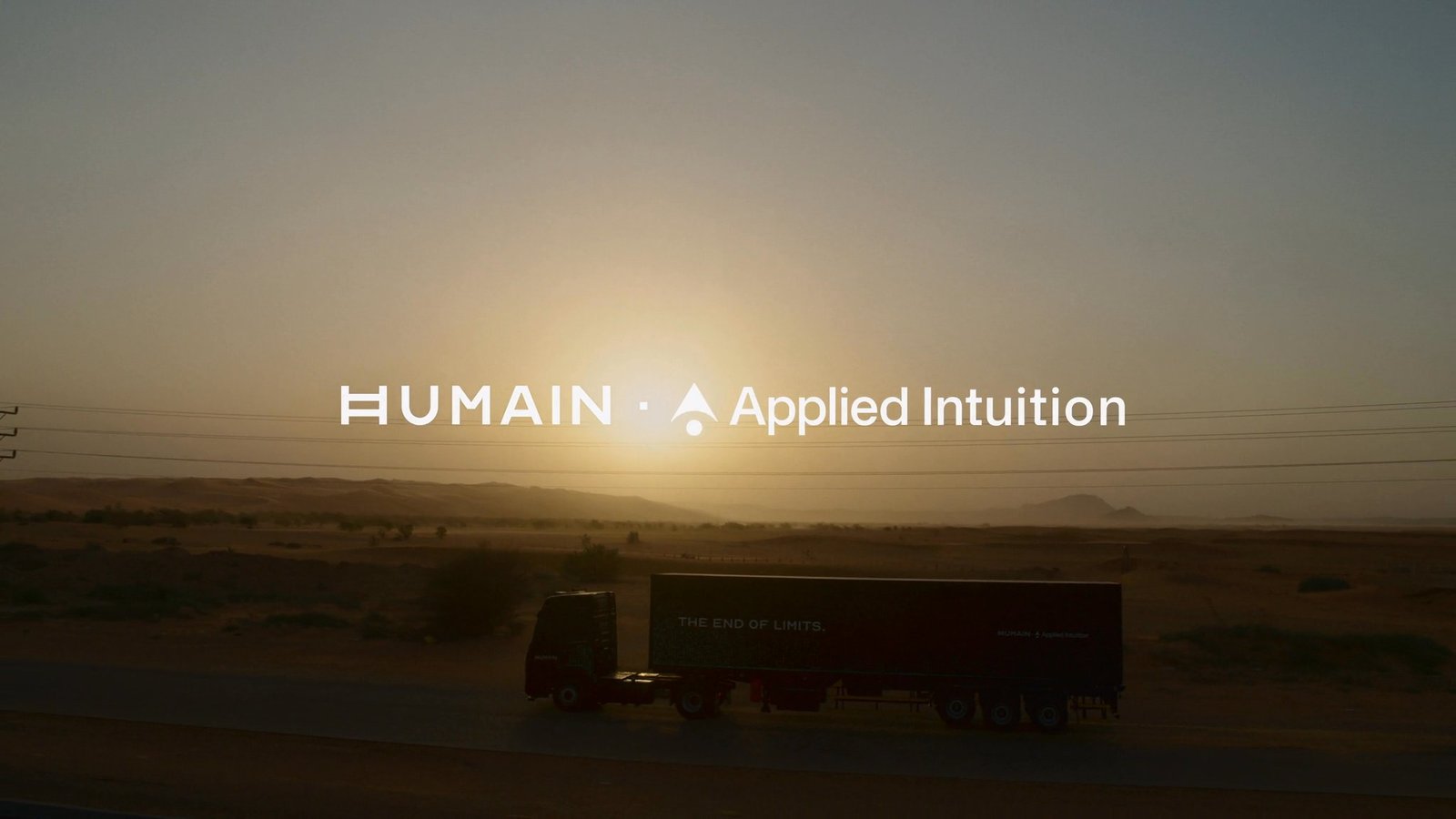
Saudi Arabia wants to treat autonomous freight as national infrastructure rather than a single-route pilot. HUMAIN — a company owned by Saudi Arabia’s Public Investment Fund — and Applied Intuition have announced a strategic collaboration whose first phase is intended to build an autonomous trucking network across key logistics routes. The stated target is thousands of vehicles by 2030.
The scale is striking, but today’s story needs precise wording. The partnership and program are real. Applied Intuition’s technology is already being developed and operated for Level 4 trucking in other markets. The specific Saudi fleet, routes, truck OEMs and timetable for first fully driverless commercial operations have not yet been disclosed.
Thousands of trucks by 2030 is a target, not the current fleet
In the official announcement, HUMAIN and Applied Intuition say they will build a unified autonomous logistics network at national scale. Trucking comes first, with thousands of autonomous trucks planned for key Saudi logistics corridors by 2030. The companies describe the future system as potentially the largest autonomous trucking network in the world.
- Target scale: thousands of autonomous trucks by 2030.
- Scope: key Saudi freight corridors connecting ports, industrial cities and distribution hubs.
- Technology: Applied Intuition Self-Driving System (SDS), Vehicle OS and supporting vehicle-intelligence technologies.
- Commercial structure: a long-term partnership.
- Future sectors: robotaxis, ports, mining, manufacturing, agriculture and construction — currently future areas for expansion, not verified deployments.
Applied Intuition says SDS is already operating on roads in the U.S., Europe and Japan and that the company is running Level 4 trucking with Isuzu. That matters as technology context, but it is not the same as a deployed Saudi fleet. Applied’s blog also says its Riyadh office opens with “trucks already on the ground,” without disclosing how many vehicles are present or whether they are development, validation or commercial units.
Physical AI without a humanoid body
For RoboMorrow, the project is a useful reminder that Physical AI is broader than humanoids. Media coverage often treats the term as shorthand for general-purpose robots with arms and legs, but a machine designed around a specific economic task can create just as much value. A truck does not need hands or bipedal locomotion to autonomously move high-value freight from point A to point B.
HUMAIN describes trucking as the first major initiative under its Physical AI strategy. Once infrastructure, data and operating expertise are established for freight, the partners say they want to explore robotaxis, ports, mining and other sectors. For now, those are roadmap ambitions, not a list of contracted deployments.
The useful benchmark: Gatik already has commercial metrics
A useful comparison is Gatik. The company recently raised $200 million and reports more than $600 million in contracted revenue plus 85,000 fully driverless orders. Those figures are company-reported rather than an independent audit, but they illustrate the difference between an ambitious national program and an operation where named customers, orders and real routes can already be analyzed.
Saudi Arabia and HUMAIN could eventually exceed that scale, but equivalent operating KPIs are not public today. RoboMorrow therefore does not write that the world’s largest autonomous trucking network already exists. The accurate formulation is that the partners plan to build a network at that scale and have launched a long-term program intended to reach it.
Why Saudi Arabia is a logical proving ground
Saudi long-haul corridors connect ports, industrial cities and logistics hubs over large distances. That can make utilization economics easier to model than a robotaxi navigating an unpredictable city center. At the same time, the environment is demanding: Applied Intuition highlights extreme heat, blowing sand and long routes as important operating conditions for the system.
The partners are also building local support. Applied Intuition has established an office in Riyadh and is hiring a technical team to launch, operate and scale fleets. That is a meaningful detail because commercial autonomy requires far more than an AI model: service, validation, safety engineering, fleet operations, infrastructure and exception-handling procedures all have to work together.
What is still unknown
Several inputs required to judge the program’s economics are missing: first-phase fleet size, truck manufacturers and models, exact corridors, contract value, approval timeline, liability model, teleoperation or remote-support architecture, cost per kilometer and the date of the first regular driverless freight service.
It is also unclear whether every vehicle counted in the “thousands” target is expected to operate at Level 4 without a driver across the full route, or whether the program will include multiple autonomy levels and operating models. Those are the questions that should trigger future updates to the same canonical story.
What it could mean for Poland and the EU
If the Saudi program actually reaches thousands of vehicles, it could become an important benchmark for Europe on safety, uptime, economics and autonomous-freight operations. Its regulatory model cannot simply be copied into the EU. European deployments depend on vehicle approval, liability, road rules, cybersecurity requirements and the cross-border nature of freight.
The subject matters for Poland in particular because of the scale of road transport and the role of Polish carriers in European logistics. A system that can operate reliably on long, repeatable routes and increase vehicle utilization could eventually affect the sector’s operating model directly. Today’s announcement is still the start of that program, not the moment when the shift has already happened.
Sources
Applied Intuition + HUMAIN — official announcement · Applied Intuition — technical program background · Sharikat Mubasher — independent local reporting · RoboMorrow — Gatik benchmark