Microduck Brings Physical AI to the Desk for €340
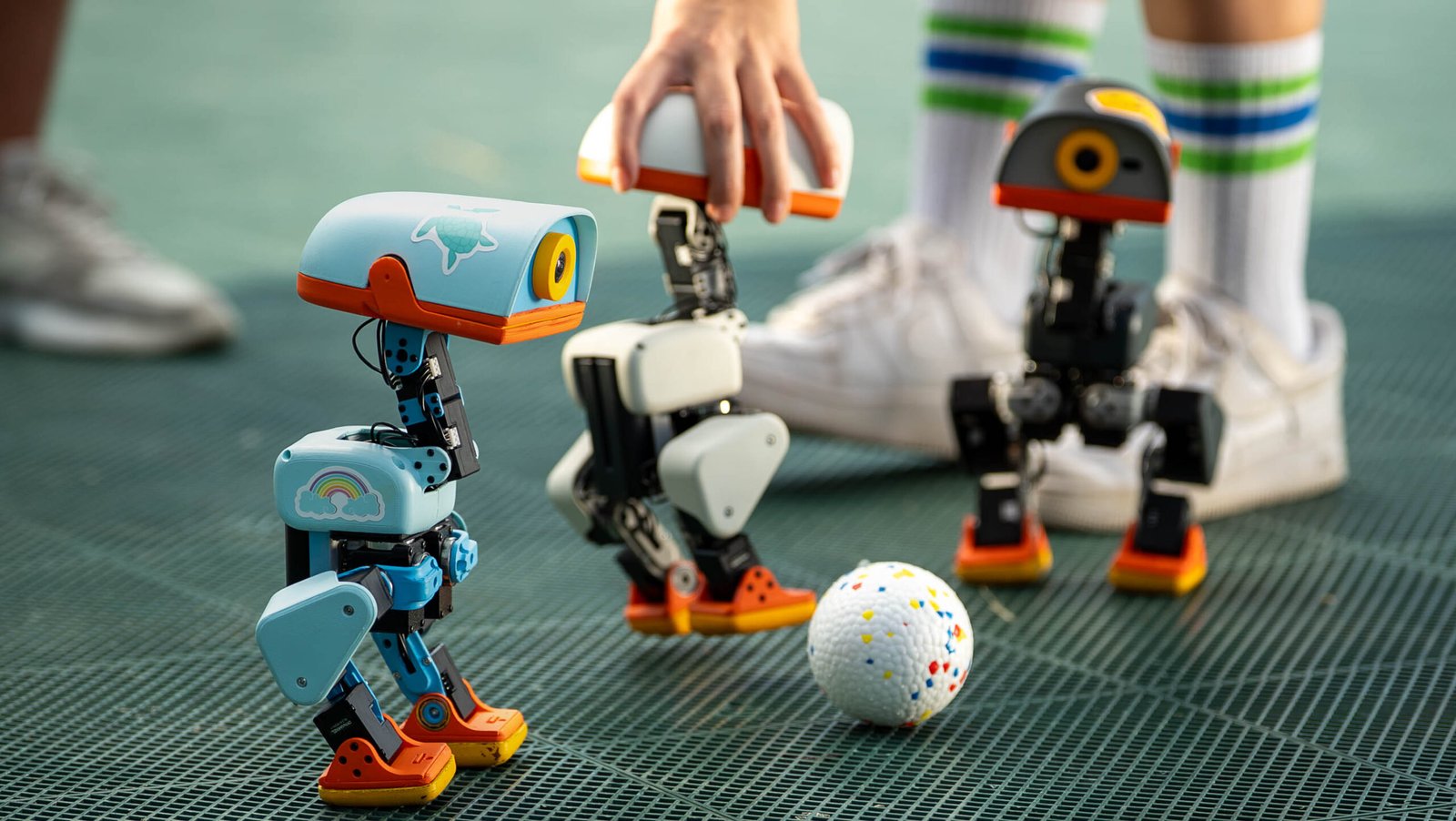
Physical AI now has the price of a game console. Microduck is not a household humanoid that will clean an apartment, but it may be one of 2026’s more consequential developer products. The 25 cm robot weighs under 800 g and is designed as an approachable platform for locomotion, reinforcement learning and sim-to-real experimentation.
Pre-orders opened on August 27. The introductory price is $399 before tax and shipping, and Pollen Robotics’ official European storefront currently lists €340. Launch availability includes the EU, UK, US, Canada, Norway, Switzerland, Japan and South Korea. First deliveries are targeted before Christmas 2026; that wording should be treated as a target rather than a guaranteed delivery date.
UPDATE: more than $2.6M of orders in the first 24 hours
Microduck's launch now has its first concrete — although still company-reported — demand signal. Hugging Face cofounder Thomas Wolf wrote on 28 August that after the full first 24 hours, the value of Microducks ordered had passed $2.6 million. He had reported the previous day that the launch crossed $1 million roughly six hours after the announcement.
RoboMorrow deliberately describes this as order value, not “$2.6 million in completed sales.” The number of paid and non-cancelled orders, accessory mix, taxes and geographic distribution have not been disclosed. Nor do we know how many of those robots will ship within the originally communicated timeline. That distinction matters for a preorder product.
Business Insider reported on 28 August that the spike in orders had created a backlog, while Wolf said the team was working with manufacturing partners to reorganize production for a volume two to three times higher than expected. These are still company statements and delivery estimates can change as the queue evolves.
For Physical AI, the more interesting point is not the $2.6 million headline by itself. Microduck suggests that a programmable embodied robot with sensors and a reinforcement-learning workflow can generate developer and consumer demand at a price measured in hundreds, rather than thousands, of euros. It does not yet prove durable mass-market demand, but it is a stronger signal than views on a viral demo.
Update source: Business Insider, 28 Aug 2026, quoting Thomas Wolf's post on X.
Watch Microduck in motion
This is official Pollen Robotics footage, not a RoboMorrow test. The video demonstrates manufacturer-shown behaviors including walking, roller skating, carrying objects with the beak, fall recovery and audio features. It is worth watching with sound on because the robot includes a speaker and a generated voice.
[embed width="1200"]https://www.youtube.com/watch?v=reiTh7K4KSc[/embed]Video: Pollen Robotics / YouTube. Manufacturer footage; the demonstrated behaviors are not an independent RoboMorrow benchmark.
A small robot built around a real Physical AI problem
Microduck has 15 degrees of freedom, a front camera, compact 8×8 ToF/LiDAR sensing, two IMUs, microphones, a speaker, NFC and an articulated beak that works as a simple gripper. Compute is based on a Rockchip RK3566 with an AI accelerator, 1 GB of RAM and 32 GB of storage. A removable NP-F550 battery is rated by the manufacturer at roughly one hour depending on use.
A game controller is included, so the robot can be used before any code is written. Pollen publishes seven trained behaviors including walking, sitting and standing, kicking, grabbing, roller-skating and recovering from common falls. The more important layer comes after the first session: users are meant to train new motion policies in simulation and deploy them to the physical robot.
Open source, with an important qualification
Pollen Robotics is open-sourcing the SDK, simulation environment and reinforcement-learning pipeline. Its press kit explicitly says that “open source” refers to software. Mechanical and electronic design files are not being released as open-source hardware. That distinction matters because describing Microduck as a completely open-source robot would be inaccurate.
The workflow is built around physics simulation: train, deploy to the real robot, observe failure, refine the simulation and retrain. None of those ideas are new on their own. The unusual combination is a low-cost assembled product, consumer-like onboarding and a stack aimed at people who do not have a dedicated robotics lab.
Why €340 in Europe matters
Large research humanoids cost thousands or tens of thousands of euros and bring space, safety and service requirements. Microduck changes the risk profile of experimentation. When a bad policy causes a fall, the result is a sub-kilogram robot on the floor rather than a human-sized machine creating a safety event.
That makes the platform potentially useful for technical schools, universities, robotics clubs, independent developers and small R&D teams. The price does not make Microduck a general-purpose robot. It has no arms, meaningful payload or ability to perform normal household chores. Its value is giving developers an inexpensive physical system for learning about motion, perception and embodied policies.
What we still do not know
- There are no independent long-duration tests yet for actuator durability, overall reliability or the quality of sim-to-real transfer for user-trained policies.
- Pollen says several specifications are still being finalized, including camera details, sensor range and parts of the SDK.
- Roughly one hour of battery life is a manufacturer estimate and depends on workload.
- The pre-Christmas delivery window is a target for the first production run, not a hard logistics guarantee.
Microduck versus Reachy Mini
Pollen frames the two products as complementary. Reachy Mini is built around AI that interacts through vision, audio and expression. Microduck is built around AI that acts through motion. That shifts the center of gravity from conversational robotics toward locomotion, reinforcement learning and embodied policies.
RoboMorrow view
Microduck is not a home-work robot; it is a low-cost entry point into Physical AI. That is precisely why it may matter. If Pollen delivers reliable hardware and a genuinely approachable sim-to-real workflow, €340 is low enough to move embodied-AI experimentation beyond specialist labs and into classrooms, maker spaces and ordinary developer desks.
Specs at a glance: a lot of sensing in 25 cm
| Component | Microduck |
|---|---|
| Actuation | 15 degrees of freedom / 15 motors |
| Size | 25 cm tall, about 14 cm wide |
| Weight | 780 g on the store listing; press kit says under 800 g |
| Perception | front camera, 8×8 ToF LiDAR, 2 IMUs |
| Interaction | articulated beak gripper, microphones, speaker, 2 NFC antennas |
| Compute | Rockchip RK3566 with AI accelerator, 1 GB RAM, 32 GB storage |
| Connectivity | Wi‑Fi and Bluetooth |
| Battery | removable 2600 mAh NP-F550; around 1 hour claimed |
| Policies | 7 behaviors in the box, 50 Hz onboard policy loop |
Those numbers explain why Microduck is more than an electronic toy. A camera, two IMUs and ToF ranging create a useful minimum stack for perception and balance experiments, while a 50 Hz policy loop means motion commands are updated fifty times per second. This is not a high-end laboratory platform, but it is enough to explore locomotion and simple physical interaction without the cost and risk of a human-sized humanoid.
The software is open. The hardware is not
This is one of the most important details in the launch. Pollen explicitly says that “open source” refers to the software stack: SDK, simulation environment, reinforcement-learning scripts and the sim-to-real workflow. Mechanical and electronic design files are not open-source hardware. RoboMorrow therefore does not describe Microduck as a completely open-source robot.
For developers, the more valuable part may be that the shipped motion policies and training tools are meant to be readable and retrainable. The intended loop is: train in MuJoCo, deploy to the robot, observe the gap between simulation and reality, refine the model and train again. Sim-to-real remains one of the hard parts of Physical AI because foot contact, drivetrain backlash, friction and latency never match a simulator perfectly.
Europe: €340 is the storefront price, not a guaranteed checkout total
Pollen's official European store currently lists Microduck at €340, while the launch page retains the introductory global price of $399 before tax and shipping. The store also says shipping is calculated at checkout, so €340 should be treated as the displayed product price rather than a guaranteed all-in cost in every country. Four colorways are offered: Cream, Graphite, Lavender and Sky.
The accessory ecosystem is unusually practical for a first release. The launch page lists a $39 Charger Pack and a $119 Dev Pack; the European collection currently shows about €33 and €99.99. The Dev Pack includes three spare motors, motor cables, two batteries, a dual charger, NFC tags, a screwdriver and spare screws. In educational robotics, access to replaceable parts can matter more than another headline feature.
Who should actually buy it?
The clearest audience is technical education, university teaching, robotics clubs, makers and small AI teams that want to train motion policies on real hardware. For a normal consumer, Microduck can be a charming programmable object, but it should not be purchased as a labor-saving home robot. It has no arms and its scale limits manipulation to light objects handled by the beak.
TechCrunch independently confirmed the $399 launch price, size and core capabilities. That still does not replace long-duration testing. We do not yet know actuator wear, how reliably new user-trained policies transfer, how much work a first custom behavior really takes, or how effectively Pollen will support the initial production wave.
RoboMorrow Reality Check
The most interesting thing about Microduck is not roller-skating. It is the cost of entering embodied-AI experimentation. At under a kilogram, a bad policy that makes the robot fall is primarily a development problem rather than the kind of safety event created by a human-sized machine. That changes how quickly people can iterate.
If Pollen delivers the promised sim-to-real workflow and durable hardware, Microduck could play a role similar to inexpensive developer boards in electronics: not the final consumer product, but the platform on which thousands of people learn how to build the next products.
Sources
Primary sources: Pollen Robotics — Microduck, the official press kit and the official European store.