Moxi 2.0 starts hospital rollout as Diligent's next-generation robot goes live
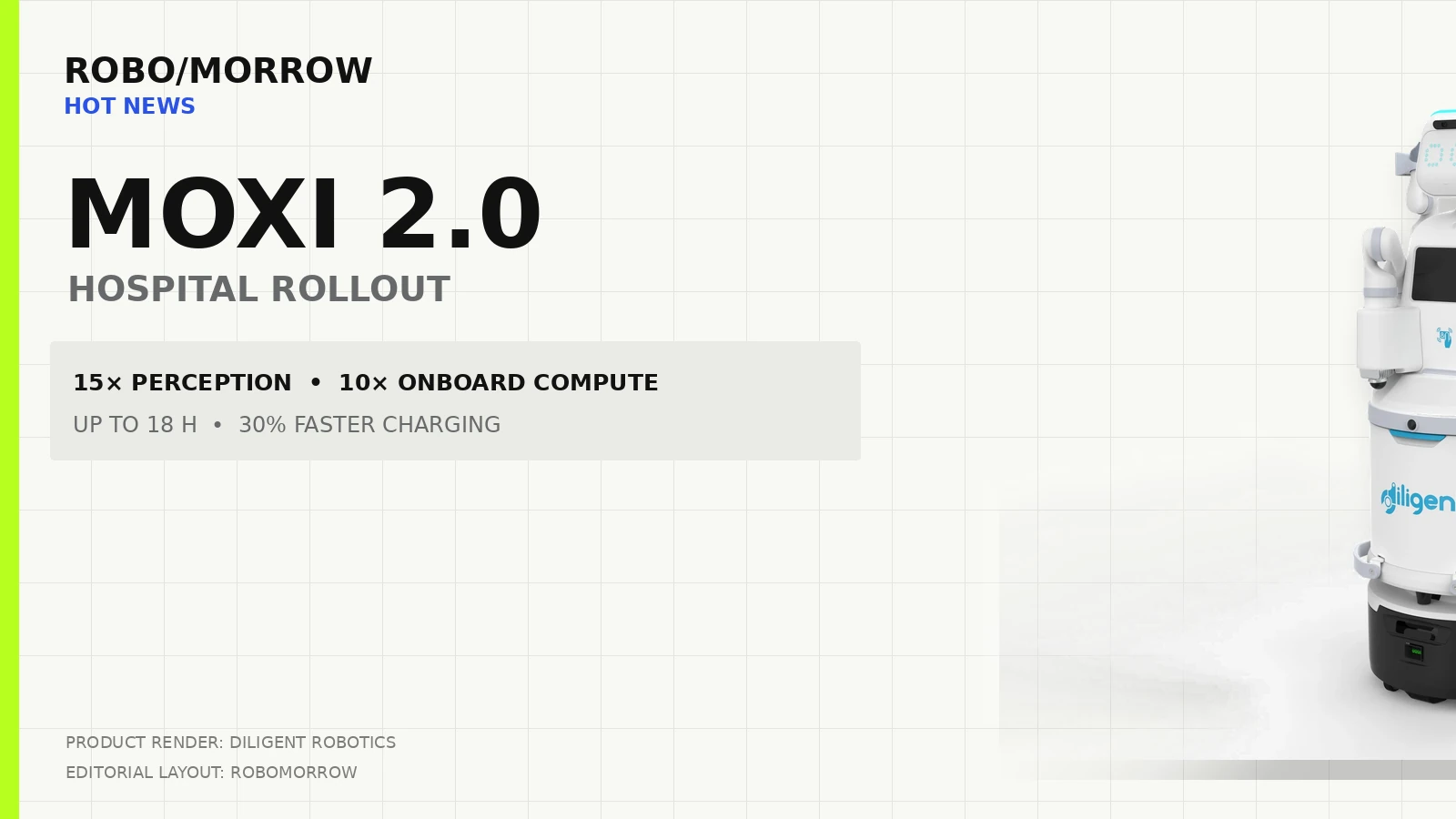
Serve Robotics has begun rolling out Moxi 2.0 to U.S. hospitals. This is more meaningful than another robot demonstration: the next generation of Diligent Robotics' platform is moving from an announced product into active healthcare deployments.
Serve said on 17 August that new robots are going to health systems including Endeavor Health Edward Hospital in the Chicago area, Providence Saint John’s Health Center in Los Angeles and Children’s Hospital Los Angeles. Reuters independently confirmed that deployment of the next generation of Moxi has begun. Reuters did not independently test the technical performance figures.
Moxi 2.0: from announcement to deployment
Diligent Robotics outlined Moxi 2.0 in October 2025, describing a new NVIDIA-powered compute platform, redesigned hardware and AI models built on several years of hospital operating data. Today's development is therefore not a product unveiling. It is the start of deployment.
Moxi handles non-clinical logistics tasks such as moving medications, lab samples, PPE and other supplies between hospital departments. It uses a mobile base and manipulator and is designed to share corridors, elevators and other spaces with hospital staff and patients.
Diligent previously reported more than 1.25 million autonomous deliveries across a fleet operating in more than 25 U.S. hospitals. Those are company figures, but they mean the second generation is being developed from a much larger body of field experience than a typical service-robot prototype.
15× faster perception, 10× compute and up to 18 hours
Serve claims Moxi 2.0 can perceive and interpret its surroundings up to 15 times faster than the previous generation. The robot is also said to have 10 times more onboard compute, upgraded sensors and storage, and improved autonomy and decision-making.
There is a small inconsistency inside Serve's own announcement. The headline deck refers to “15x faster processing power”, while the detailed technical section separates the numbers into 15× faster perception and 10× onboard compute. RoboMorrow uses the more specific technical figures rather than the simplified marketing line.
The manufacturer also claims up to 18 hours of operation and 30% faster battery charging. For a hospital robot, these metrics can matter more commercially than maximum speed: more time away from a charger can potentially translate into more missions per day and fewer robots required for the same workflow.
However, no full test methodology, workload profile or comparative uptime data has been published. It is also unclear how runtime changes under intensive manipulator use, repeated elevator journeys or heavier payloads.
World Model and the value of fleet data
Serve describes Moxi 2.0 as introducing Diligent's robotic “World Model”, a learning system intended to improve individual robots using experience gathered across the fleet. Earlier Diligent material also described a robot foundation model for navigation and manipulation.
The interesting part is not the model name but the data loop created by live deployments. Hospitals are difficult to simulate perfectly: people change direction, beds and carts block corridors, elevators and doors generate edge cases, and building layouts vary from site to site.
If Diligent can turn those edge cases into better models and safely redeploy improvements across the fleet, it could create an advantage that is harder to copy than an individual sensor or mechanical specification. That remains a manufacturer-led strategy, however; there are no public independent benchmarks comparing the World Model with competing systems.
Why the rollout matters for Serve Robotics
Moxi is becoming a second Physical AI pillar for Serve alongside sidewalk delivery robots. On the same day, the company announced a Grubhub partnership in Chicago, Los Angeles and Alexandria, new DoorDash markets in San Jose and Washington, D.C., and a small-footprint “micro depot” operating model.
Following its acquisition of Diligent Robotics, Serve is therefore no longer only a sidewalk delivery robotics company. It is expanding into complex indoor environments where robots must work around people and integrate with existing building infrastructure.
This could also matter commercially. Food delivery is sensitive to order density, weather and street regulation. Hospital robots operate in a more controlled environment and can perform repetitive tasks for many hours a day. Serve has not disclosed how much revenue Diligent currently contributes or how quickly it expects the hospital business to scale.
What we still do not know
There is no public Moxi 2.0 price, detailed subscription or service model, disclosed first-wave robot count or comparable ROI data. Public figures are also missing for remote human assistance rates, unsuccessful missions and real-world uptime by hospital.
There is no confirmed European launch plan either. In the EU, autonomy would be only one part of deployment: cybersecurity, data protection, machine safety, access-control and elevator integration, and responsibility for robot behaviour in patient-shared spaces would all matter.
What it could mean for Poland and Europe
Moxi illustrates a pragmatic route to commercialising Physical AI. Instead of trying to replace a person across a broad range of jobs immediately, the robot takes over a narrow, repetitive logistics workflow while the manufacturer develops autonomy using data from successive deployments.
For Polish hospitals, the decisive variables would therefore extend far beyond hardware price and specifications. Integration with existing buildings, local service, SLA, safety, completed-mission rate and measurable staff time savings would determine the business case. Only if Moxi 2.0 genuinely increases fleet availability and reduces human intervention will the claimed technical leap translate into commercial advantage.
RoboMorrow assessment
This is a deployment story, not a launch story. Moxi 2.0 had already been announced, but it is now beginning to reach named hospitals. That matters more than another render or demo because real operation will show whether extra compute, longer runtime and fleet-trained models actually reduce the cost of a completed mission.
For now, the strongest verified fact is the rollout itself. The 15×, 10×, 18-hour and 30% faster-charging figures are worth tracking, but they should remain clearly labelled as manufacturer claims until independent operating data becomes available.
Sources
- Serve Robotics — 17 August 2026 announcement
- Diligent Robotics — Moxi 2.0 announcement, 28 October 2025
- Reuters — independent confirmation of Serve and Moxi rollout
- Axios — independent confirmation of initial Moxi 2.0 shipments
Featured image: official Moxi 2.0 render — Diligent Robotics; RoboMorrow editorial layout. The shared PL/EN visual contains no Polish-only messaging.