NEURA enters hospitals. Its first robot targets bed transport and 1,300 staff hours
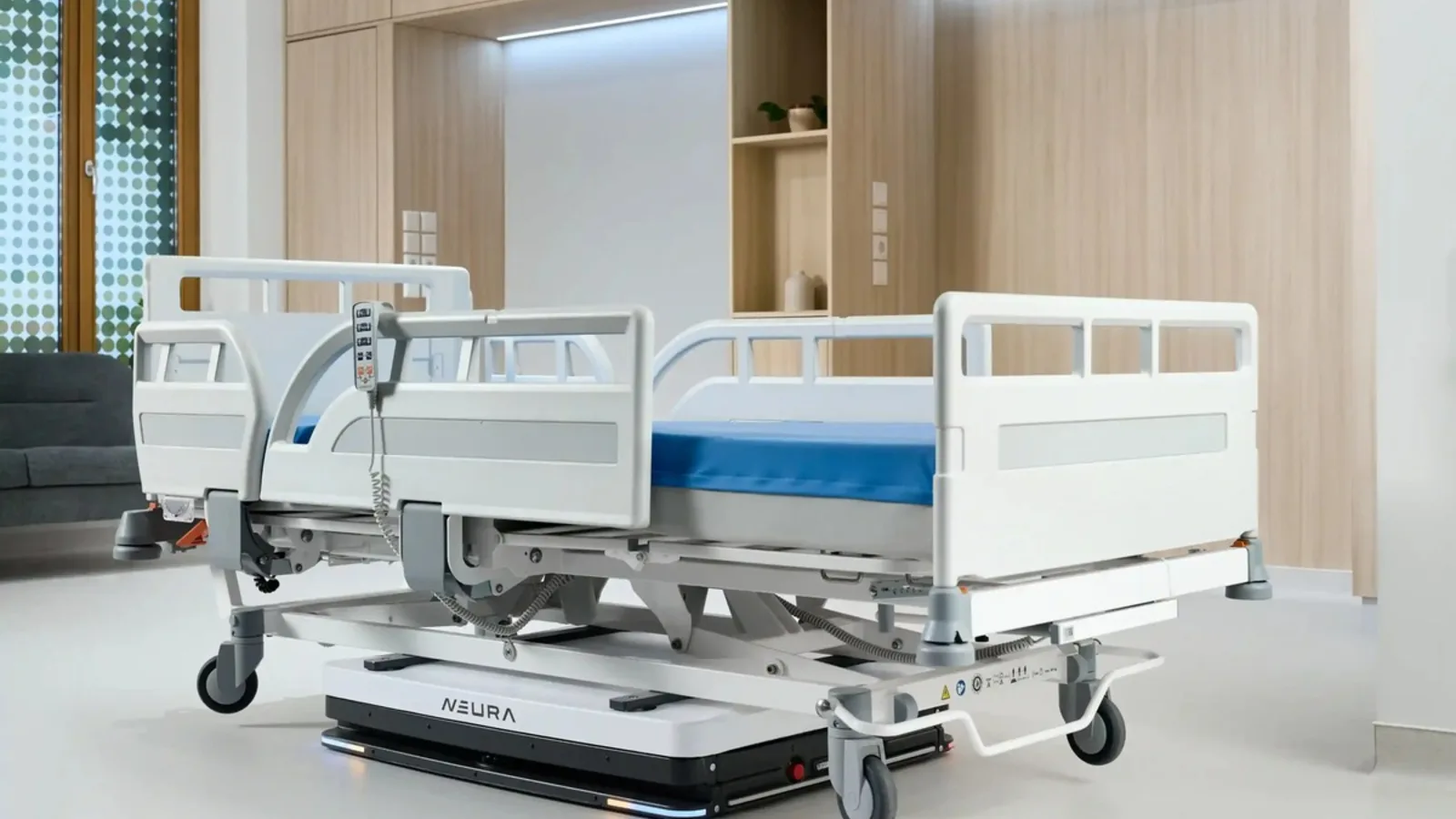
NEURA Robotics is creating a dedicated HealthTech unit and starting with a job that has little to do with flashy humanoids: moving empty beds and sterile goods through hospitals. That may be exactly the kind of robotics that scales earlier—a narrow, measurable process that consumes expensive staff time.
The German company announced its healthcare and life-sciences push on September 30. The first dedicated application is an autonomous mobile robot for moving empty beds between wards and floors. NEURA says about 20 moves per day could return more than 1,300 hours per year to care teams. That is a manufacturer estimate and needs validation at each hospital.
Hospital logistics first, not direct patient care
The entry point is sensible. Moving an empty bed is heavy, repetitive work that consumes staff time, yet it does not require the robot to perform a medical procedure on a patient. Safety, crowds, elevators, doors, hygiene and workflow integration still matter, but the clinical responsibility is different from robotic caregiving.
NEURA also refers to sterile-goods transport. These tasks resemble internal logistics, except the environment is substantially more sensitive. Success should therefore be measured in safe completed transports, interventions, cycle time, fleet availability and staff workload—not autonomy in a promotional video.
A platform that moves under the bed
The first HealthTech system is an autonomous mobile platform designed to move underneath an empty bed, take over its transport and travel between assigned points. NEURA describes a single-request workflow that can include movement between floors.
There is not yet a public technical sheet covering every bed format, minimum maneuvering space, elevator interfaces, corridor speeds or infrastructure requirement. Those details will decide whether a particular hospital is a straightforward deployment or a substantial integration project.
A business unit, not just one product
The announcement also establishes NEURA HealthTech as a dedicated expert unit. That suggests the company wants separate domain competence, integration and go-to-market capabilities for healthcare rather than treating a hospital as one more generic robot application.
That distinction matters in healthcare and life sciences. Beyond the machine, deployments need documentation, safety processes, cybersecurity, hygiene, uptime, service and clear responsibility. A product can share a Physical AI stack while still facing a different adoption barrier from warehouse automation.
Neuraverse as the connecting layer
NEURA presents the system as part of Neuraverse, its ecosystem connecting robots, sensors and AI. In practice, buyers will need to understand which Neuraverse components are required, where data is processed, what interfaces exist for building systems and how the platform integrates with hospital software.
An “open ecosystem” creates value only when it shortens integration, provides maintainable interfaces and supports existing systems. The marketing term itself does not replace technical documentation.
The 1,300-hour claim needs local math
NEURA states that more than 1,300 staff hours per year can be returned to patient care at around 20 transports a day. Averaged across the year, that implies several staff-hours per day, but the real result depends on distance, elevator waiting, staffing, handoff procedures and the fraction of missions requiring help.
A good pilot should measure active human minutes before and after deployment, not merely robot travel time. If staff still prepare the bed, escort the machine, clear blockages and receive it at the destination, part of the theoretical saving disappears.
How it fits NEURA’s broader strategy
RoboMorrow has already covered NEURA’s European industrialization steps, including the SECO compute-module partnership and the acquisition of Bosch Rexroth’s ACTIVE Shuttle platform. HealthTech adds a vertical where mobile robotics may create value earlier than a general humanoid.
The common logic is clear: combine mobile robots, manipulation, sensors, AI and eventually humanoids in one ecosystem. A bed-transport platform is less spectacular than 4NE1, but its business case can be easier to define and verify.
What is missing before product judgment
There is no public price, complete specification, named large-scale hospital deployment or independent reliability dataset yet. We do not know how the platform performs in crowded corridors, with different elevator controllers, unusual bed designs or connectivity failures. Service models and SLA details are also not public.
For now, this is an important vertical and application launch, not evidence of deployment scale. The next proof point is a real hospital with mission counts, intervention data and measured staff-time savings.
NEURA’s least humanoid move may be one of its most meaningful
Humanoids attract attention because they are easy to demonstrate. Healthcare may reward robots that remove a specific repetitive burden without entering the most regulated part of patient care. Empty-bed transport is a good example.
If NEURA can show repeatable deployments and economics, HealthTech will become a useful test of the Physical AI thesis: the goal is not to look human, but to absorb a piece of physical work that expensive clinical staff should not need to spend time doing manually.
How to validate the 1,300-hour claim in a pilot
NEURA presents more than 1,300 hours as potential annual staff time recovered at roughly 20 bed moves per day. That is a useful business-case starting point, not an independently measured deployment result. A hospital should first measure the current end-to-end transport task: waiting for staff, travel time, elevators, doors, handover and return. Only then can it test how many of those minutes the robot actually removes from staff workload and whether the recovered capacity can be redeployed to patient care.
A pilot should record completed missions per day, the share of missions without intervention, elevator and door success, service response time, system availability, hygiene procedures and safety exceptions. Under a service model, the monthly scope matters too: integration, maintenance, software, parts, standby coverage and SLA terms. Only that complete dataset allows the automation cost to be compared with the real cost of today’s process.
Featured image: NEURA Robotics imagery showing the autonomous platform beneath a hospital bed; sourced from RobotsBeat coverage where the photo is credited to NEURA Robotics. Image source.
Sources and methodology
This article uses primary sources plus editorial cross-checking and was verified on 3 October 2026. Manufacturer claims are kept separate from independent evidence. This is not a RoboMorrow hands-on test.