Gemini-Powered Humanoid Starts Public-Facing Trial at Osaka Metro
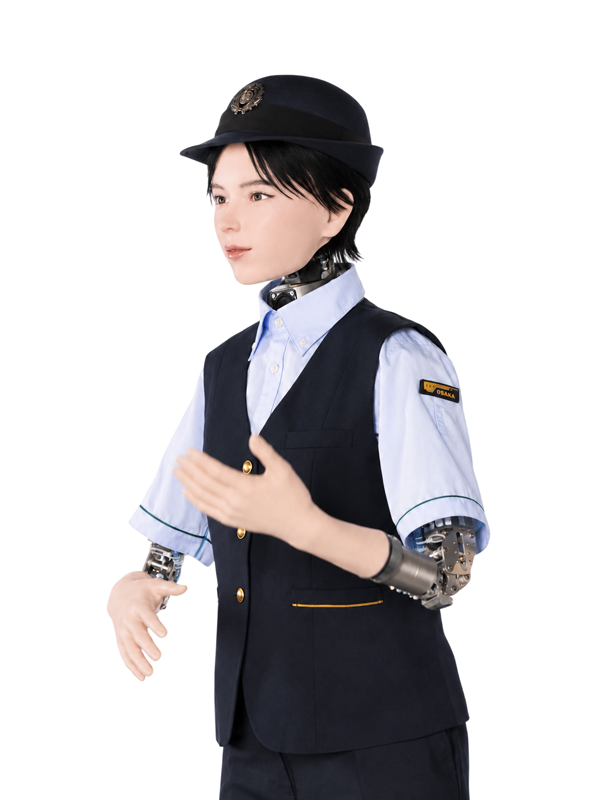
Osaka Metro, KDDI and AVITA are moving a humanoid from controlled demonstrations into a place where weaknesses are difficult to hide: a busy public transport environment. From 31 August to 15 September, a humanoid wearing an Osaka Metro uniform is scheduled to answer station, transfer and nearby tourism questions, support multilingual conversations and hand detailed route information to a passenger’s phone via QR code. Google Gemini powers the conversational layer.
This should not be described as “a humanoid replacing a station employee.” The official objective is narrower and more useful: test demand for the service, passenger acceptance and practical operational issues before any broader deployment. That is precisely why the project is more valuable than another polished manufacturer video.
Where and when the robot will operate
The first phase runs at Metro Opus Umeda from 31 August to 6 September. The second is planned for Metro Opus Tanimachi Kyuchome east from 9 to 15 September. Normal hours are 11:00–20:00, except the opening day at 13:00–20:00. That creates dozens of hours of contact with normal users, including tourists and people speaking different languages.
- station information and transfer guidance,
- nearby tourism recommendations,
- complex questions and multilingual interaction, including English and Chinese,
- a QR code on the robot’s display so users can take detailed route guidance onto a smartphone.
What Gemini is doing here
Osaka Metro says the humanoid integrates Gemini to enable more flexible conversation. KDDI and AVITA also claim real-time detection of vocal tone, speed, intonation and emotional nuance, plus very low response latency. Those are partner claims. Before the public trial begins, there is no independent benchmark for answer accuracy, latency, escalation rate or performance during crowded periods.
Conversational AI also needs to be separated from physical robotics. In this use case the machine is primarily a conversational, visual and social interface. There is no claim that it autonomously patrols platforms, manipulates station equipment or performs general physical tasks. This is better understood as a test of an embodied interface — AI with a face and physical presence — rather than a benchmark of general-purpose Physical AI.
Why a public station is a useful test
Transport environments create conditions missing from laboratory demos: noise, different accents, children, older passengers, tourists, time pressure, unexpected questions and constantly shifting context. For the language model, that challenges hallucination control and instruction accuracy. For the hardware, it tests microphones, displays, thermal stability and sustained availability. For the operator, the critical question is whether passengers actually prefer and trust this channel.
Osaka Metro says it will examine demand, acceptance and practical operating issues. The most valuable evidence should therefore arrive after the experiment. Interaction counts, task-resolution rates, human escalations, uptime and passenger feedback would tell us far more about maturity than another promotional clip.
From avatars to a humanoid
AVITA is led by Hiroshi Ishiguro, known for decades of work on androids and human–robot interaction. The machine is based on a humanoid he designed, with functionality refreshed for this project. KDDI and AVITA announced a broader Physical AI partnership in March 2026 and disclosed Gemini integration in July. The Osaka Metro pilot is therefore a visible real-world test of a program that has been building for months.
It also fits a broader market pattern: humanoid motion is improving much faster than dependable productive work. RoboMorrow examined that gap in Humanoids Can Run. Why Can't They Work Yet?. Osaka Metro takes a deliberately narrower route, starting with an information task where usefulness can be measured without requiring dexterous manipulation.
Why Europe should watch
European transit operators, airports, shopping centers and hotels face similar multilingual service and staffing problems. A successful pilot would not automatically prove that humanoids are the right answer; a kiosk or screen can provide many of the same functions at lower cost. The humanoid therefore has to demonstrate that physical presence improves engagement, accessibility or task completion enough to justify the extra complexity.
RoboMorrow status
Publish as a real-world pilot story. We are not calling this a review or a production deployment. After 31 August, the valuable update is not another video but operating evidence: uptime, interaction volume, resolution rate and passenger response.
Sources
Osaka Metro — official release · KDDI + AVITA — Physical AI partnership · KDDI + AVITA — Gemini integration