Humanoids Can Run. Why Can't They Work Yet?
We are getting very good at teaching robots to move like people. The much harder part is teaching them to work. That distinction matters. In 2026, humanoid mechanics are advancing faster than reliable perception, manipulation and decision-making in messy real-world environments.
A Reuters special report from China makes the gap unusually visible. China now has more than 150 companies developing humanoids, while public authorities spent at least $230 million on humanoids and related projects in the first half of 2026. Yet at a training center Reuters visited in Liuzhou, simple tasks required many failed attempts, and one staff member estimated some robots at roughly 20% of human speed or output. That is an observation from one center, not an industry-wide benchmark, but it captures the problem that polished demonstrations rarely show.
The humanoid body is no longer the only bottleneck
For years, the basic engineering challenge was brutal: build a machine that can walk, balance, survive impacts, carry useful loads and avoid collapsing after the first unexpected contact. That work is far from finished, but progress has been dramatic. The August World Humanoid Robot Games showed locomotion performance that would have sounded implausible not long ago. Platforms such as Unitree H2 demonstrate increasingly fluid motion, while actuator torque, power density and joint ranges continue to improve.
But an elegant gait does not answer the question a factory manager actually cares about: how much value will this machine create during one shift? A backflip is irrelevant if the robot needs human recovery every twentieth pick. Commercial robotics lives by less glamorous metrics: task success, cycle time, uptime, intervention rate, mean time between failures, service cost and cost per completed task.
That is why conventional industrial arms remain so hard to beat in structured processes. They are not general and they do not look human. They simply repeat a constrained motion with extreme speed, precision and predictability. A humanoid becomes economically interesting only when flexibility compensates for lower raw throughput or avoids an expensive redesign of the environment.
The bottleneck is moving into the robot brain
A useful robot must do much more than recognize an object. It must infer where it is, how it can be grasped, what force to apply, whether contact succeeded, what changed after the motion and how the next action should adapt. This is the territory of vision-language-action models, world models and the broader Physical AI stack.
The physical world is unforgiving to models trained on narrow distributions. A change in lighting, camera angle, object pose, surface or process timing can turn a successful laboratory behavior into a failure. A language model can produce an awkward sentence and still be useful. A robot holding a heavy component needs to know what it is doing before it moves.
TechCrunch recently described the sector through the analogy of a robotics “GPT-2 era.” That is an industry metaphor, not a technical benchmark, but the framing is useful: the hardware is becoming impressive, while the intelligence layer has not yet reached a broadly accessible moment comparable with the leap that made language models useful to millions of people.
Robots have a data problem that chatbots largely avoided
The open web gave language-model builders a gigantic pool of text, images and video. Robotics has no equally convenient corpus containing millions of high-quality examples of grasps, slips, collisions, force corrections, failed insertions and recoveries from unfamiliar physical situations.
Reuters cites an industry estimate of roughly 500,000 hours of high-quality training data for the humanoid sector against a potential requirement of around 100 million hours. Those figures are analytical estimates rather than an audited census, but the implied gap helps explain the sudden investment in teleoperation centers, egocentric video collection and simulation.
This creates an awkward loop. Better models require robot data. Large amounts of robot data require lots of robots in the real world. And deploying lots of robots economically requires better models. China is trying to break that loop with hardware scale and financed deployment.
China's overbuild could be both a weakness and an advantage
More than 150 humanoid companies sounds like the setup for brutal consolidation, and many of them will probably disappear. But from a Physical AI perspective, excess hardware has a second function. Every machine in a training center, warehouse or store can become a sensor for edge cases, failures and real-world variation.
The strategy resembles patterns seen in other Chinese industries: create huge supply, compress component costs, encourage ferocious competition and let the market select a small group of survivors. Humanoids make the bet riskier because commercial demand and the underlying technology are less mature. Yet if the hardware wave creates a massive proprietary data asset, some of today's apparent overinvestment may still strengthen the eventual winners.
In our earlier H1 2026 humanoid market analysis, we argued that a shipment is not the same thing as a productive deployment. The latest evidence reinforces that distinction. Unit volume matters only when we know whether those units are paid work tools, research platforms, data-generation machines or projects sustained by subsidies.
The first commercial wave may be boring — and that is good
The most meaningful deployments may not look like a humanoid that can run an entire household. They may focus on one repetitive job where the environment is constrained enough to achieve reliability, but flexible enough for a general robot to offer an advantage over fixed automation.
Galbot G1 in Chinese pharmacies is a useful example. The company reports task success above 95%, while Reuters describes actual deployments across more than two dozen cities. The success figure is a Galbot claim, not an independent benchmark. The more important point is the shape of the deployment: a narrow task, a bounded environment and economics that can be measured.
That may define the next stage of general-purpose robotics. Not one machine doing everything, but increasingly general intelligence entering vertical applications where it can earn revenue, collect data and improve from real failures.
Isaac 0.5 shows where the competition is moving
Perceptron's Isaac 0.5 is a useful signal. It combines video understanding, embodied reasoning and robot control in one model and is trained across many robot systems alongside large-scale general video. This does not mean Isaac has solved general robotics — most of the performance evidence comes from its creators — but it shows how the competitive question is changing from “who builds the best body?” to “who builds intelligence that can learn across bodies and data sources?”
The same shift is visible around Generalist, Physical Intelligence, NVIDIA, Google DeepMind and multiple Chinese embodied-AI teams. The most valuable asset may ultimately be less a particular humanoid chassis than the data engine + model + deployment tooling that improves across many machines.
How will we know when humanoids are really working?
RoboMorrow uses a simple filter. Instead of asking whether a robot “can” perform a task, ask for five numbers:
- success rate across hundreds or thousands of attempts, not a selected clip;
- intervention rate showing how often a human has to recover or take control;
- cycle time compared with a person or conventional automation;
- uptime / MTBF across multi-hour operation;
- cost per completed task, including hardware, service, operators, energy and integration.
Those metrics separate a capability demonstration from a product. The humanoid industry still publishes far too few of them.
What this means for Europe and Poland
Europe is unlikely to outcompete China by creating the largest number of humanoid startups or subsidizing hundreds of similar platforms. It can still build an advantage in the parts that make commercialization difficult: integration with installed automation, safety, service, cybersecurity, industrial data and high-value vertical deployments.
For Polish factories, the best question today is not “which humanoid should we buy?” It is “which process could generate ROI from a flexible robot despite today's limitations?” The strongest candidates are likely to be ergonomically difficult or variable tasks that are expensive to automate with a fixed arm, but repetitive enough to constrain the operating domain and generate useful training data.
That is also why our 2026 humanoid availability guide treats buying a robot as only the first step. The real product is the system that can be deployed, trained, monitored, serviced and kept productive.
Bottom line: the sprint was easier than the work shift
The spectacular 2026 story is that humanoids are beginning to run at extraordinary speeds. The important story is much less cinematic: the industry is trying to make a robot do one useful thing for hours without surprises.
If data, models and reliability improve quickly, China's hardware advantage could become a powerful learning flywheel. If they do not, part of the boom will end in excess factories, expensive data centers and consolidation. Either way, the next two years will be less about what a humanoid can do on stage and more about what it does after the cameras turn off.
Sources and methodology
Primary market evidence: Reuters Special Report, August 27, 2026. Context on the data bottleneck and the “GPT-2 era” analogy: TechCrunch, August 26, 2026. Isaac 0.5 details: Perceptron's official model card and official GitHub repository. RoboMorrow separates independently observed evidence from manufacturer claims and does not treat a selected demonstration as proof of commercial reliability.
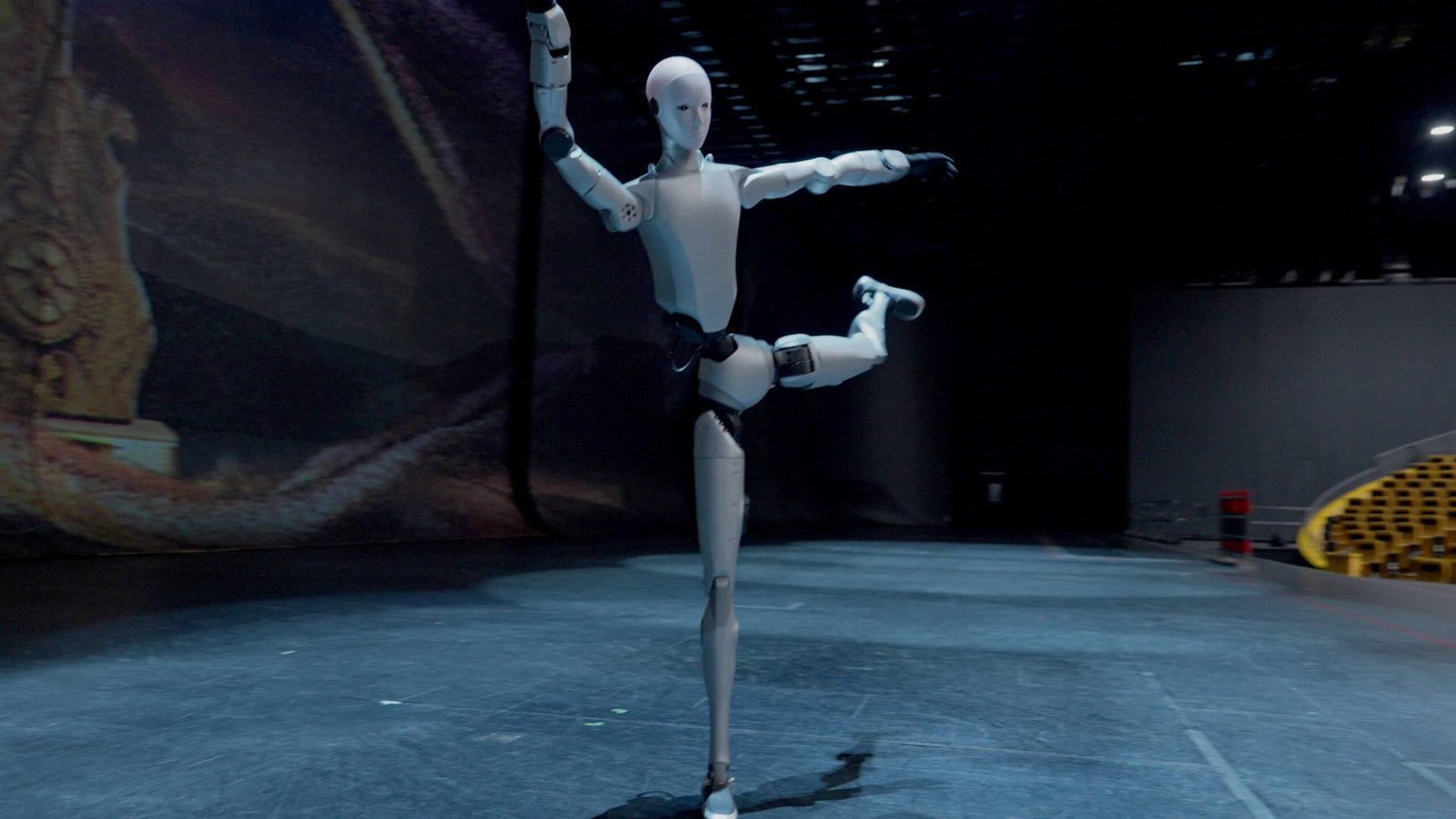
Featured image: official Unitree H2 material used illustratively to represent the rapid progress in humanoid mechanics. It does not show the Liuzhou training center reported by Reuters.