Humanoids in 2026: which can you actually buy, order or reserve?
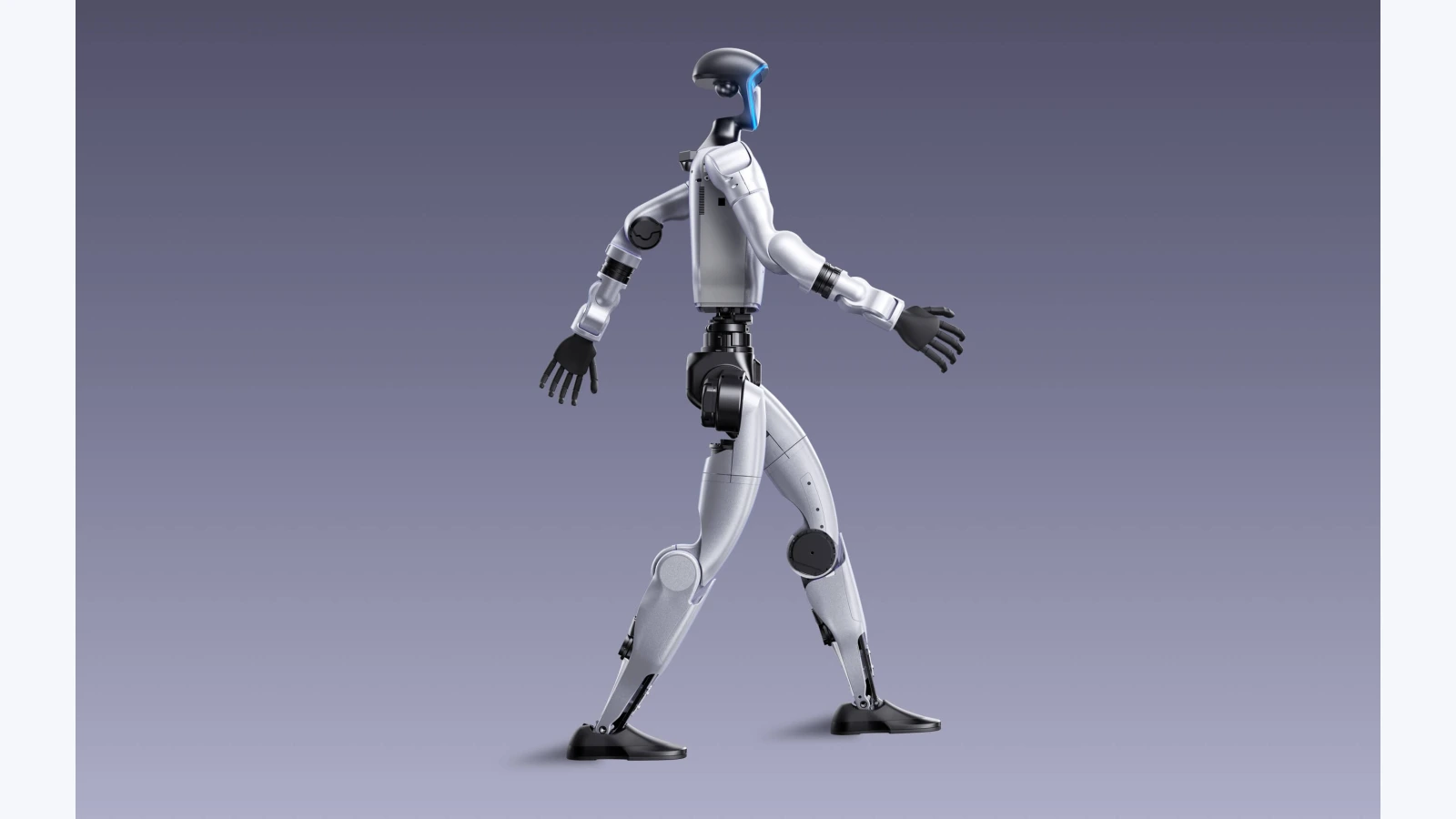
Featured visual: Unitree Robotics. Product material; not a RoboMorrow hands-on test photograph.
In 2026, you can find a humanoid with a buy button, a platform supplied through a project and a reservation for a future machine. These are three different purchases. This guide separates commercial offers from development announcements and explains what the buyer needs beyond the robot itself.
Checked on 28 September 2026. This is not a ranking of household assistants. We cover research platforms, industrial deployments and emerging consumer offers, assessing a purchasing route separately from autonomy. The exact configuration, delivery date and documentation still need confirmation before an order.
The practical answer first
Unitree G1 has commercial channels, including a visible European marketplace offer for an EDU variant. NEURA accepts reservations for 4NE1 and Mini, with separate estimated machine prices. Digit 5 remains a 2027 product announcement. Agile ONE should be assessed through a specific proposal, not the group’s total automation deployment count. [14] · [17] · [4] · [5] · [11] · [6]
The most important filter is not the manufacturer’s logo. It is whether you need a platform for developing behaviours, a demonstrator or a delivered solution for a defined process. Those goals lead to different configurations and acceptance criteria.
| Model / family | Buying route at verification | Price / quotation | Important limitation |
|---|---|---|---|
| Unitree G1 / EDU | Manufacturer and selected seller offers | Request a configuration-specific European quotation | G1, G1 EDU and U1 are not interchangeable specifications. |
| NEURA 4NE1 Gen 3.5 | Reservation; deliveries expected towards the end of 2026 | Estimated €98,000 for 1–19 units; tax and shipping excluded | €100 is a refundable reservation payment, not the robot price. |
| 4NE1 Mini | Reservation | Standard €19,999; Pro €29,999, estimated before tax and shipping | Standard does not provide Pro-style manipulation. |
| Digit / Digit 5 | Earlier deployments versus a future generation | Project quotation | Digit 5 early access expected in the first half of 2027. |
| Agile ONE | Supplier discussion and configuration assessment | Project quotation | Do not equate wheeled-robot production with biped deliveries. |
The table describes buying routes and source statements, not independently verified inventory, delivery or installation compliance. A listing is not a recommendation to pay before confirming the configuration. [17] · [4] · [5] · [11] · [7]
1. Unitree G1: buying hardware is not buying an employee
G1 illustrates the boundary between commercial availability and application readiness. Unitree distinguishes standard and EDU versions, and a seller’s offer should identify the precise configuration. Comparing an entry-level price with a more extensively equipped research model is not meaningful without accounting for what is included. [14]
The European marketplace listing examined for this update concerns G1 EDU U1, not any G1 seen in demonstration footage. The product label is only the starting point. Buyers should obtain the equipment list, hand configuration, onboard computer, licences, developer tools and control-access limitations.
A laboratory may accept that its own team will develop behaviours. A factory buying automation needs something different: a defined task that works in its environment. That distinction matters more than the claim that a platform supports AI.
Read the G1 and EDU profile and our analysis of humanoids reaching a mainstream marketplace.
2. NEURA 4NE1: a reservation has its own economics
Reserving a future product purchases the entitlement specified by the reservation terms; it does not automatically deliver a complete operating system. A refundable payment still leaves questions about final specification and the point at which pricing and timing become binding.
4NE1’s indicative pricing depends on order quantity. A single-unit purchasing analysis should not use a volume price intended for a larger commitment. A small laboratory and a fleet project have different commercial cases even when they consider the same robot family. [4]
Before committing, request a document defining the delivered scope: hardware, controller, charging, commissioning, software and support. Update arrangements matter too. A function under development should not be mistaken for something already contracted.
For a reader following the market, a reservation is evidence that a commercial route is opening. For procurement, it remains a stage before a confirmed offer. Those two forms of interest justify different levels of diligence.
3. Mini: a lower price does not mean identical capabilities
The first comparison between 4NE1 Mini Standard and Pro should concern use cases. Standard does not provide the manipulation capabilities associated with Pro. Showing grasping footage next to the entry price can therefore create a misleading purchasing impression. [5]
A locomotion, interaction or education project might accept limited hand functionality. A team studying manipulation and teleoperation may find it decisive. Before comparing prices, write down three or four experiments the system must support.
Also establish whether later upgrades are actually offered and what they cost. Do not assume that every difference can be solved through software. Missing hardware or access rights may require choosing another version at the original purchase.
A smaller body can suit some research environments, but it does not remove the need for supervision and a controlled setup. Educational positioning should not be interpreted as evidence of suitability for unsupervised use around children.
4. Digit: a deployment proposal is a different transaction
The Digit family demonstrates the difference between existing commercial experience and the announcement of a next generation. A purchasing table should not use one blanket “available” label that transfers previous deployments to Digit 5. Our Digit profile keeps the generations separate.
An enterprise proposal may cover the task, integration, support, servicing and fleet-management functions as well as hardware. The absence of a public price does not mean the supplier has no commercial operation, but it makes comparison with a research-platform checkout price inappropriate.
Request a quotation covering the agreed scope rather than trying to reconstruct it from speculation about manufacturing cost. A project planned around a future generation should distinguish forecast dates from contractual commitments.
The same applies to performance. A supplier may propose a measurable service outcome, or it may supply equipment for the customer to develop. Those are different responsibilities and should not disappear inside an apparently simple monthly price.
5. Agile ONE: identify the platform and project status
Two machines can share similar upper bodies and hands while differing in their mobile base and intended use. A statement that a factory is producing robots does not establish that the exact biped shown in a video is offered on the same terms as a wheeled model.
Ask the supplier which configuration will be delivered, for which process and at what stage of readiness. A photograph or hardware revision should accompany the proposal. Group-level marketing is not a sufficient purchase specification.
Agile ONE’s mechanics can help qualify an opportunity. They cannot replace a demonstration using the buyer’s own objects and acceptance criteria. See the Agile ONE profile and the German robotics analysis.
R1, H2, NEO, Atlas, Figure and Optimus: the other buying routes
The market does not stop at G1 and NEURA. Other prominent platforms belong to different commercial categories. This table describes what the reviewed manufacturer pages establish; it does not confirm inventory, delivery or a complete European quotation.
| Platform | Documented route | Important distinction |
|---|---|---|
| Unitree R1 / AIR / EDU | Public hardware offer, with differentiated international prices | Request a European landed quotation for the exact version. Developer access differs. |
| Unitree H2 / EDU | Published international H2 pricing; EDU by enquiry | The standard machine does not automatically include all EDU equipment and access. |
| 1X NEO | US Early Access ownership or subscription offer, with a reservation payment | Ownership, subscription and deposit are different transactions; US timing does not establish European delivery. |
| Boston Dynamics Atlas | Enterprise sales discussion | An industrial deployment proposal, not a retail price for a household robot. |
| Figure 03 / Tesla Optimus | Product and technology-development pages | The reviewed pages do not establish open European retail purchasing with a price and delivery commitment. |
Table sources: Unitree R1 — AIR, standard and EDU comparison; Unitree H2 — manufacturer specifications and pricing; 1X NEO — ordering, ownership, subscription and Expert Mode; Boston Dynamics Atlas — enterprise product page; Figure 03 — manufacturer product page; Tesla Optimus — official AI page. We do not convert international starting prices into apparently local euro offers: European configuration, delivery and taxes have not been verified for these entries.
R1: a low entry price does not answer the developer-access question
R1 AIR, R1 and R1 EDU are not the same kit in different colours. Unitree distinguishes degrees of freedom and development access; its comparison reserves secondary development for EDU. Hands are not an identical standard component across the range either. For a research team, saving on the original purchase could restrict the very function the project intends to investigate. Unitree R1 — AIR, standard and EDU comparison.
Define the task before comparing R1 with G1. A locomotion project needs different tools from a hand-manipulation experiment. Confirm the actual version with the seller: a demonstration of the product family does not specify its cheapest configuration. We also do not transfer a store-wide availability message to every colour and equipment option.
H2: a larger machine changes the project requirements
Unitree lists H2 at approximately 1.82 metres, 70 kg and 31 degrees of freedom. That puts it in a different physical class from G1, not simply a higher price bracket. The manufacturer distinguishes H2 from H2 EDU, including development scope and optional equipment. Hands, additional computing and tools should not enter a budget as assumed free extras. Unitree H2 — manufacturer specifications and pricing.
A larger platform needs an appropriate workspace, handling arrangements and operating procedures. Choose it because the task justifies its characteristics, not simply because it produces an impressive demonstration. A payload statement for one configuration should not become an unconditional guarantee for every posture and end effector.
NEO: a consumer offer is not a promise of complete independence
1X separates Early Access ownership, the Standard subscription and a refundable reservation payment. Its ordering page says US deliveries start in 2026. We did not find a confirmed European delivery date or complete European price on that page, so this guide does not invent either. The US plan is a different market offer, not a euro price available to a European household. 1X NEO — ordering, ownership, subscription and Expert Mode.
The operating model matters just as much. 1X describes foundational autonomy and Expert Mode: for an unfamiliar task, an owner can schedule help from an expert who remotely guides the robot. That does not establish that every action is teleoperated. It also does not establish unattended autonomy for the whole catalogue of household tasks.
A prospective owner should clarify how such sessions work, who can access camera views and which functions work independently. Those are practical questions about a service that can involve a human operator, not an allegation about the vendor. This distinction makes NEO worth following as a consumer-oriented offering without presenting it as a universally capable household employee.
Atlas, Figure 03 and Optimus: recognisable names, different transactions
Boston Dynamics presents Atlas as an enterprise product, with a sales-contact route and industrial applications. It should not be grouped indiscriminately with a research concept. The absence of a public retail price does not rule out a commercial route; it means discussing the proposed deployment and responsibilities. Boston Dynamics Atlas — enterprise product page.
Figure describes Figure 03 and Helix, while Tesla presents its development objective for Optimus. The pages reviewed do not establish a European consumer checkout with a binding price and delivery commitment. We do not fill the gap with an aspirational interview price or a speculative launch date. These are important platforms for technology readers; purchasing teams still need a specific commercial offer. Figure 03 — manufacturer product page; Tesla Optimus — official AI page.
Do you actually need a humanoid?
For tabletop manipulation research, an arm such as Franka Research 3 may be a more relevant comparison. It is not a discounted humanoid or a replacement for every whole-body function. It isolates a different research problem.
A factory should also consider a mobile robot, a workstation cobot or a process change. A humanoid’s advantage should be stated as a concrete benefit: less rebuilding, access to multiple stations or flexibility that justifies additional complexity.
The best purchasing outcome need not be the most visually sophisticated machine. It should be a solution the team can commission, evaluate and maintain. A simpler platform that answers the actual question may be a better research instrument as well.
There is value in explicitly excluding unnecessary requirements. A project that needs force-controlled manipulation may not need legs. A project studying locomotion may not need sophisticated fingers. Removing the wrong requirements can reduce both cost and experimental uncertainty.
What belongs in the full cost?
Hardware is only the first part of the budget. A research project may also need computers, sensors, tooling, a work area and engineering time. An industrial application adds particular attention to integration, site preparation, training, maintenance and exception handling.
We do not apply one universal integration cost to every model. It depends on the task and allocation of responsibility. A checklist of items to quote is more honest than an arbitrary multiplier attached to a headline hardware price.
A practical budget separates one-time and recurring costs and identifies who owns each assumption. Battery price is different from the assumed replacement frequency. A quoted support service is different from an assumption that failures will not occur.
Include the unsuccessful-pilot scenario too: what can be reused, how the project can end and what happens to retained data. That is not pessimism; it limits the downside of a decision made with incomplete information.
For a fair comparison, keep the time horizon and scope consistent. Comparing a bare robot bought outright with a supported installation over several years can produce a precise-looking number that answers the wrong question.
Accepting a robot rather than a promise
A useful acceptance protocol defines the task, objects, conditions and evaluation period. It also specifies permitted interventions and how failures are counted. Agreement that the robot “works well” is not an acceptance metric.
Human help should not be hidden. Teleoperation can be a sensible part of training or a service, but it should be named and included in the cost. The same applies to scene preparation, object positioning and restarts.
For marketplace purchases, establish the contractual seller, delivery scope and service route. A public listing confirms a commercial channel. It does not independently confirm manufacturer authorisation, stock or the suitability of a future application.
Documentation and safety assessment should match the particular country, application and configuration, with a competent supplier or integrator. This guide does not replace assessment of the complete installation.
Keep the proposal, technical annex and demonstration aligned. A convincing video of a high-specification unit should not become evidence for a lower-specification order. Similarly, an advertised future update should remain separate from the functions used to approve today’s purchase.
Frequently asked questions
Are these ready-made household assistants?
The reviewed offers do not establish that. A purchasable platform and demonstrated skills do not imply safe, unattended performance of arbitrary household work.
Does a €100 reservation buy an inexpensive humanoid?
No. In the NEURA offers discussed here, the reservation payment and estimated machine price are separate.
Should G1 EDU cost the same as a standard G1?
Not necessarily. Compare identical equipment, control access, software and support terms first.
Is a public buy button enough for a decision?
Not for a product of this complexity. Obtain a specification, confirmed timing and agreed responsibility and acceptance terms.
The conclusion
A useful humanoid list distinguishes hardware offers, future-product reservations and deployment projects before it compares prices. Only then can buyers meaningfully assess configuration, autonomy and total cost.
Continue with Unitree on a mainstream marketplace, Digit 5 and the economics of work and Robotics Nations.
Sources and methodology
Editorial analysis based on the linked sources, checked on 28 September 2026. Manufacturer and seller statements are not RoboMorrow test results. We have not independently tested these robots.
Unitree G1 / G1 EDU — manufacturer comparison · Allegro — G1 EDU U1, offer 18646284985, seller digitpl · NEURA 4NE1 Gen 3.5 — reservation and estimated pricing · NEURA 4NE1 Mini — Standard / Pro reservation · Agility — Digit 5 announcement, 15.09.2026 · Agility — Digit 5, development specifications · Agile ONE — manufacturer product page · Agile Robots — From lab to line, 16.09.2026 · Franka Research 3 — manufacturer product page