Germany built an industrial powerhouse. Can it turn that into a robotics advantage?
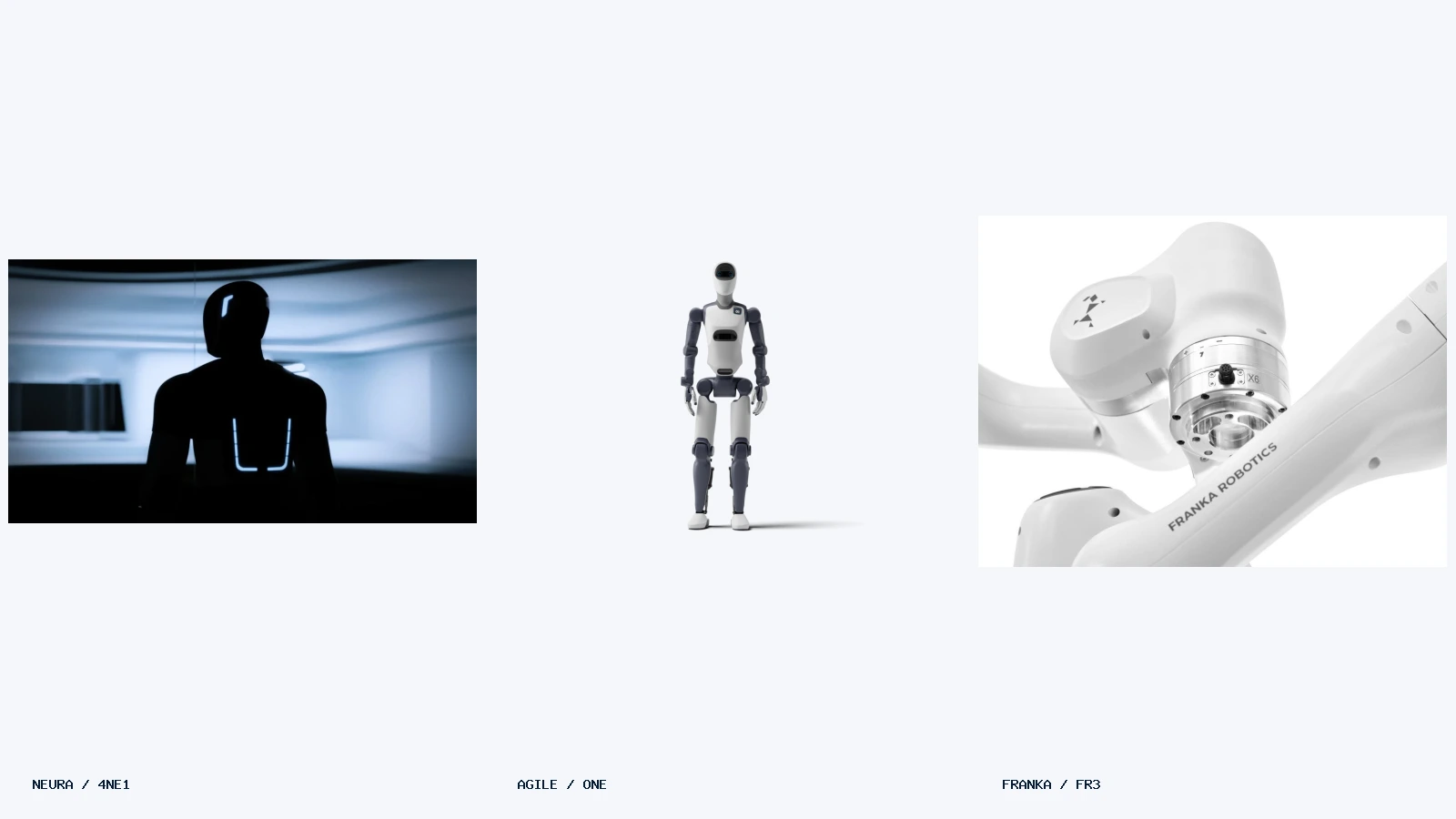
Featured visual: NEURA Robotics / Agile Robots / Franka Robotics; RoboMorrow layout. Product material; not a RoboMorrow hands-on test photograph.
Germany does not have to win the competition for the most spectacular humanoid video to matter in robotics. It can supply complete machines, but also the less visible foundations of useful robots: manipulation, electronics, software interfaces and experience integrating automation. The question in 2026 is therefore not simply “where is Germany’s Optimus?” It is who can turn a demonstration into a repeatable process.
In the second instalment of Robotics Nations, we examine NEURA Robotics, Agile Robots, group company Franka Robotics and the role of industrial partners. This is a technology and business analysis, not a national league table. A manufacturer’s headquarters, production site, owner and AI-model supplier may be in different countries. Those dependencies are part of the story rather than inconvenient footnotes.
The central argument: industry creates an opportunity, not a guaranteed win
Our argument is more cautious than saying German engineering will automatically beat the United States or China. Access to factories can help teams choose valuable tasks and understand failures. It does not replace a capable control model, repeatable grasping, recovery from unexpected events or a cost the customer can accept.
Imagine two demonstrations. In one, a humanoid walks impressively across a factory. In the other, a less theatrical machine completes a station task, reports a problem, stops safely and resumes after a short intervention. The second demonstration may matter more to an operator. That is where established industrial robotics and the new Physical AI conversation meet.
| Company / platform | Its role in this story | What not to infer |
|---|---|---|
| NEURA / 4NE1 | Humanoid development and a Physical AI ecosystem | A reservation is neither a delivery nor universal task readiness. |
| Agile Robots / Agile ONE | Manipulation, industrial data and manufacturing | Group automation deployments are not a count of bipedal humanoids. |
| Franka Research 3 | Research arm and control interfaces | FR3 is not a humanoid or an independent competitor to its parent group. |
| Bosch / SECO | Data, industrialisation and electronics partnerships | A collaboration does not establish an achieved production volume. |
NEURA: building the system around the humanoid
NEURA’s more interesting proposition is the infrastructure around the machine. Its Bosch partnership covers real-process data and industrialisation. The September SECO collaboration concerns robot compute modules. AWS is to support Neuraverse infrastructure. These are three different layers of the development problem, not three independent proofs of delivered humanoid sales. [1] · [2] · [3]
Why does that distinction matter? Mechanics determine what a robot can physically attempt. Data and software influence whether it recognises the correct object, chooses a workable grasp and recovers when something goes wrong. Industrialisation determines whether successive units can maintain consistent quality. An integrator still has to combine those elements into an application. An ecosystem becomes valuable when it makes that job easier.
NEURA also offers a practical way to see the boundary between interest and purchase. The public 4NE1 Gen 3.5 reservation is not a robot on sale for €100: that is a refundable reservation payment. The machine’s estimated price and expected delivery timing are separate. Our 4NE1 Gen 3.5 profile explains the distinction. [4]
For a prospective customer, the important questions concern conversion from reservation to order: final specifications, delivered software, spare parts, training and acceptance date. Without those details, a feature list is the beginning of a discussion rather than the scope of an agreed service.
Agile Robots has a factory. What actually leaves it?
Agile Robots describes a 10,000-square-metre facility in Fürstenfeldbruck. Its 16 September account reports series production but adds an essential qualification: most machines currently shipped are wheeled. A story about a “humanoid factory” should not erase that distinction. [7]
That need not be a disappointment. If the job involves collecting a part and moving it to another station on a flat floor, wheels may be the rational choice. Legs should justify their additional complexity through access, working-height changes, obstacles or avoided changes to the environment. More human-shaped does not automatically mean more economical.
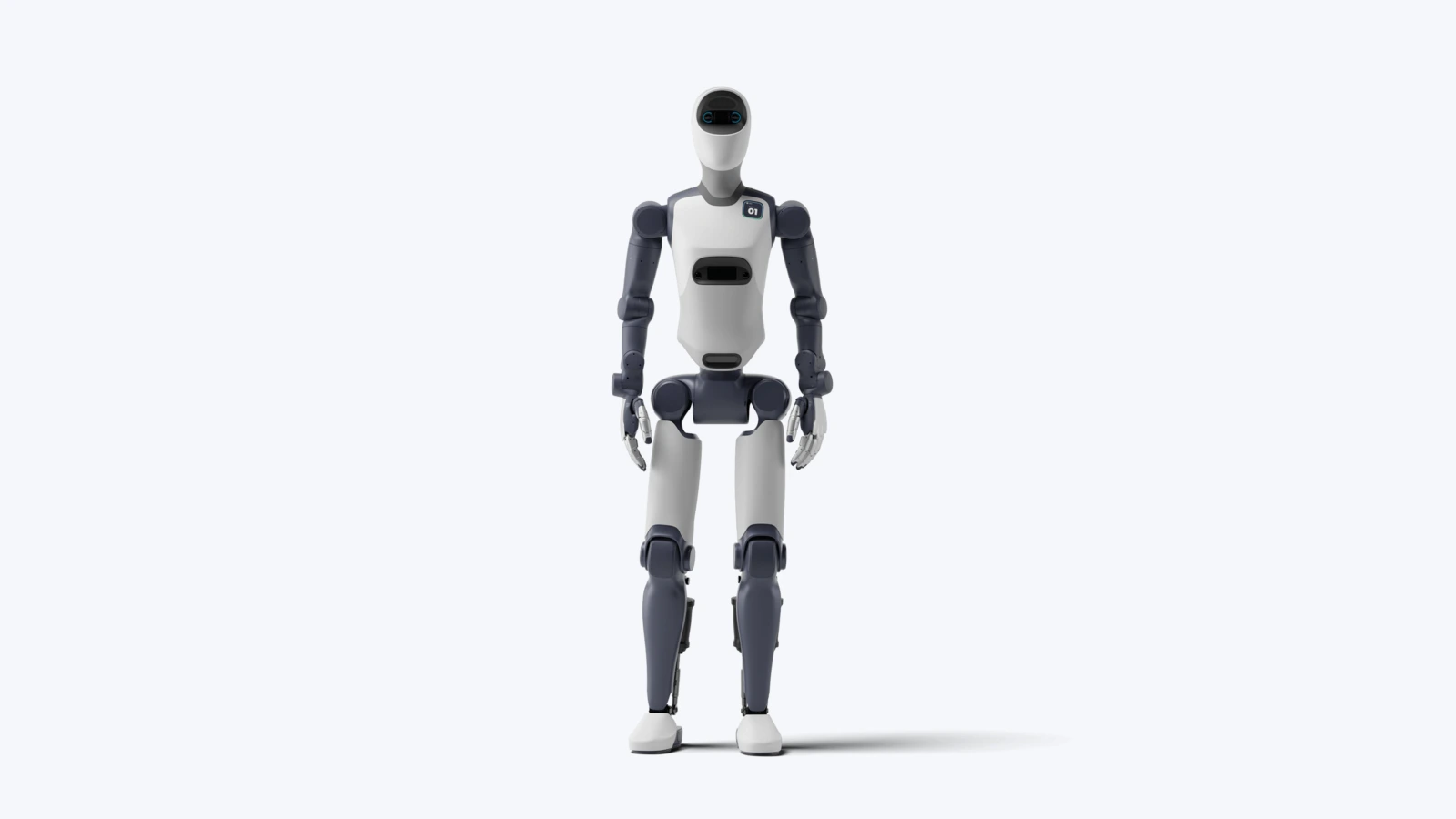
Agile ONE represents the company’s ambition for a humanoid with advanced manipulation. The product page highlights force and tactile sensing and hands with 21 joints. These are construction claims, not an independently measured success rate on a customer’s production line. The Agile ONE profile distinguishes product features from availability evidence. [6]
The Google DeepMind collaboration is intended to combine Agile hardware with Gemini Robotics models. It shows why a national robotics map cannot stop at flags. European hardware and an overseas AI model can form one system. Buyers then need to understand responsibility for updates, access to operational data and the ability to maintain the installation throughout its planned life. [8]
Franka: an important player that does not need legs
Franka Robotics has belonged to Agile Robots since 2023. FR3 is a research arm, not a third German humanoid. Its tools support both accessible experimentation and low-level control research. This is a different proposition from purchasing a robot for a fully specified production task. [10] · [9]
That role is easy to miss when attention is limited to whole-body demonstrations. Many Physical AI problems begin at a table: grasping a delicate object, correcting contact or completing a movement after a part changes position. They can be studied without simultaneously solving balance for an entire humanoid body.
For a research team, repeatable experiments, accessible interfaces, useful logs and reproducible configurations may be more valuable than a spectacular video. The return can be a faster explanation of why a new algorithm fails. This is why Franka Research 3 belongs in a discussion of Germany’s robotics capabilities even though it does not look like a science-fiction character.
Where industrial experience can genuinely help
First, task selection. A factory can identify work that is repetitive and expensive without being visually exciting. Reliable component presentation within a defined cycle may be more useful than dexterously pouring a drink. A sensible pilot starts with that need rather than a prior decision to use a humanoid.
Second, the quality of failure information. Collecting a large amount of video is not enough. Observations need to be linked to outcomes: whether a part was correct, which grasp failed, when a person intervened and how long recovery took. Without that connection, a team can accumulate an impressive video library while remaining unable to tell whether the next software release improves the process.
Third, maintainability. An industrial operator needs a procedure for replacing a worn component, clear responsibility and a predictable path back to operation. Those aspects receive less attention than joint counts, but they are where a vendor’s promise becomes the customer’s recurring expense.
These are opportunities to use experience, not evidence of an automatic advantage for every German supplier. A younger company may develop better software; an established manufacturer may struggle to deploy it. Industrial history is a resource to exploit rather than a guarantee of the outcome.
What would make the next update more convincing?
The most useful future disclosures would move beyond reservation totals towards accepted deliveries, repeatability and post-deployment operation. We would look for the same process working at more than one customer site, with a stated supervision boundary and results that include unsuccessful attempts.
That does not require a single universal ranking for every robot. It requires a shared language: what was ordered, what was delivered, which task was performed, for how long and with how much human assistance? “Autonomous” is not enough when a person may prepare every object or approve every subsequent movement.
The alternative matters as well. A humanoid may solve a problem, but the purchasing case depends on comparison with other automation, a workstation redesign or a simpler tool. Flexibility has value; the customer still needs to identify which future process changes are worth paying for now.
It is also worth separating a manufacturing achievement from an operating achievement. Producing a repeatable machine is a substantial step. Maintaining the required task performance after an update, a repair or a change in packaging is another. A credible deployment plan should address both, rather than assuming that a factory opening settles the software question.
RoboMorrow’s conclusion: follow the route from lab to process
Germany’s robotics team is more interesting as a set of complementary capabilities than as a collection of Tesla challengers. NEURA, Agile and Franka show different routes along that path. Their wider partnerships also demonstrate that the next generation of robotics is being built across borders.
The decisive question is not whether a machine looks impressive. It is whether a specified configuration performs a useful task on terms a customer can accept. That is the evidence needed to judge whether an industrial base has become an advantage in Physical AI.
Continue with Robotics Nations, our humanoid buying and reservation guide and the IROS 2026 report.
Sources and methodology
Editorial analysis based on the linked sources, checked on 28 September 2026. Manufacturer and seller statements are not RoboMorrow test results. We have not independently tested these robots.
NEURA Robotics / Bosch, 14.01.2026 · NEURA Robotics / SECO, 07.09.2026 · AWS / NEURA, April 2026 · NEURA 4NE1 Gen 3.5 — reservation and estimated pricing · Agile Robots — From lab to line, 16.09.2026 · Agile ONE — manufacturer product page · Agile Robots / Google DeepMind, 24.03.2026 · Franka Research 3 — manufacturer product page · Franka Robotics — company and group membership