Humanoids do not need another backflip. Digit 5 targets something more useful
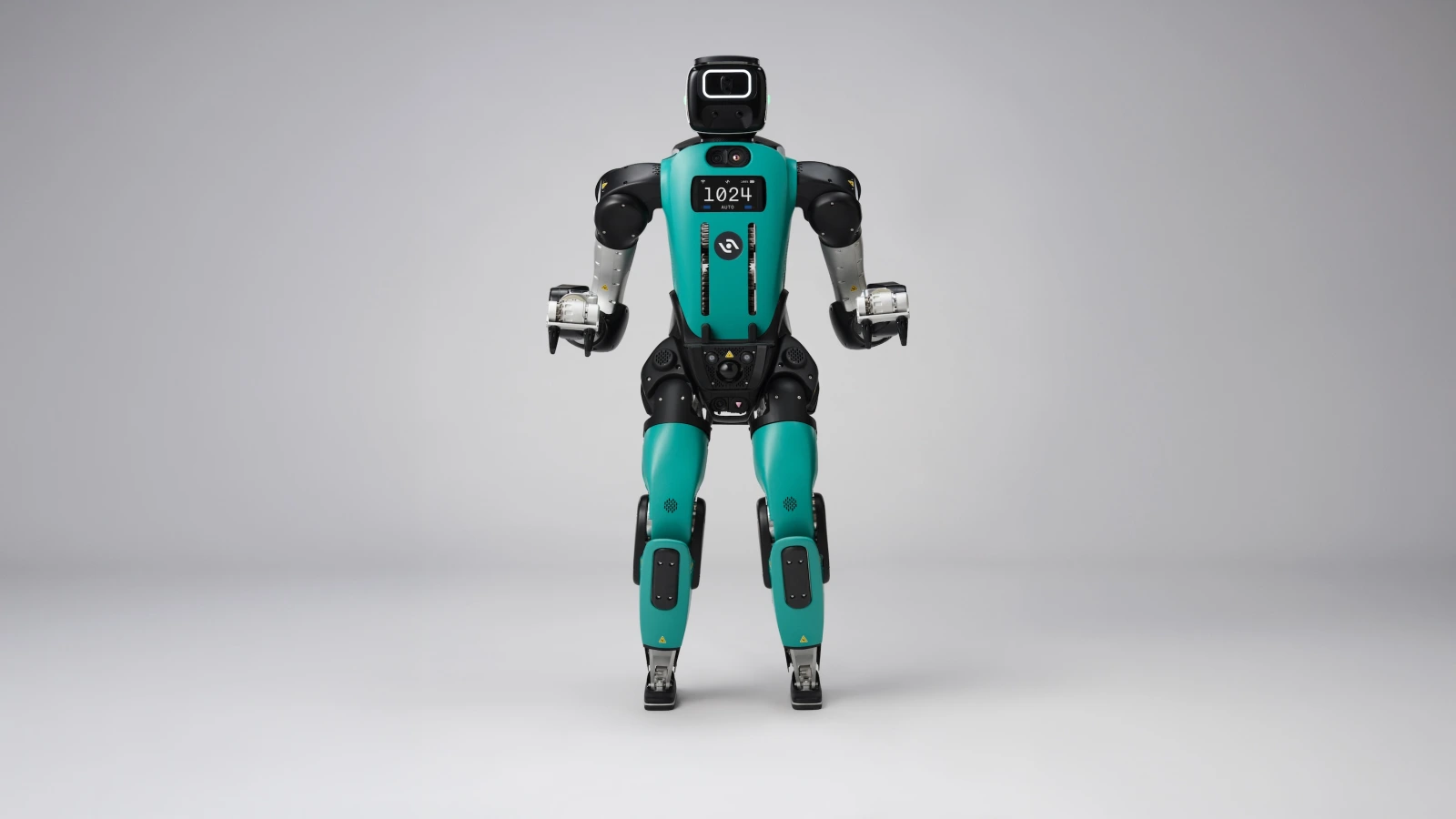
Featured visual: Agility Robotics. Product material; not a RoboMorrow hands-on test photograph.
Another humanoid backflip attracts attention. Less time at a charger could change the economics. Digit 5 shows how different the conversation becomes when the reference point is a facility workflow rather than a short video.
Agility unveiled the new generation on 15 September. Early access is expected in the first half of 2027, with general availability for industrial customers expected by the end of 2027. This is a product announcement, not confirmation that Digit 5 is shipping today. [11]
The changes worth paying attention to
The manufacturer’s development specifications include a 22.7 kg payload and 90 minutes of operation followed by nine minutes of charging. The design also provides for interchangeable working tools. These are not independent test results or a guarantee for every application. [12]
They address three constraints easily lost in a conversation about humanoid intelligence: the weight of real loads, time available for work and the fit between a gripper and its task. An AI model can help select actions, but it does not remove hardware or infrastructure limits.
| Topic | What is established | What it does not establish |
|---|---|---|
| Timing | Customer availability is planned for 2027. | Retail availability in 2026. |
| Energy | A manufacturer-stated 10:1 run-to-charge ratio. | Guaranteed productive use throughout a shift. |
| Experience | Operational data from earlier Digit robots. | Tens of thousands of operating hours for Digit 5. |
| Safety | An architecture designed for closer work around people. | Automatic suitability for every tool and workstation. |
Charging: energy availability is not throughput
In a deliberately simplified cycle of 90 minutes running and nine minutes charging, the operating fraction is 90 / 99, or approximately 90.9%. Repeated without interruption, that corresponds to about 21.8 hours in a day. This is our calculation from the manufacturer’s claim, assuming identical continuous cycles. It is not a Digit 5 measurement.
The calculation excludes travel to a charger, queues, checks before restarting, lack of available tasks, failed grasps and service work. Actual runtime may also depend on load. A customer needs to know how many correct operations are completed during the entire shift, not simply the ratio of charging time to time away from the dock.
Fleet design matters for the same reason. If several robots need charging at similar times, the performance of one robot does not automatically describe the system’s throughput. Charging stations, scheduling and task assignment become part of the installation.
A useful acceptance test should therefore include energy-related delays in the same operating record as all other delays. Removing those minutes from the denominator may make a demonstration look cleaner while making the purchasing comparison less useful.
Payload and tooling: optimise the task, not the resemblance
A human-like hand can look compelling on video. A simpler gripper matched to a container or component may be preferable in a particular process. Interchangeable tools point towards a design in which a robot need not imitate every human detail to work in a human-oriented environment.
A buyer should specify more than object weight: dimensions, deformation, centre of mass and required orientation also matter. The same mass presents a different challenge when lifted from an awkward position or carried far from the body.
Tool changes raise their own questions. Does a person perform the change? How are attachment and configuration checked? How long until the robot resumes work? The word “interchangeable” does not answer those questions, and the answers can determine whether using one robot for several operations makes sense.
Digit 4 experience is not a Digit 5 benchmark
Agility attributes more than 65,000 operating hours to the earlier Digit 4 fleet. That is relevant development context, but it should not be assigned to a model whose availability is still ahead. Conditional multiyear orders are likewise not the same thing as delivered units or recognised revenue. [11]
A new design may address earlier limitations while still requiring its own evidence. Changes to legs, weight, energy systems and tools also change operating conditions. Readers should keep product-family experience, measured performance of a particular generation and projections for a future model separate.
The opposite simplification would also be unhelpful: earlier operating experience is not worthless. It can guide the choice of problems to solve. It just does not remove the need to show how the next platform performs after customers receive it.
What cooperative safety means for the buyer
Digit 5 is being designed for closer operation around people. The customer must nevertheless evaluate the complete application: robot movement, tooling, carried objects, surroundings and recovery procedures. A claim about architecture does not settle every possible workstation scenario. [12]
Stopping while holding a container is not the same scenario as stopping with a sharp tool. A pilot should establish what triggers a stop, how an operator recognises the system state and who may authorise resumption. These are deployment questions, not instructions for bypassing safeguards.
European buyers also need to preserve the distinction between expected market access and current availability. Future regulatory markings and planned delivery windows should not be described as proof of a standard, immediately deliverable product suitable for arbitrary installations across the EU.
A pilot worth paying for
Start with one workflow with a defined beginning and end. Measure correct operations, the full shift duration, interventions and the consequences of stoppages. Record the work that a person completed instead of the robot. Without that last category, the degree of automation is easy to overstate.
Then compare the outcome with another form of automation or a workstation change. The objective is not to prove a humanoid unnecessary. It is to identify the concrete value of its flexibility. Where that value exists, it may justify a more complex system.
Finally, separate delivered functions from the roadmap. An operator should accept the capabilities actually provided rather than treat a promised software update as an already working part of the process. The same principle applies to tooling, fleet functions and support coverage.
A useful record should survive the original demonstration team leaving the site. That means the customer can see failures, reproduce a standard task, recognise a degraded state and understand the route to support. A pleasing demonstration is the beginning of that conversation, not its completion.
The conclusion: more useful questions, not a declared winner
Digit 5 matters because it focuses attention on energy, tooling and integration rather than because it settles the humanoid race. These are the right questions. Answers still require operating evidence from the new generation.
Find the generation and availability distinctions in our Digit family profile, compare humanoids with actual buying paths and see how we assess IROS demonstrations.
Sources and methodology
Editorial analysis based on the linked sources, checked on 28 September 2026. Manufacturer and seller statements are not RoboMorrow test results. We have not independently tested these robots.
Agility — Digit 5 announcement, 15.09.2026 · Agility — Digit 5, development specifications