Tesla Is Building Hundreds of Optimus Robots a Week. The Problem Starts With the Hands
Optimus is starting to compete for memory with the broader AI market
Musk first said Tesla would reduce planned AI5 memory from 144 GB to 72 GB of LP5 and AI6 from 216 GB to 144 GB of LP6. He said the cuts were necessary to secure enough memory volume for Optimus production while lowering cost. Hours later he revised AI5 upward to 96 GB, saying that at 72 GB Tesla would otherwise be the only buyer using the minimum LP5 memory configuration.
This does not prove mass production of Optimus, but it exposes a new scaling constraint. A humanoid needs more than motors, gearboxes, hands and batteries: at large volumes it also competes for high-bandwidth memory. Musk says the capacity reduction should have little impact on Optimus performance because memory bandwidth is the greater limitation, but no public Optimus benchmark comparing these configurations is available.
What changed versus the previous version of this article: the earlier bottlenecks centered on complex hands, component quality and assembly throughput. Tesla is now explicitly pointing to memory availability as another factor affecting future production volume and cost. The next meaningful checkpoint is a formal Tesla AI5/AI6 specification and verified Optimus production-rate data.
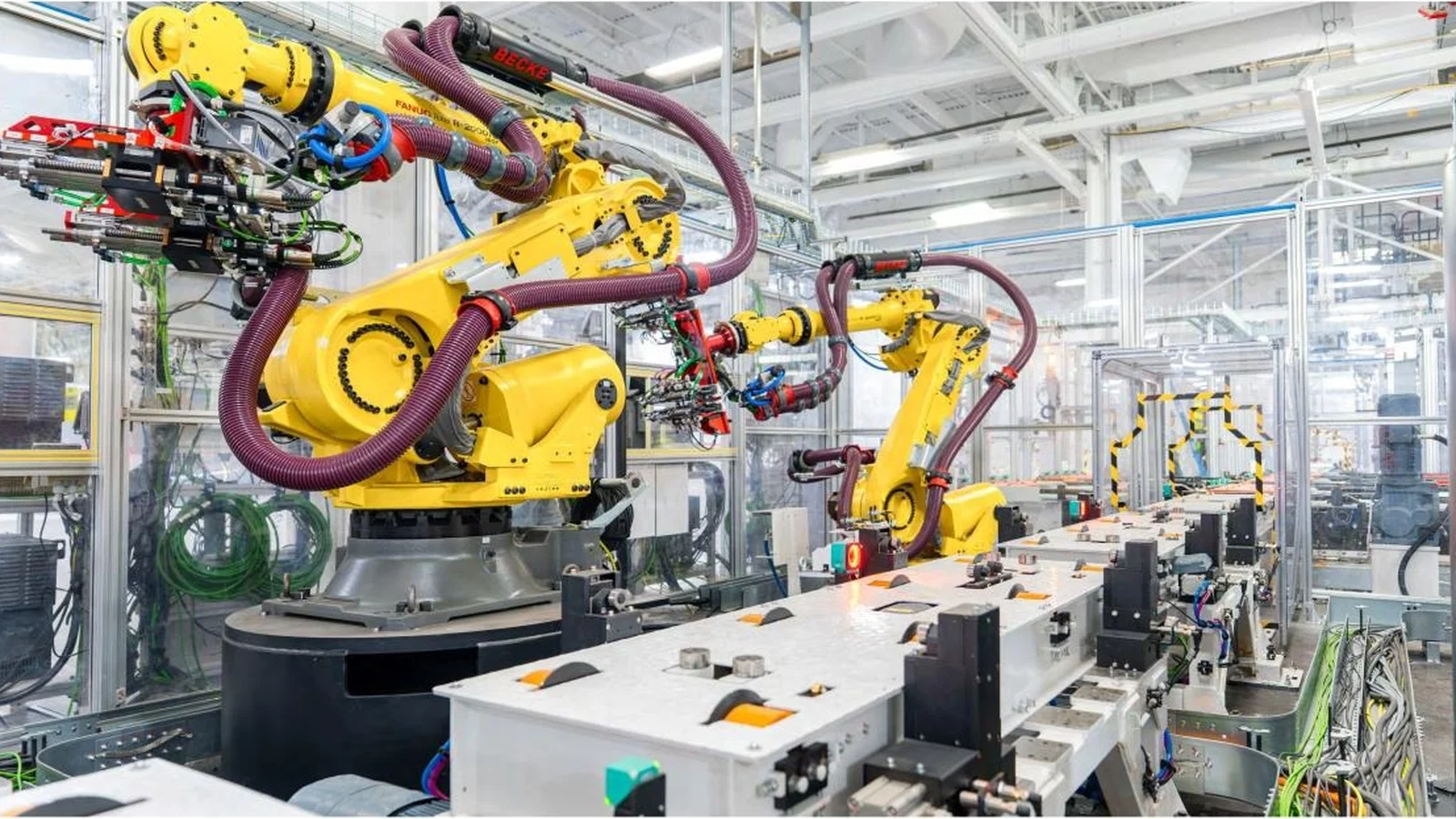
Tesla appears to have crossed the milestone we were waiting for: Optimus is no longer just a production line “under installation.” According to a new report, robots are now coming off that line by the hundreds every week. That sounds like mass production. The less glamorous second half of the story is just as important.
Output is rising, but manufacturing reliability, hands and software still constrain the program. That tension is what makes this update significant: Tesla may be materially further along in industrializing Optimus than it was a month ago, while still lacking evidence that the robot is a repeatable, customer-ready product.
Several hundred Optimus robots a week — roughly 10× the Q2 rate
The Information reports that Tesla was building only a few dozen Optimus units per week during small-batch testing in the second quarter. By August, that had reportedly increased to several hundred per week. Managers are also said to be targeting a continuous, more automated line capable of exceeding 1,000 robots per week by the end of 2026.
That is a major change from the evidence available when we updated this page on 21 August. At that point the strongest primary source was Tesla's official Q2 2026 update, which confirmed that the Model S/X lines in Fremont had been decommissioned and first-generation Optimus lines were being installed in their place. The new reporting suggests that the line has moved beyond installation and is actually producing repeated batches of robots.
But robot output is not the same as product readiness. Several hundred units a week does not mean several hundred customers or several hundred robots performing broadly autonomous work. Most of the current units are reportedly used inside Tesla for testing, training and data collection. Robots operating in factories are described as working in controlled areas on specific tasks.
The biggest manufacturing headache starts with the hands
A humanoid can look spectacular in a demo, but its industrial value depends on a less cinematic question: can thousands of identical machines be built quickly, consistently and without constant rework?
The hands and forearms appear to be particularly difficult. The Information describes an assembly with more than one hundred small screws and components, some of which still require manual work. That complexity can be manageable at prototype volumes. At thousands of robots per week, every extra assembly step, tolerance and rework loop becomes a throughput and cost problem.
The report also describes difficulty aligning small parts at some automated stations and maintaining component quality as volume increases. That does not mean the project has failed. It means Optimus is entering the stage where manufacturing physics matters as much as the AI demo.
The second problem may be even harder: the robot still has to learn the job
Scaling the hardware is only half the challenge. Sources cited by The Information say Optimus still does not generalize new tasks reliably enough, and learning even a relatively basic task can take several days. That gap is fundamental. A general-purpose humanoid must eventually adapt to new workflows more flexibly than a conventional machine programmed for one process.
Tesla describes Optimus as a general-purpose, autonomous biped intended to perform unsafe, repetitive or boring tasks. That remains the official goal of the program, not a demonstrated autonomy level for today's fleet. In our earlier analysis, we separated what Tesla has actually confirmed from what remains a promise. The new reporting shows why that distinction still matters.
What is confirmed — and what still comes from reporting
| Item | Status on 26 Sep 2026 |
|---|---|
| Optimus line in Fremont | Officially confirmed by Tesla in its Q2 2026 update. |
| Several hundred robots per week | Reported by The Information based on people familiar with the program; Tesla has not publicly published the number. |
| Goal of 1,000+ units/week by year-end | Internal target reported by The Information, not a guaranteed production rate. |
| Hand, tooling and supplier-quality problems | Reported by The Information; no separate technical disclosure from Tesla. |
| Regular external sales | Still not launched. There is no public list price or open buying channel. |
Is this mass production?
RoboMorrow would not use that label without qualification yet. A rate of several hundred per week is far beyond a typical one-off prototype program, but we still do not know line yield, rework rate, how many robots perform sustained work, or how long they can operate without intervention.
We also do not know unit manufacturing cost, hand durability, mean time between failures or the full specification of the customer version. The Information says the V3 robots being built now are not exactly the version Tesla intends to commercialize. In other words, the ramp can be both real production and part of the development program at the same time.
External sales: H2 2027 remains a useful reference point
This update does not invalidate our August conclusion. Reporting around a JPMorgan meeting had indicated that external commercialization of Optimus could begin no earlier than the second half of 2027. The new report describes higher output, but it also describes manufacturing and AI constraints. There is no basis yet to conclude that broad customer availability has moved forward.
The Information reports that Tesla plans to initially lease robots to a short list of companies whose factories and warehouses resemble Tesla's own environments. Technically, that would be logical: it limits scenario diversity, simplifies support and lets Tesla collect data under controlled conditions. It is still a reported plan, not a public commercial offer.
What this means for Europe and Poland
For Europe, the key signal is that the humanoid race is moving from demonstrations toward industrialization. Tesla is trying to scale its own line while several rivals pursue enterprise deployments and commercial access. Across the RoboMorrow Humanoids section, the same distinction appears repeatedly: production volume matters, but it does not answer uptime, intervention rate, cost per workflow or real autonomy.
Optimus still has no confirmed sales channel, price or delivery timetable for Poland or the wider EU. For a company planning automation today, Tesla therefore remains a program to watch rather than a product that can be placed into a current procurement plan. Our 2026 humanoid availability guide continues to classify Optimus as roadmap/pre-commercial rather than openly purchasable.
RoboMorrow view: this is real progress — just not the kind that looks best on stage
The most interesting part of this story is not that Optimus can walk. It is that Tesla is reportedly trying to build it by the hundreds every week. If the reported rate is accurate, the program has taken a meaningful step toward industrial scale. At the same time, hand complexity, manufacturing quality and task generalization show why the hardest humanoid problems are less spectacular than the demos — and probably much more important.
The next checkpoints are concrete: Tesla publicly confirming a production rate, commercial-version durability, a named external customer, measurable uptime and tasks performed for weeks without constant supervision. Those are the signals that would move Optimus from a production-and-training program toward a product.
Sources
The Information — Tesla’s Optimus Hits Snags in Hands, Suppliers as Scale-Up Begins · Tesla Q2 2026 Update · Tesla AI & Robotics · Electrek — summary and context