Isaac 0.5 Wants to Be an Open Robot Brain. There's One Important Catch
The humanoid race is becoming less of a hardware contest. A growing group of companies is trying to build an intelligence layer that can transfer across different robots and tasks. Perceptron — founded by former Meta FAIR researchers — is joining that race with Isaac 0.5.
According to the official model card, Isaac 0.5 is a 36B sparse model that takes images, video, language instructions, robot state and previous actions. A shared backbone can produce text, spatial outputs, task-progress estimates and robot actions.
35 robot systems and one million hours of general video
Perceptron's central claim is about data. The company says Isaac 0.5 was trained across more than 35 robot systems, 100,000 hours of robot experience, one million hours of general video and three trillion multimodal tokens. These are developer-reported figures; RoboMorrow does not have access to a complete training-data audit.
The strategy directly targets one of Physical AI's biggest constraints: teleoperated robot data is expensive. If general and egocentric video can teach enough about motion, geometry and changes in a scene, the amount of costly robot-specific demonstration data needed for a new embodiment could fall.
Perceptron reports an internal scaling experiment in which, at a fixed held-out action-loss target, increasing general video from 1,000 hours to one million hours reduced the measured teleoperation requirement from roughly 5,900 to 28 hours. This does not mean a real robot automatically needs 210 times less data to become productive. It is an internal training result under a particular loss target and setup, not a factory benchmark for task success, uptime or human intervention.
One model for seeing, reasoning and control
Isaac 0.5 is designed to span several layers of the robotics stack. It can analyze video and track objects, while also producing continuous and discrete control outputs. The documentation says continuous actions use a Flow expert and a 36-block diffusion transformer, while discrete control uses a vocabulary of 2,048 FAST tokens.
That matters because a conventional robotics pipeline often separates perception, localization, planning, control and task logic. End-to-end models try to reduce some of those boundaries. The potential benefit is better transfer and simpler learning from large datasets. The trade-off is harder debugging and a greater burden on safety validation.
“Open” — yes, but with an important catch
Perceptron positions Isaac 0.5 as an open model. The public GitHub repository exposes training and inference integration through LeRobot, while the Hugging Face model card documents the architecture, licensing and resources.
At RoboMorrow's verification time, however, the documentation contains one notable inconsistency. The model card says the release includes base and action-capable weights, but its Resources section still marks the weights link as “COMING SOON.” We therefore do not describe the full weights as universally downloadable today. The code and documentation are public; teams should re-check weight availability before planning a deployment.
The repository also carries a practical caveat: a clean checkout does not yet include every dependency required for rendering, training or inference because part of the runtime is maintained separately. That is not unusual for a fresh research release, but it matters to anyone reading “open source” as “clone and run.”
Why Isaac 0.5 matters beyond another AI model
The important conclusion is not that Perceptron has built the best robot brain. There is not enough independent evidence to make that claim. Most performance evidence comes from the model's creators, and robotics still lacks a single benchmark that can fairly compare general models across different machines in real environments.
What matters is the direction. Isaac is designed around multiple embodiments and multiple data types rather than one fixed robot. If that approach transfers skills reliably between machines, value could shift away from the chassis itself and toward software + data.
That is the same bottleneck explored in our analysis “Humanoids Can Run. Why Can't They Work Yet?”: robot bodies are improving quickly, while commercial reliability depends on data quality, generalization and the speed at which a system can learn a new process.
Who is Perceptron?
TechCrunch reports that Perceptron was founded in November 2024 by Armen Aghajanyan and Akshat Shrivastava, both formerly at Meta FAIR. The company is targeting visual intelligence for manufacturing, logistics, warehousing, security and mobility. PitchBook data cited by TechCrunch says the startup previously raised $16 million.
That business background is independent context, not validation of model quality. The important test starts now: whether Isaac works on customer hardware, how often humans must intervene and how much extra data it needs for new tasks.
What we should see next
- weights that are clearly downloadable with unambiguous licensing terms;
- independent reproduction of the published benchmarks;
- closed-loop tests across several different robots and tasks;
- task success, intervention rate and cycle-time data from real deployments;
- a cost comparison for fine-tuning versus models that require more robot-specific data.
If Perceptron can deliver those pieces, Isaac 0.5 could become more than an interesting research release. For now, it is another strong signal that the robotics battle is moving into the brain-and-data layer.
Sources and methodology
Primary sources: Perceptron — Introducing Isaac 0.5, the official Hugging Face model card and the official GitHub repository. Independent context on the founders and funding: TechCrunch, August 26, 2026. Scaling results are treated as developer-reported evidence, not an independent RoboMorrow benchmark.
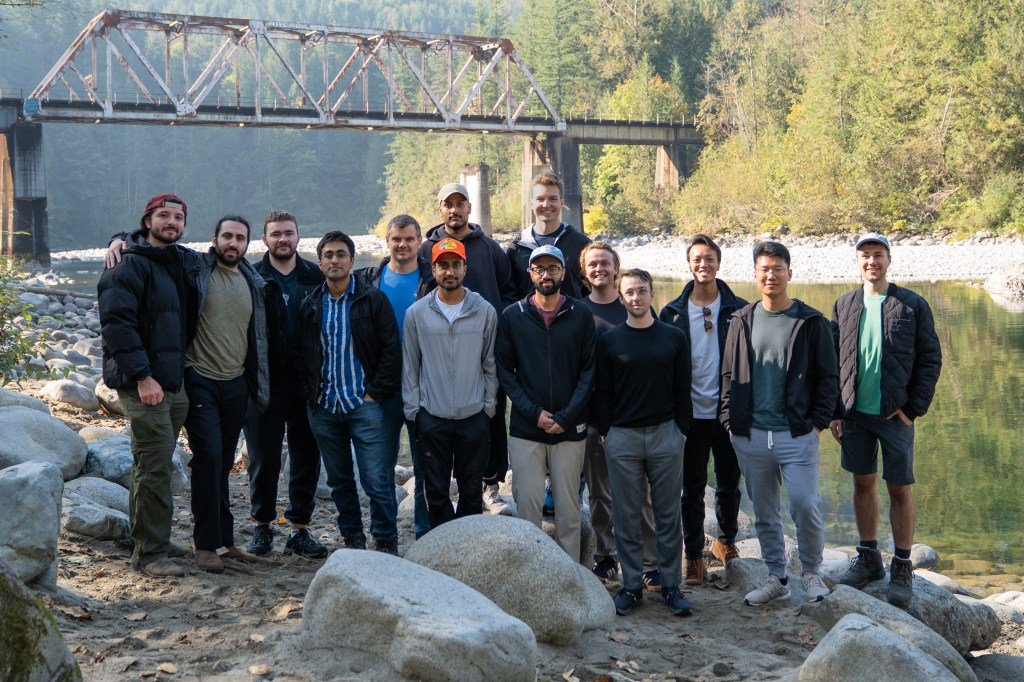
Featured image: Perceptron team photograph supplied by the company and published by TechCrunch; used illustratively. It is not an AI-generated visualization.