Pony.ai Unveils Gen-4 Robotruck: Europe Is the Plan, Production Comes Next
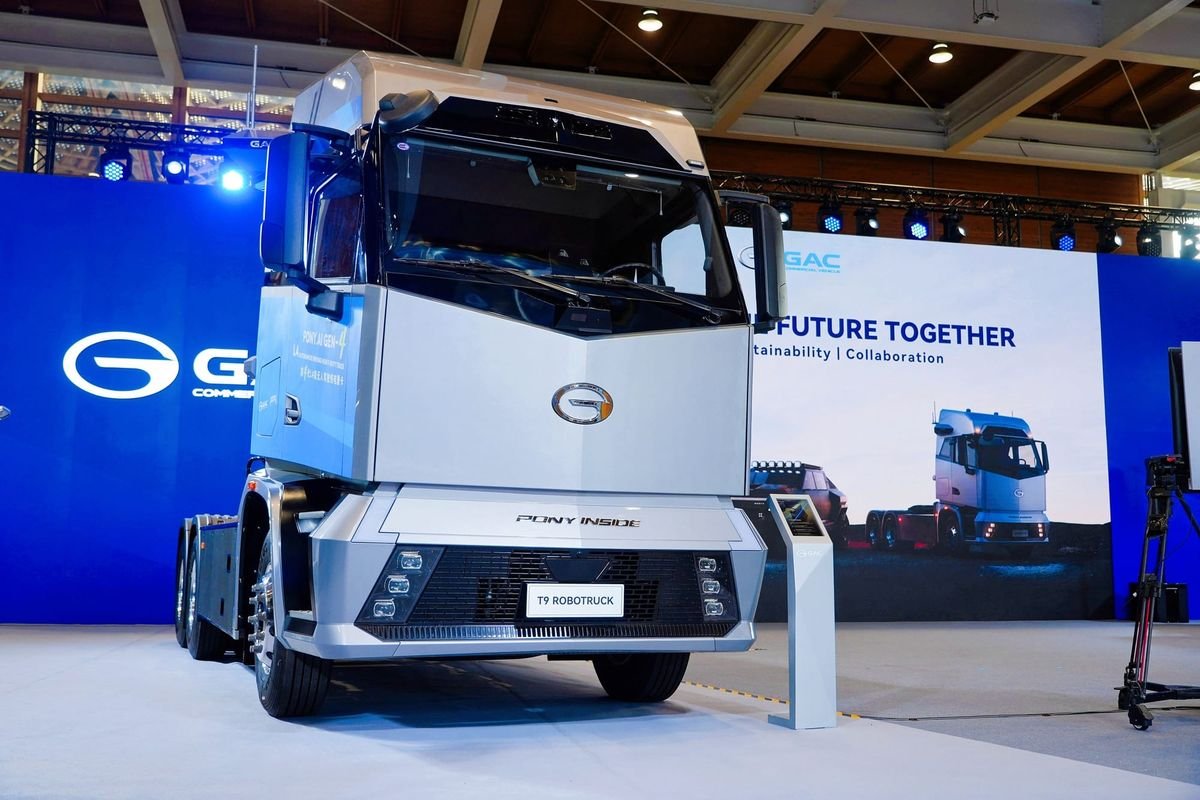
Pony.ai wants to extend autonomy from passenger rides into heavy freight. Its new Gen-4 Robotruck on the battery-electric GAC T9 platform matters for more than its sensor count. The important questions concern production and a business measured in completed freight movements, rather than an impressive demonstration drive.
What was unveiled in Hanover?
Pony.ai and GAC Commercial Vehicle presented an L4 truck based on the electric T9. The company names long-haul freight, dedicated logistics routes and ports as target applications. Its autonomous-driving kit combines nine lidars, three radars and 13 cameras. Pony.ai says it shares a domain controller with its seventh-generation robotaxi.
Common components could make development and support easier, but passenger-car experience cannot simply be transferred to a truck. Braking dynamics, vehicle dimensions, blind spots and the consequences of failure differ. A practical assessment concerns the complete vehicle operating within defined conditions, not simply the number of devices observing its surroundings.
Three cost figures that should not be confused
The company reports a 70% reduction in the autonomous-driving kit’s bill of materials versus the previous generation. It also projects around 30% lower cost per tonne-kilometre and 10% lower energy use. These are company statements and forecasts, not independent results from a European fleet operator. They do not mean the complete truck is 70% cheaper.
For a buyer, the definition of transport cost matters. Financing, charging, maintenance, insurance, remote support and downtime can change the outcome. A cheaper component does not automatically deliver an equally large reduction in the freight bill. An energy comparison also needs a stated load, speed and route.
Why a port or fixed corridor could be a useful starting point
This is our analysis of deployment options, not news of a signed customer contract. A repeated route makes it easier to define collection points, charging, safe stopping locations and incident procedures. The operator can measure the same task across successive shifts rather than compare unrelated journeys.
That does not make the environment simple. Ports contain pedestrians, equipment, changing storage locations and unexpected manoeuvres. The potential benefit is clearer coordination of responsibilities and workflows, not an absence of risk. Every deployment needs to identify when the vehicle operates alone, when it requests help and who recovers it following a failure.
Europe is an expansion plan, not an available service
Pony.ai plans to enter European and Middle Eastern Robotruck markets within two years. Reuters reports discussions with European governments and ports about testing. The material used here does not name a European T9 customer or provide a price list and commercial start date for a particular country. Reuters reporting.
For a Polish or European haulier, this is a reason to prepare requirements and follow developments, not to book autonomous-driving savings into next year’s budget. Before a pilot, define the route, operating conditions, terminal handling, charging responsibilities, support model and the treatment of journeys that still require human involvement.
In our assessment, a useful pilot should have an acceptance test agreed in advance: the proportion of jobs completed without extra operator work, cost per completed movement and fleet availability. Mileage alone does not establish whether the system saves time across the entire chain.
A separate event from Pony.ai’s Zagreb robotaxi operations
Our coverage of Pony.ai, Verne and Uber in Zagreb concerns passenger transport. T9 is a new heavy-truck platform and a separate product event. The stories belong within the same company strategy, but fleets, generations and operating status should not be merged.
The Waymo rollout in Denver, San Diego and Tampa represents another operating model. Yet there is a useful common question: how much organisational work remains around a vehicle once the driver is no longer sitting inside?
What would change the assessment next?
A confirmed production start, a named customer, the defined operating domain of a European deployment and transparent cost results would materially strengthen the case. Another presentation of the same specifications would not answer those questions.
RoboMorrow’s assessment: the T9 Robotruck is a significant announcement about scaling autonomous freight. For now, it remains a launch with production and expansion plans, rather than evidence that driverless freight is already available and cheaper on a Polish route.
Sources and method
Based on manufacturer documentation and the reporting identified below. Editorial verification: 14 September 2026. News and analysis; not a RoboMorrow hands-on test.
Europe: permission and an operating corridor come before scale
Reuters confirms that Pony.ai is talking with European governments and ports about testing. That is a meaningful signal, but it is not yet a contract for regular freight operations. For a first EU pilot we would look for a tightly defined ODD: terminal-to-warehouse, port-to-logistics-centre or a fixed industrial route. Only then can availability, safety and cost be compared with a human-driven truck on the same job.
“Mass production” also needs careful wording. Pony.ai had already reported that other Gen-4 Robotrucks entered mass production in China earlier in 2026. The new announcement concerns this specific GAC T9-based model and schedules its volume production for later in the year. It should not be framed as if the entire Gen-4 family were only now entering production for the first time.