RobotPlusPlus Raises Series C After 2M Robot Operating Hours
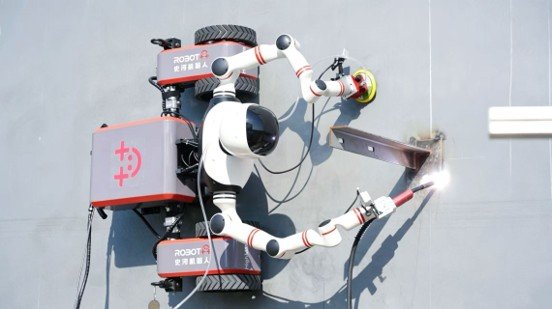
Verified 17 September 2026. RobotPlusPlus has closed a Series C worth “hundreds of millions of RMB”, or tens of millions of US dollars. The company did not disclose one exact figure, so RoboMorrow does not invent one. The strongest part of the story is the company-reported total of more than two million robot operating hours.
Robots for jobs people should not have to perform manually
RobotPlusPlus builds machines for cleaning, inspection, surface preparation and other work on ship hulls, tanks, oil-and-gas facilities, wind assets and building façades. These tasks are hazardous, repetitive and relatively easy to measure economically.
The company says its hull-derusting robots have been deployed at more than 100 shipyards and worked on more than 10,000 vessels. It also claims 5–6x higher efficiency and 30–50% lower cost than manual methods in selected applications. Those are manufacturer figures, not an independent audit across every project.
Two million hours as a data advantage
In embodied AI, data from real worksites can be more valuable than a perfect laboratory demo. A shipyard generates variations in surface condition, corrosion, weather, operator setup and geometry that are difficult to simulate completely. RobotPlusPlus plans to use those data for vertical AI and higher autonomy in future systems.
Series C: do not invent an exact amount
The official release says “hundreds of millions of RMB”. Qianggang Capital Fund led the round, with GIG Capital Group, Sealand Innovation, Juntong Capital and existing investor Fosun RZ participating. The funding is intended for global expansion, embodied AI, manufacturing scale and industry standards.
What it means for Europe
Europe has large shipbuilding, offshore, petrochemical and energy sectors. Poland also has shipyards, terminals and industrial assets where reducing work at height can have direct safety value. The announcement does not name a new Polish deployment.
Procurement should focus on square metres per hour, surface quality, intervention frequency, setup time, service, consumables and uptime. Those are the metrics that need to validate the claimed advantage over manual processes.
A specialist robot has a clearer path to ROI than a “general worker”
RobotPlusPlus does not need to prove that one machine can perform hundreds of human tasks. It only needs to show that one process, such as preparing a steel surface, can be completed faster, safer and with fewer people on scaffolding. That lets buyers build a business case from concrete labour hours and square metres.
It is an interesting counterpoint to the direction covered in our ZINOVA Tool Intelligence article. ZINOVA wants different robots to use existing human tools; RobotPlusPlus takes the opposite route, building specialised machines first and then expanding intelligence using field data.
Two million hours may be a data moat, but dataset structure matters
Training value does not depend only on raw hours. Models benefit from synchronised sensors, actions, errors, teleoperation and task-quality outcomes. If much of the two-million-hour total is conventional operating telemetry without rich action labels, its training value differs from datasets designed specifically for policy learning. RobotPlusPlus has not published a full methodology.
How to measure a shipyard or industrial deployment
- effective square metres per hour including setup and relocation;
- surface-preparation quality and rework rate;
- operator interventions per shift;
- abrasive, water and energy use per square metre;
- uptime and service response time;
- human work-at-height hours eliminated.
Where this could fit in Europe
Shipyards, storage tanks, steel structures, energy assets and large industrial facilities are natural targets. The announcement does not name a new Polish project, so RoboMorrow does not present this as a local deployment. Procurement should verify service coverage, certification, attachment procedures and which tasks are genuinely autonomous versus teleoperated.
Affiliate status
This is project-based B2B equipment. There is no credible retail affiliate path; adding a shopping link would be artificial. TCO evidence and integrator access are more useful than a marketplace CTA for this category.
The biggest advantage of a specialist robot: success is easier to define
For a surface-treatment robot, buyers can define a quality standard, hourly productivity and an acceptable rework rate. That is far simpler than evaluating a humanoid’s “general intelligence”. The supplier can iterate on perception and control without changing the entire product definition, while customers can run a pilot with clear go/no-go criteria.
Embodied AI can expand capability without sacrificing predictability
Shipyard robots often work near people, on variable geometry and in environments that are harsh on electronics. More adaptive models may improve exception handling, but the system still needs predictable motion limits. Safety functions should therefore remain independent from the AI layer making higher-level task decisions.
Operating data should turn into concrete benchmarks
If RobotPlusPlus really has millions of hours of telemetry, a natural next step is to publish benchmarks showing how intervention rate changes between software generations. That would be stronger evidence of the data advantage than the raw hour count alone. Uptime in marine conditions and setup time between tasks would also be highly useful metrics.
Featured image: real operational RobotPlusPlus robot photo supplied with the company’s press release, showing work on a steel structure.