Apptronik Apollo 2
BUYING IN YOUR MARKET
Availability in your country
Sales, delivery and support can differ by country and exact model. Choose your market to see the evidence we have checked.
Apptronik Apollo 2
No verified local offer in this dataset
A current local sales offer, exact regional variant, delivery date and service coverage have not been verified for this country in the regional dataset. This does not mean that the robot is unavailable.
- Price
- No verified local price in this dataset
- Delivery
- No confirmed date for your address
- Warranty and service
- Local coverage not verified
“Listed” confirms a product page or sales route, not stock, delivery to every address or local service. “Pre-order” is not immediate availability. Unverified means we lack evidence; it does not mean unavailable. Prices belong to the named market and currency. Confirm the exact version, tax, shipping and support before ordering.
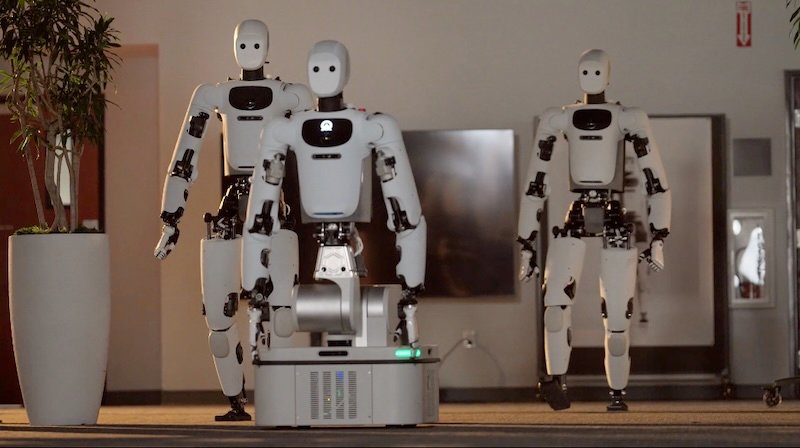
Apollo 2 is not a “humanoid you can buy” in the same sense as Unitree H2. It is something equally important for the market: an operating data-collection platform Apptronik is using to build its next commercial generation. The company has shown Apollo 2 in both bipedal and wheeled-base form and runs fleets across Robot Park, partner sites and customer environments.
The key fact: Apollo 2 is training the future fleet
Apptronik calls Apollo 2 the workhorse behind its data system. Inside the expanded Robot Park in Austin — roughly 90,000 square feet — robots perform customer-inspired logistics, manufacturing, retail and manipulation tasks. Similar workflows are deployed with partners and customers including Google DeepMind, Mercedes-Benz and GXO.
That changes how this database card should be read. Apollo 2 is not presented as the final retail product. Apptronik explicitly says the experience and data streams generated by Apollo 2 are feeding the development of Apollo 3, its upcoming commercial platform.
Wheels or legs? Apptronik does not pretend legs are always the answer
Modularity is one of Apollo 2's most interesting design choices. The biped can work in human-designed spaces and supports research into complex mobility. The wheeled base prioritizes stability, throughput and easier alignment with existing industrial mobile-robot safety standards. It is a pragmatic position: embodiment should follow the task rather than the need for the most dramatic demo.
Artemis, Fleet Connect and hardware form one operating system
Apollo 2 is more than mechanics. Apptronik describes a three-layer platform. The robot is the physical body; Artemis coordinates perception, planning, controls, safety and task execution; Fleet Connect provides fleet monitoring, task orchestration, deployment management and operational data. For an automation buyer, these software layers can matter as much as joint count.
The company states 90%+ actuator efficiency and uses swappable batteries to support what it calls 7x22 operation. That does not mean one battery lasts 22 hours; it describes an operating model built around quick battery swaps and minimized downtime.
Autonomy: separate three sources of behavior
Robot Park combines teleoperation, autonomous execution and simulation. That distinction is essential. Apollo 2 training data may come from a human operator, an autonomous model or simulated experience. A robot being physically present at a customer site does not prove that every task shown is autonomous.
At the same time, Apollo 2 has become an important embodiment for Google DeepMind. Gemini Robotics 2 demonstrates whole-body control and manipulation tasks on the platform. That is a significant software signal, but it does not replace production metrics such as uptime, intervention rate and task economics.
Price and availability
Apptronik does not publish an Apollo 2 MSRP or a normal online checkout. Sales contact is available, but public evidence centers on partner programs, Robot Park and data/deployment sites. RoboMorrow therefore classifies Apollo 2 as D — LIMITED DEPLOYMENT / TRAINING PLATFORM, not BUY NOW.
When can Apollo 2 make sense for an enterprise?
- when the company wants to co-develop a workflow through a pilot,
- when real-world Physical AI data collection is strategically valuable,
- when wheeled versus bipedal mobility needs to be evaluated,
- when the organization has integration resources and is not expecting an off-the-shelf appliance.
Questions to ask before a pilot
Ask for the percentage of autonomous task execution, operator interventions per hour, SLA, battery-swap assumptions, WMS/MES integration method, safety architecture for the selected configuration and how much of today's Apollo 2 investment transfers to Apollo 3.
See where Apollo 2 sits relative to robots with public prices or reservations in our Humanoids 2026 buying guide. Enterprise teams can also use the RoboMorrow business section.
Apollo 2 is not yet an off-the-shelf product
The most important distinction is between Apollo 2 as a data-collection and learning platform and the future commercial Apollo 3. Robot Park exists so a fleet of Apollo 2 systems can perform tasks, generate data and exercise the Artemis and Fleet Connect stack. That is stronger evidence than a one-off demo, but it is still not a public sales channel or a promise of turnkey deployment for any buyer.
The wheeled and biped configurations should not be treated as cosmetic body variants either. Wheels can reduce energy use and simplify mobility on a flat factory floor, while legs become valuable when thresholds, stairs or human-designed infrastructure require human-like geometry. A pilot should therefore start with the workflow and environment before selecting morphology.
What does Gemini Robotics 2 integration mean?
Google DeepMind's public demonstrations show whole-body control and generalization on Apollo 2, but they do not guarantee a factory SLA. Buyers need to separate model capability from full-system readiness: perception, grasping, networking, battery management, recovery and supervision. For an enterprise, the percentage of autonomous cycles in its own task matters more than a single benchmark.
RoboMorrow has not physically tested Apollo 2. We treat Apptronik, Reuters and Google DeepMind material as evidence of the current program stage, not as a substitute for an independent deployment test.
RoboMorrow has not performed a hands-on test of Apollo 2. This card is based on official Apptronik and Google DeepMind material plus independent reporting.
Where to buy
We do not yet have a verified exact Amazon product page for this model. Check the official source above.
News about this robot and brand
Humanoids in 2026: which can you actually buy, order or reserve?
Unitree G1, R1 and H2, NEURA, NEO, Digit, Agile, Atlas, Figure and Optimus: separate hardware purchases, reservations, subscriptions and deployment projects.Read more →Guides
No related guides are available yet.
Comparisons and rankings
No related comparisons are available yet.