Fourier GR-3
BUYING IN YOUR MARKET
Availability in your country
Sales, delivery and support can differ by country and exact model. Choose your market to see the evidence we have checked.
Fourier GR-3
No verified local offer in this dataset
A current local sales offer, exact regional variant, delivery date and service coverage have not been verified for this country in the regional dataset. This does not mean that the robot is unavailable.
- Price
- No verified local price in this dataset
- Delivery
- No confirmed date for your address
- Warranty and service
- Local coverage not verified
“Listed” confirms a product page or sales route, not stock, delivery to every address or local service. “Pre-order” is not immediate availability. Unverified means we lack evidence; it does not mean unavailable. Prices belong to the named market and currency. Confirm the exact version, tax, shipping and support before ordering.
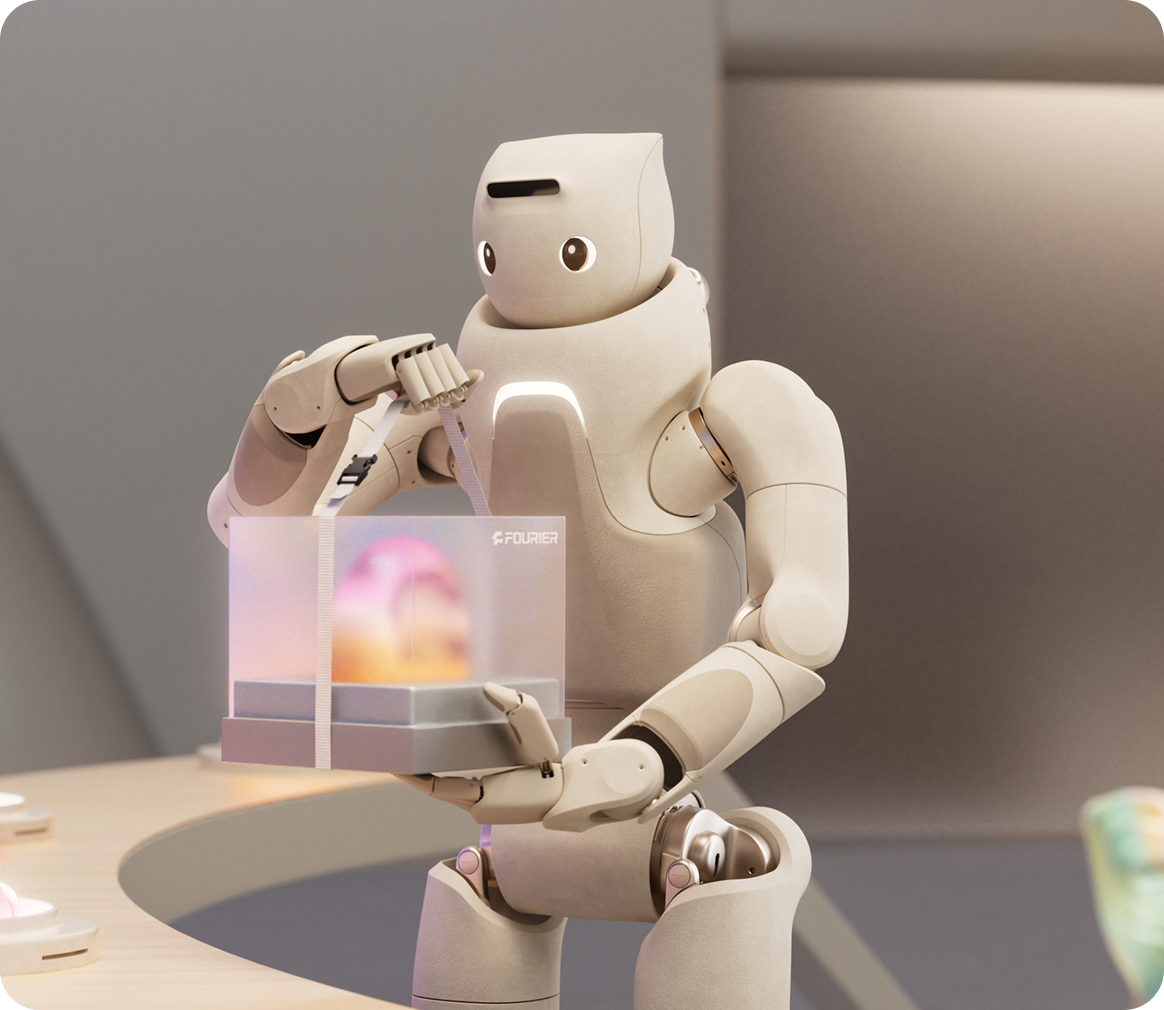
Fourier GR-3 takes a different path from humanoids built mainly to move heavy totes. Fourier calls it its first “Care-bot” and designs it around human interaction: soft exterior materials, hearing, vision, touch, gestures and service-space behavior. That makes GR-3 interesting, but it also needs to be evaluated differently from Digit or Atlas.
The specification prioritizes interaction over maximum payload
GR-3 is about 165 cm tall and weighs about 71 kg. Official documentation lists up to 55 degrees of freedom, maximum joint peak torque of 440 N·m and roughly 3 kg single-arm payload. The base hand has six DoF, while an optional hand can provide 12 DoF. Walking speed is listed at about 6.1 km/h.
The power system totals roughly 936 Wh and Fourier states around three hours of runtime with hot-swappable battery support. Base compute uses an AMD Ryzen 7 8845HS, 32 GB memory and 1 TB storage. That makes GR-3 a concrete developer platform rather than only a social-robot concept.
Full-Sense Interaction: three channels, not one
Fourier combines hearing, vision and touch. Official documentation lists sound-source localization microphones, cameras and distributed pressure sensors across the head and torso. The goal is more natural communication in public and service environments. It should not be interpreted as proof that the robot “understands emotions” in the human sense; that language describes the product direction and its multimodal interaction stack.
Teleoperation is a feature, not a hidden detail
GR-3 documentation explicitly supports immersive remote control using a VR headset or exoskeleton. For research and service deployment this can be useful for collecting demonstrations, handling exceptions and gradually increasing autonomy. It also means editorial coverage must separate remote operation from autonomous behavior.
What do we know about sales?
Fourier operates official product and developer-support channels but does not publish a standard GR-3 retail price. RoboMorrow therefore classifies it as C — ENTERPRISE / DEVELOPER SALES. A real purchase requires discussion about configuration, SDK access, hand options, support and intended use.
The lack of public pricing makes direct comparison with Unitree H2 or 4NE1 harder. Prices from older GR-1/GR-2 platforms should not be copied across to GR-3 because the products and configurations differ.
Where can GR-3 be stronger than a typical industrial humanoid?
- Reception and public spaces where appearance, gestures and voice are part of the product.
- HRI research focused on human-robot interaction, touch and multimodal perception.
- Care and rehabilitation research adjacent to Fourier's historical portfolio, while any real medical use still requires separate evidence and compliance.
- Embodied-AI development using a physical platform, SDK and teleoperation.
Where should buyers be especially skeptical?
A roughly 3 kg single-arm payload makes clear that GR-3 is not a direct substitute for heavy factory handling. The “Care-bot” label also does not mean automatic clinical approval or autonomous care capability. Buyers need a safety case, task-level autonomy evidence, certification details and clear operator responsibility.
What should a buyer ask to see in a demo?
Do not stop at a voice conversation. Ask for a complete sequence: detect a person, interpret an instruction, approach, manipulate an object, handle a failure and finish safely. Record interventions and cycle time. That tells you far more about usefulness than a scripted highlight clip.
We compare GR-3 with home, service and industrial platforms in the Humanoids 2026 mega guide. See also the RoboMorrow business section.
Why a 3 kg per-arm payload does not disqualify GR-3
Three kilograms per arm looks modest next to industrial lifting platforms, but GR-3 is positioned as a Care-bot. In care, reception, education or assistance, the relevant work often involves light objects, human interaction, stability and perception quality rather than moving heavy totes. That is a different optimization target from a warehouse humanoid.
At the same time, the Care-bot label should not be interpreted as medical certification. Healthcare deployment requires a separate check of device, workflow and local regulatory requirements. Fourier's public material describes the platform and interaction stack; it does not establish universal clinical approval.
The developer angle: collecting demonstrations
Fourier explicitly supports VR and exoskeleton teleoperation, which can be useful for collecting demonstration data for manipulation policies. Buyers should still ask about data format, latency, sensor rates, synchronization, hand APIs and session replay. Those details determine whether GR-3 is merely an impressive demo platform or a practical research tool.
What to verify before purchase
Request the exact 55-DoF configuration, 6- versus 12-DoF hand option, battery hot-swap details, compute version, SDK access, safety documentation, SLA and spare-parts terms. With no public MSRP, comparing GR-3 on specifications alone without a project quote can be misleading.
RoboMorrow has not physically tested GR-3. Technical data comes from Fourier's official developer center, updated in June 2026.
Where to buy
We do not yet have a verified exact Amazon product page for this model. Check the official source above.
News about this robot and brand
Humanoids in 2026: which can you actually buy, order or reserve?
Unitree G1, R1 and H2, NEURA, NEO, Digit, Agile, Atlas, Figure and Optimus: separate hardware purchases, reservations, subscriptions and deployment projects.Read more →Guides
No related guides are available yet.
Comparisons and rankings
No related comparisons are available yet.