ROSCon 2026: NVIDIA and Google open a new Physical AI software layer
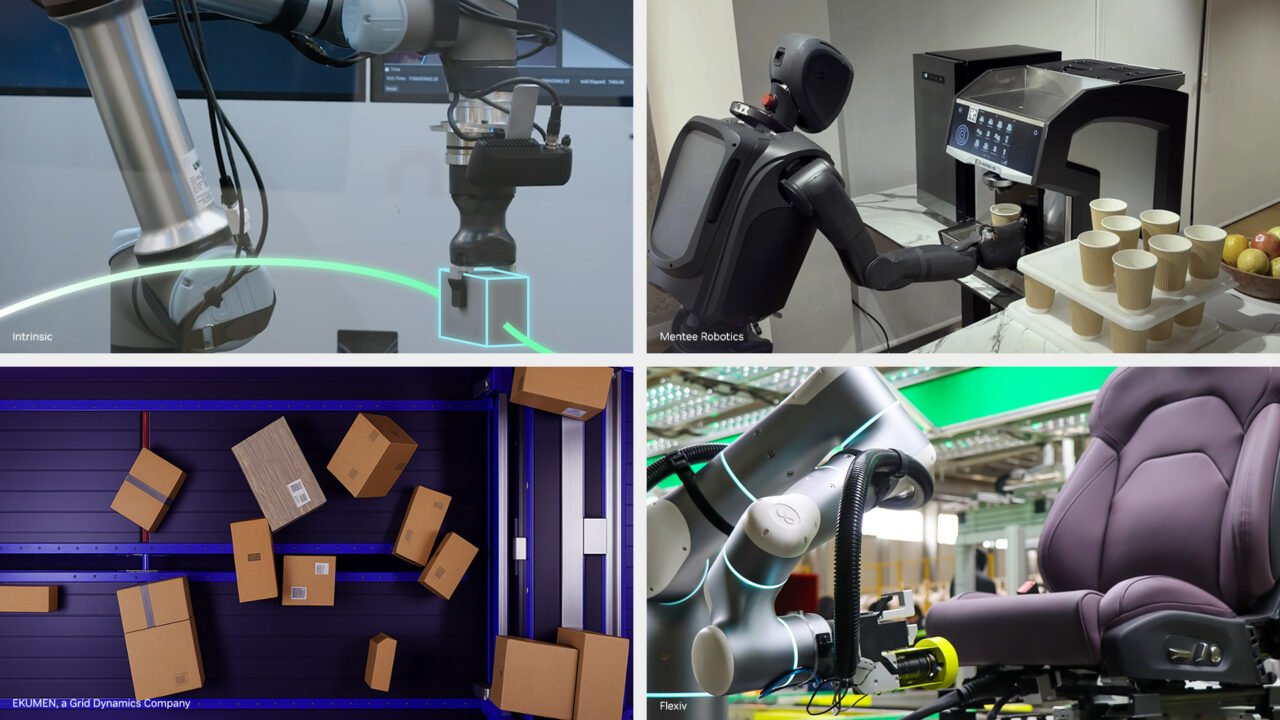
On September 22, NVIDIA released Isaac ROS 5.0 and Google's Intrinsic open-sourced Intrinsic Core under Apache 2.0. They are separate releases, but together they show the same shift: more Physical AI value is moving into an open robotics software stack.
ROSCon 2026 produced two launches that are less visually dramatic than a new humanoid but may have a larger effect on how quickly robots are built. NVIDIA introduced Isaac ROS 5.0 with agentic workflows and updated perception libraries, while Intrinsic released open-source services for control, planning, perception and simulation.
The shared idea is straightforward: robotics teams should spend less time assembling infrastructure from scratch and more time on the task the robot must perform. That matters because integration cost remains one of the largest barriers to commercial robotics.
Isaac ROS 5.0: an AI agent enters the robotics developer workflow
NVIDIA describes Isaac ROS as a set of GPU-accelerated packages built on ROS. Version 5.0 adds agent-ready skills and documentation designed so AI agents can assist with setup, manipulation and Isaac tooling. One example is a FoundationStereo fine-tuning skill that can help adapt a stereo model to a specific camera configuration and environment.
FoundationPose now has an agent-ready inference library that NVIDIA says can estimate and track object pose up to 5.5 times faster. That is a vendor benchmark, not a RoboMorrow test. The release supports ROS Lyrical and Ubuntu 24.04 and scales from Jetson Orin Nano to Jetson Thor.
NVIDIA points to integrations with Mentee Robotics, Universal Robots, ROBOTIS, FieldAI, Flexiv and other robotics companies. The key point is that Isaac ROS is not only a simulation framework. It is intended to connect development with code running on edge compute inside physical robots.
Intrinsic Core: Google opens an industrial robotics runtime
Intrinsic Core is a different type of product. It packages ready-to-use capabilities and services including sensor-based control, pose estimation, motion planning, grasp planning, camera calibration and Gazebo-based simulation. Intrinsic emphasizes ROS compatibility and a hardware-agnostic real-time control framework.
The most practical component is the Open Machine Tending Solution, a reference application for CNC machine tending. Intrinsic lists ecosystem partners including NVIDIA, Universal Robots, FANUC, ATI, Schunk, Robotiq and Basler. Instead of a broad promise that a robot will do everything, the project provides a starting point for a specific industrial workflow.
Why the two releases belong in the same conversation
NVIDIA and Intrinsic are not offering the same stack. Isaac ROS is closely tied to NVIDIA accelerated compute and Physical AI libraries. Intrinsic Core is trying to provide a broader, hardware-agnostic runtime and pre-integrated industrial capabilities. They meet, however, around ROS and the idea that reusable components should be assembled rather than rebuilt for every project.
That changes where robotics companies compete. Hardware still matters, but in 2026 data, models, runtime, simulation, calibration and developer workflow are becoming equally strategic. RoboMorrow has covered the same infrastructure shift in our D-Robotics Physical AI compute analysis.
Jetson Orin Nano remains one of the lower-cost entry points into NVIDIA edge AI. Check current Amazon availability. Affiliate link; verify memory and kit configuration before buying.
What we still do not know
- how much development time Isaac ROS agentic workflows save in production projects;
- how reliably agents handle large multi-package ROS codebases;
- which parts of Intrinsic's value remain open source versus enterprise services;
- whether Intrinsic Core builds a broad ecosystem beyond launch partners;
- how portable applications will be across different compute platforms and robot brands.
What this means for a small European company
The opportunity is not that software suddenly makes integration free. It is that the path to a first working cell can become shorter. A small integrator can start with existing motion planning, perception and simulation, then spend engineering time on the gripper, customer process, safety and cell economics.
Open components can also lower the cost of experimentation. A company does not necessarily need to buy a complete closed platform before testing a concept. It still needs robotics expertise, but some infrastructure work becomes shared across the ecosystem rather than repeated inside every team.
RoboMorrow take
The strongest signal from ROSCon 2026 is that Physical AI is becoming a competition over the software stack, not only the robot body. Isaac ROS 5.0 brings AI agents into the developer workflow, while Intrinsic Core opens components for industrial applications. If these tools genuinely reduce integration time, their impact may be larger than another increase in humanoid degrees of freedom.
What to watch over the next six months
The best test of Isaac ROS 5.0 will not be download count but whether agentic workflows appear in real repositories and reduce setup time. In robotics, an agent-generated mistake can move beyond code and affect a physical machine, so strong testing, simulation and human review remain essential. An agent that removes boilerplate is useful; an agent that changes control parameters without validation can create risk.
For Intrinsic Core, the key signal will be contribution outside Google and its launch partners. Open source becomes most valuable when drivers, examples and integrations appear for many robots, cameras and grippers. If the project remains mostly a single-company repository, its impact will be smaller. If Open Machine Tending attracts reusable modules across machine tools and robot brands, it could become a practical starting standard for integrators.
RoboMorrow will also watch whether these tools reduce deployment cost in measurable terms. Useful evidence includes integration time, engineering headcount, intervention rates and application portability between cells. Those metrics will show whether “agentic robotics development” is an economic change or mainly a new interface layer.