D-Robotics Raises $400M as Robot Computing Moves to Scale
Verified 17 September 2026. D-Robotics has closed a $400 million Series C round. The company is not betting on one humanoid body; it is building shared computing infrastructure for many robot categories through Sunrise chips, RDK developer systems and a software layer spanning development, simulation and inference. The official release was published on 17 September at 03:00 ET.
$400 million for a shared robotics layer
D-Robotics says the funding will expand the Sunrise chip portfolio across multiple computing tiers and strengthen an integrated hardware-software stack. The strategy resembles a platform supplier: robot makers can focus more of their effort on mechanics, sensors and applications instead of recreating the entire compute stack from scratch.
For the first half of 2026, D-Robotics reports multiple-times year-on-year revenue growth and more than eight million cumulative Sunrise chip shipments. One caveat matters: eight million chips does not mean eight million humanoids. Sunrise devices also serve mobile robots, consumer products and other edge-AI systems.
S600: 560 TOPS and on-device VLA
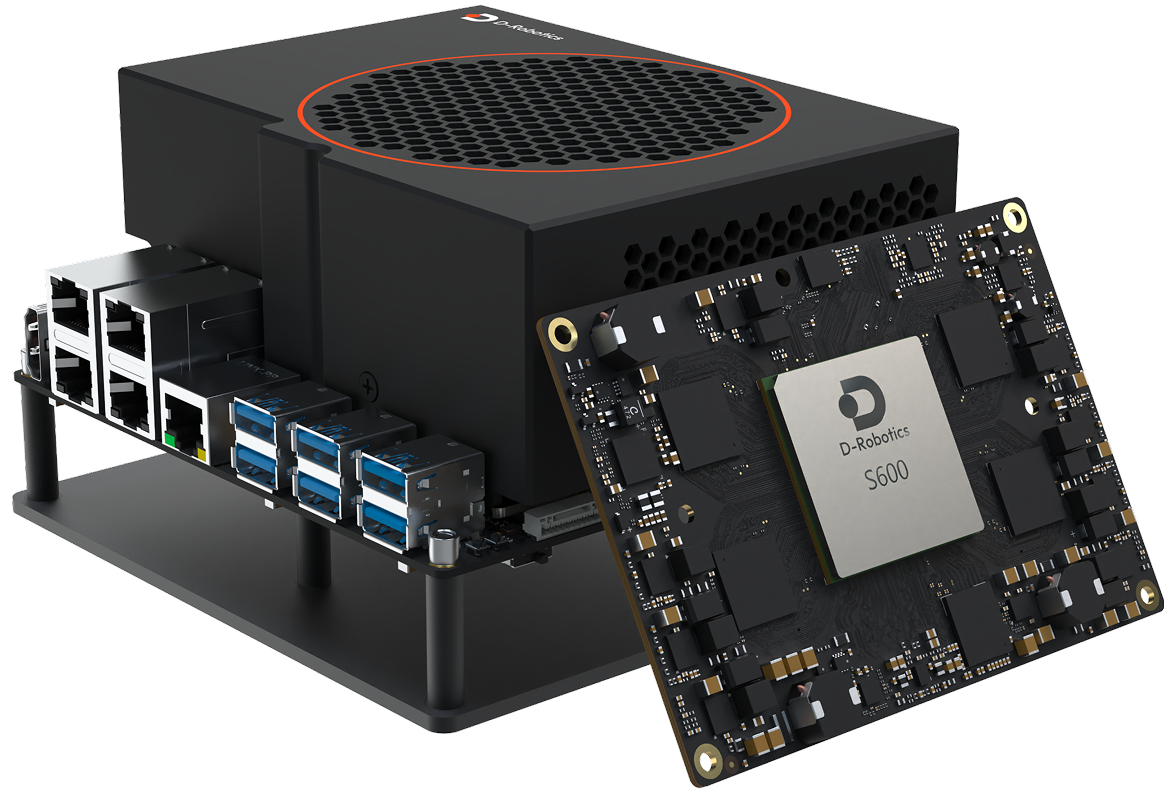
The Sunrise S600 is rated by D-Robotics at up to 560 TOPS INT8 and is aimed at more demanding embodied-AI workloads. Official material shows support for multimodal and VLA model families including Pi0/0.5. The practical proposition is to run more perception, planning and control locally rather than sending every decision to the cloud.
D-Robotics says S600 was adopted by more than 20 embodied-AI customers within six months of launch, including UBTECH, Fourier, PaXini, Astribot and Booster Robotics, with most projects already moving into mass-production delivery. Those are company figures; there is no public audited shipment breakdown by customer.
The ecosystem matters more than TOPS alone
Raw compute does not determine a robotics platform winner. Sensor drivers, libraries, model optimisation, documentation, functional-safety tooling and supply-chain predictability all matter. D-Robotics says more than 100,000 developers and 500 universities in over 20 countries use its platform. That is also company-reported data, but it illustrates the strategic goal: build an ecosystem around the silicon.
What it means for Europe
European robot makers gain another alternative to established Western compute platforms. The opportunity comes with questions about cybersecurity, long-term updates, regulatory compliance, component availability and vendor dependence. A production evaluation should measure end-to-end latency, energy use, thermals, driver stability and model-porting effort rather than relying on nominal TOPS.
What would make this a real breakthrough?
Not another funding round, but hundreds or thousands of S600-based robots working for named customers. On-device VLA benchmarks and sustained-power data will also matter. Those figures will show whether D-Robotics is becoming a broad infrastructure supplier or remains primarily a strong development platform.
Eight million chips does not mean eight million robots
D-Robotics reports more than eight million cumulative Sunrise chip shipments. That is a large number, but it must not be translated into eight million robots or humanoids. Sunrise devices serve several edge-AI categories. For robotics, the more relevant signal is the company’s claim that S600 has been adopted by more than 20 embodied-AI customers and that most of those projects are already in mass production. Public sources still do not provide an S600 unit breakdown by customer.
Why compute infrastructure can matter more than another robot brand
The robotics market is separating into layers: bodies, models, sensors, simulation, data and compute. D-Robotics is positioning itself as a shared infrastructure provider. That resembles the market direction described in our CoreWeave Physical AI Field Engineering analysis: as the sector matures, value can accumulate around tools that shorten the path from data and models to a physical machine.
Another reference point is the growing number of models designed to transfer between robot platforms. Our Isaac 0.5 analysis covered an attempt to build a more general robot “brain”. S600 represents the other side of the problem: the compute and software required to run such models locally with practical latency.
What a European robot maker should validate
- sustained power consumption and thermals under VLA/VLM loads;
- end-to-end latency from sensors to action, not a single-model benchmark;
- support for cameras, LiDAR, real-time buses and safety MCUs;
- quantisation tooling and the cost of porting models;
- security-update cadence and platform support life;
- component availability and EU supply-chain risk.
- Tech in Asia — independent funding confirmation
What would count as a material update?
The next meaningful step is a named production robot using S600 with concrete operating data: units, power, intervention rate and real VLA benchmarks. Another financing announcement without deployment evidence would not materially change the maturity assessment.
S600 versus Western platforms: do not compare only the table
European teams will naturally compare S600 with NVIDIA Jetson/Thor and other edge-AI systems. Raw TOPS comparisons can be misleading because architectures differ in precision, sparsity, memory bandwidth and operator support. A robot runs an entire pipeline: camera decoding, sensor fusion, model inference, planning and real-time control. A platform with a lower nominal number can still be the better engineering choice if its software is more mature and a target model is easier to deploy.
A serious OEM evaluation should therefore run the same workload on several platforms and measure latency, power, thermals, stability over long sessions and engineering time required for porting. Those measurements reveal the compute layer’s real TCO. D-Robotics is explicitly competing on hardware-software integration, so integration effort deserves the same scrutiny as the chip specification.
Featured image: official D-Robotics RDK S600 product render from the manufacturer’s developer documentation. It is a product visual, not a customer-deployment photo.
Related RoboMorrow coverage
- CoreWeave Moves Into the Factory With Physical AI Field Engineering
- Isaac 0.5 Wants to Be an Open Robot Brain