Humanoids building humanoids: Schaeffler opens a 7,500 m² factory in China
ROBO/MORROW / FACTORY / PHYSICAL AI / 20 OCTOBER
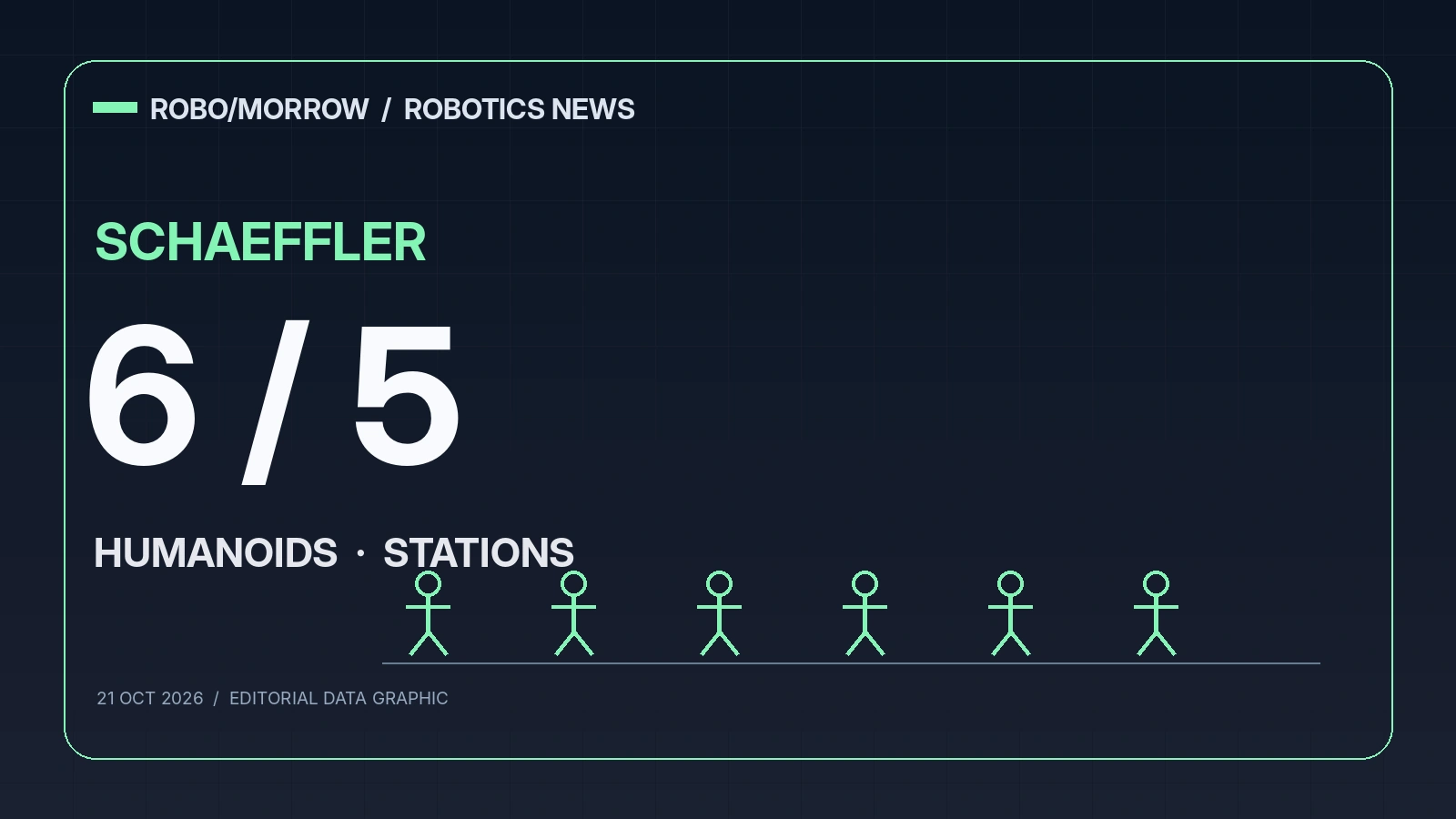
Humanoid robots assembling components needed by the next generation of humanoids. Schaeffler opened its Taicang lighthouse factory in China on 20 October, bringing component manufacturing, robot training and digital twins together. The week’s strongest industrial robotics story comes with specific figures: approximately 7,500 m², six humanoids across five workstations and roughly €400 million in global incoming orders for the humanoid robotics business.
OFFICIAL MANUFACTURER VIDEO
Schaeffler — inside the Taicang humanoid lighthouse factory
What was built in Taicang?
The new lighthouse factory combines an assembly line, an industrial robot training centre, data collection infrastructure and a digital twin platform. Skills can be rehearsed in a virtual representation, tested on the machines and evaluated in real manufacturing conditions. The aim is to connect research and production with the same operational data.
At the centre sits an assembly process for joint modules, including linear and rotary actuators. Schaeffler says six humanoids work across five stations handling operations such as staging, sorting, joining, inspecting, labelling and packaging parts. Those are bounded, measurable steps in a real production process, not a general claim that robots can run a factory unsupervised.
Why robots making robot parts matters
The industrial challenge is not simply moving an arm. A plant requires correct assemblies, consistent takt time, quality, operator safety and controlled cost. Deploying humanoids on a line that makes key parts for future humanoids is a more meaningful demonstration than a stage performance because it connects the robot to an accountable workflow.
But this is not self-replication. The robots perform selected tasks in a wider process that still depends on supplied materials, conventional machines, software systems and human oversight. Schaeffler has not provided a complete cost comparison with purpose-built assembly machinery or an audited share of autonomous work.
The digital twin has a specific job
Schaeffler says the virtual factory receives real-time line data including assembly accuracy, step duration, energy use and equipment condition. Changes can be evaluated in simulation before they are applied to the physical workstations. That is a practical route to reducing iteration costs in robotics development.
The performance questions remain familiar to any production engineer: takt time, yield, scrap, unplanned downtime, human interventions and maintenance effort. The press announcement does not supply a full independent KPI dashboard. A credible next milestone would be a publicly comparable cycle-time and quality report.
€400 million: order inflow, not revenue
After adding two customers from Greater China in Q3 2026, Schaeffler says its global incoming orders for humanoid robotics reached approximately €400 million. These are orders, not recognised sales and not a direct count of humanoid robots shipped. RoboMorrow previously covered the €350 million position earlier in 2026.
The distinction matters. The value covers parts and programmes with different delivery horizons. Converting it into a simple “robots sold” figure would create a false precision that the manufacturer itself does not provide.
What this means for European suppliers
Humanoid manufacturing creates markets not just for branded robots but also for precision actuators, drive systems, safety engineering, integration and industrial software. Schaeffler is positioning its motion-technology business as a supplier and practical development partner for that emerging ecosystem.
The relevant milestone is that humanoids now perform defined operations on a line making parts for other humanoids — not that factories have become fully autonomous. The next proof point is production economics and reliable sustained output.
Frequently asked questions
How many humanoids work on Schaeffler’s line?
The company says six humanoid robots work across five stations.
Does the factory build complete humanoids?
The announcement specifies components such as joint modules and actuators, not end-to-end autonomous robot manufacture.
Is the €400M already revenue?
No. Schaeffler describes approximately €400 million in global incoming orders for the humanoid robotics business.
Sources and verification
- Schaeffler — oficjalna informacja 20.10.2026
- Schaeffler — oficjalny film fabryki
- Gasgoo — relacja przemysłowa
This report is based on Schaeffler’s 20 October 2026 release. RoboMorrow did not independently audit the line or test the robots.
By RoboMorrow Editorial · sources checked 21 Oct 2026