Simbe passes 3,000 contracted robots as retail Physical AI scales
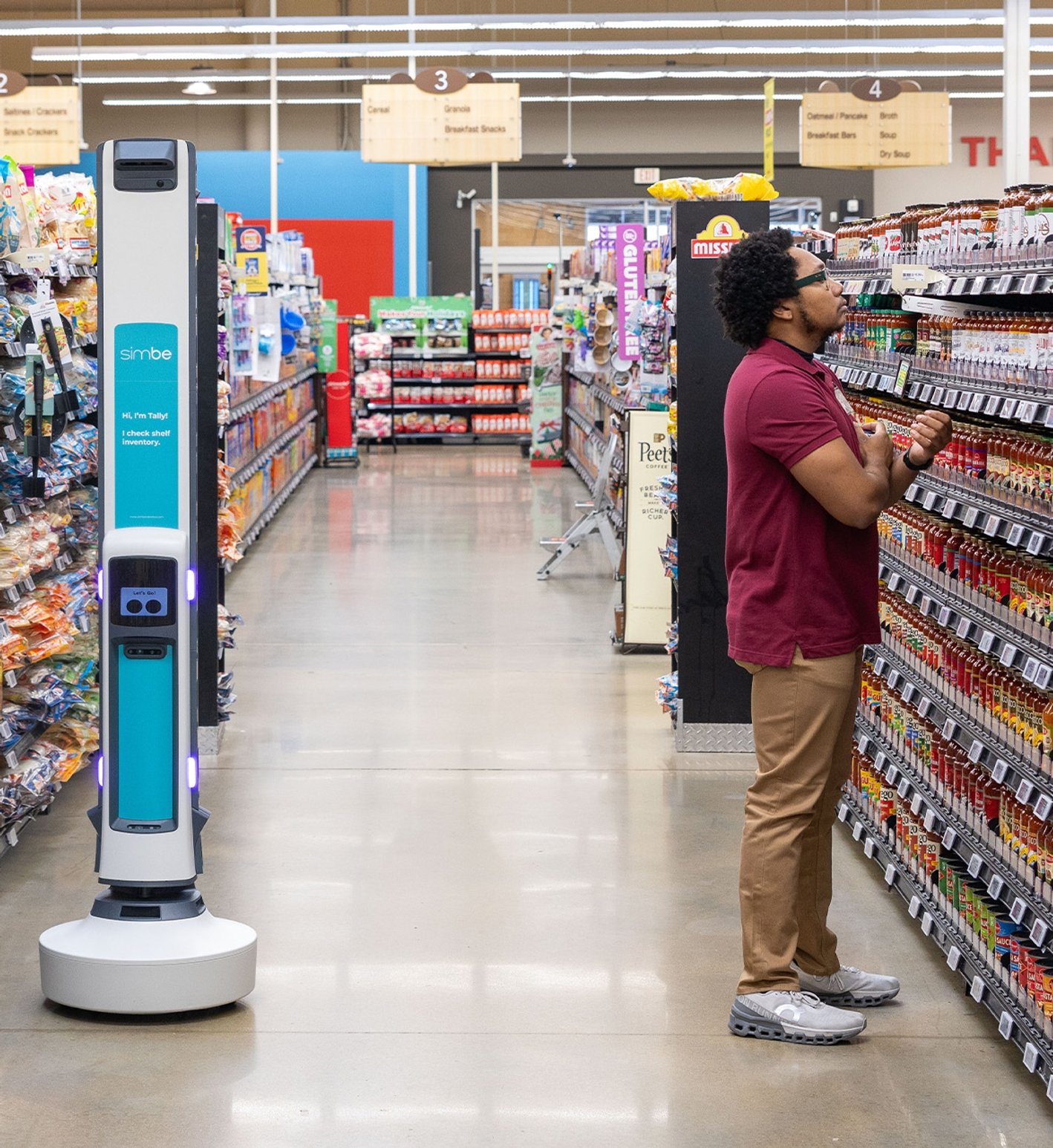
Simbe says it has more than 3,000 autonomous units under contract. That is not the same as 3,000 robots operating in stores today. The company did not disclose the active deployed count in the same announcement.
Simbe Robotics has passed 3,000 autonomous units under contract. In Physical AI, the more important point is what those units actually do. Tally is not a stage demo or a laboratory prototype. It has spent years moving around shoppers and store associates, scanning shelves and converting the physical state of a store into operational data.
Simbe describes the milestone as the largest commercially committed shelf-intelligence fleet identified in its own research. That qualification matters. RoboMorrow treats 3,000 as a manufacturer-reported contracted figure, not as an independently audited count of robots simultaneously operating in the field.
What Tally actually does
Tally autonomously travels store aisles and uses cameras and sensors to identify out-of-stocks, pricing errors and misplaced products. Simbe combines the robot with RFID, fixed sensing, a mobile app and analytics. The product therefore does not end at the robot: the business value appears when shelf data becomes prioritized tasks for store teams and feeds merchandising, e-commerce and replenishment workflows.
The company says its technology is used by more than 75 retail banners across nearly a dozen countries. Simbe also reports 5 million hours of fully autonomous operation, 45 billion shelf photos captured and analyzed, and 18 billion price tags scanned. These are company figures, but they illustrate a data scale that is difficult to reproduce with a short robotics pilot.
On its product page, Simbe states up to 12 hours of operation per charge and the ability to scan outside normal shopping hours. Tally moves at a low speed and carries multiple sensors for public environments. The more meaningful test, however, is not a single successful route. It is whether the system remains accurate and available for months, and whether store teams trust the tasks it generates enough to change daily operations.
Why 3,000 contracted units can matter more than another flashy humanoid demo
Robotics in 2026 is full of demonstrations that look impressive in a short clip but reveal little about maintenance cost, intervention rates or reliability in uncontrolled environments. A store is the opposite of a laboratory: people, carts, displays, lighting and aisle conditions change continuously. Keeping autonomy working across thousands of such locations is less cinematic than a humanoid stunt, but far easier to connect to measurable business outcomes.
The signal is comparable to the 200-robot Richtech DUST-E retail contract covered by RoboMorrow. In both cases, the key issue is the move from a pilot toward a repeatable fleet model. Simbe is further along the maturity curve because its system has accumulated years of operational data across many retail environments.
What we still do not know
- how many of the 3,000-plus contracted units are physically deployed and active today;
- how the fleet is split between different products and platform components;
- the average RaaS, deployment and integration cost for a retailer;
- fleet uptime, intervention frequency and service cost per store;
- what share of new contracts is coming from Europe.
Why it matters for Europe
Simbe already has European references and is actively expanding on the continent. For European operators, the interesting question is not the robot's appearance but the economics of continuously digitizing shelves. If an autonomous system can identify availability, pricing and merchandising problems more consistently than distributed manual checks, it becomes part of the store's data infrastructure rather than a novelty.
It is also a useful lesson for Physical AI more broadly. Valuable automation does not always need to manipulate objects. A robot that observes the physical world can create the ground-truth layer used by ordering systems, workforce tools and AI agents. In retail, that path may scale sooner than a general-purpose robot attempting to perform every human task.
RoboMorrow take
Simbe's milestone is evidence of commercialization around a narrow, measurable workflow. It does not prove that retail is autonomous, and it does not prove that 3,000 robots are already operating. It does show that Physical AI can reach thousands of contracted units when the task is defined, ROI can be measured and the system has years of real-world operating data.
How to measure whether a retail robot actually pays back
Retail ROI cannot be reduced to robot price and labor hours. A useful model should include on-shelf availability, pricing-error reduction, associate time reallocated to higher-value work, e-commerce fulfillment impact and the cost of handling exceptions. Data quality matters as well: one false alert is cheap, but thousands of false alerts across a large SKU base become real labor.
A strong pilot is not one impressive week. Retailers need comparable test and control stores, several months of data and a clear definition of what counts as human intervention. They should measure not only detected shelf gaps but the share of problems resolved before lost sales occur. That is the point where a robot becomes an operating tool rather than another reporting system.
Scalability is the second dimension. A five-store deployment can be supported manually by a vendor team. Hundreds of sites require remote diagnostics, update management, spare parts and consistent safety procedures. That is why the 3,000-unit contracted milestone is useful: it suggests Simbe has had to build at least part of the fleet infrastructure required beyond the pilot stage.