ALVEST Acquires EasyMile and Launches TLD Robotics
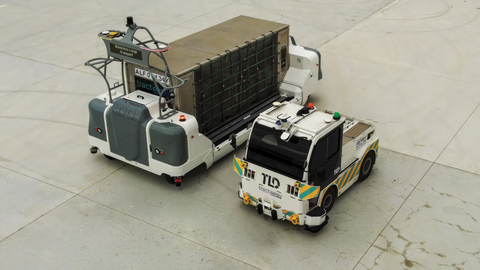
Verified 17 September 2026. ALVEST has acquired EasyMile and combined its technology with TractEasy and TLD's existing driverless activities under TLD Robotics. This is a consolidation of operating deployments rather than a company starting from a prototype.
35+ active operations and 50,000 missions
The official release says TLD Robotics supports more than 35 active operations in over 10 countries, including more than 15 airports and more than 20 industrial sites. The company reports more than 50,000 fully autonomous missions, with some sites operating 24/7.
Named customers include dnata, BMW Group Dingolfing, Daimler Truck, Bosch, John Deere, Munich and Narita airports, and Lufthansa Cargo. That matters because the systems are operating in live industrial environments rather than only at demonstrations.
Software, vehicle, fleet and service in one company
EasyMile contributes the autonomy stack and deployment experience, TractEasy contributes vehicles and logistics operations, while TLD adds airport-equipment manufacturing and a service network. The new company wants to own the full workflow: onboard software, fleet supervision, traffic integration, vehicles and ongoing support.
TLD operates 12 factories in seven countries. From a scaling perspective, that may matter more than the rebrand itself because industrial autonomy requires series hardware, spare parts, service and local support.
Autonomy in structured environments
Airports, factories and logistics yards are favourable environments for autonomy: routes are more predictable than city streets, tasks are repetitive, and labour and downtime costs are easier to calculate. That can make the economics mature faster than some open-city robotaxi programmes.
What remains a company claim?
The 35+ operations, 50,000+ missions and annual fleet-tripling figures come from TLD Robotics. There is no public audited vehicle count, revenue, margin or average ROI data in the announcement. The EasyMile acquisition price is also undisclosed.
What it means for Poland and the EU
Poland has large automotive, warehousing, logistics and aviation sectors, giving this type of system obvious use cases. The announcement does not name a new Polish customer. Deployment decisions should focus on uptime, integration with people and forklifts, local service, cybersecurity, emergency procedures and total fleet cost.
Why 12 factories may matter more than another algorithm
In industrial autonomy, perception is no longer the only bottleneck. Customers need vehicles, spare parts, local service, safety procedures, traffic integration and a path to expand a fleet without rebuilding the project. Bringing EasyMile into a group with 12 factories across seven countries could therefore change commercial scaling more than a single software update.
This is not the same problem as robotaxi
Airports and factories provide structural advantages: known pickup points, controlled traffic rules, defined zones and repetitive tasks. That does not make autonomy easy, but productivity can be measured more directly. The story is therefore a good companion to our guide to pallet-transport robots, integration and TCO.
A second comparison is the live public-road Lidl + Einride project in Germany. Both show European autonomy moving from presentation to defined material flows, even though their ODDs, regulation and liability models are different.
Five numbers that are still missing
- active vehicle count across the 35+ operations;
- missions per vehicle per day and intervention rate;
- average uptime and MTBF;
- full deployment cost including infrastructure and integration;
- customer payback period.
- ARC Advisory Group — independent industry confirmation
What would count as a material update?
Not another strategy interview, but a major new contract, entry into a new country, a disclosed vehicle count or operating data. A European case study showing costs before and after automation would be particularly valuable.
Affiliate status
TLD Robotics is a project-based B2B solution. There is no meaningful consumer affiliate path, so the article intentionally carries no affiliate CTA. In this segment, integration and TCO information are more useful than a “buy now” link.
The hardest part starts after the first deployment
An autonomous tractor can work well on one route, but scaling across an airport or factory changes the problem. Fleet intersections, priorities, charging, manually driven vehicles, emergency cases and customer-system integration all appear. That is why TLD Robotics emphasises fleet supervision and operations management. In a mature fleet, value shifts from “the vehicle can drive itself” to “the entire material flow remains stable for thousands of hours”.
How should 50,000 missions be interpreted?
The number is a strong experience signal, but meaningful supplier comparison needs a denominator. Fifty thousand missions could be many short trips or longer cycles with heavy loads. The useful metrics are distance and duration per mission, mission success rate, remote interventions and exception categories. Those would make reliability comparable across different operating environments.
Regulation may be simpler than robotaxi, but it does not disappear
Many TLD applications operate on controlled sites, reducing some road-homologation complexity. Requirements remain significant when a vehicle crosses public roads, works in airside environments or shares space with people. Operators still need a defined ODD, takeover procedures, liability rules and emergency scenarios. European deployment must be assessed country by country and site by site.
Featured image: real official EasyMile/TLD vehicle photo from the TLD Robotics launch material.
Related RoboMorrow coverage
- Pallet transport robots: cost, integration and ROI
- Lidl and Einride: driverless Level 4 freight in Germany