Unitree Dex5-S: 22 DOF, a claimed 620 g and pricing from RMB 39,900
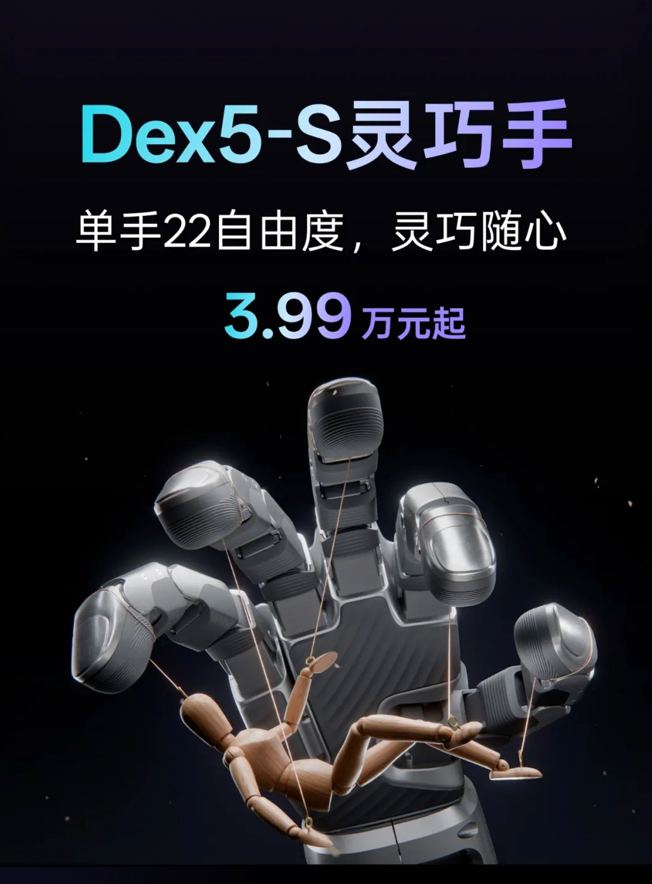
Unitree introduced the Dex5-S robotic hand on September 21, 2026. The company lists 22 degrees of freedom and 22 motors, a form factor close to a human hand, and a starting price of RMB 39,900. This is not a new humanoid robot; it is a manipulation component, and hands remain one of the hardest pieces of practical humanoid robotics. Unitree’s launch material shows fine finger motions, but a manufacturer demonstration is not an independent durability, force or task-success benchmark. Source: Unitree Robotics.
Twenty-two degrees of freedom matter only if they are controllable
Unitree and same-day launch coverage describe 22 active degrees of freedom, with all 22 joints smoothly backdrivable. In practical terms, backdrivability can allow a mechanism to yield under external force rather than behaving like a fully rigid linkage. That can be useful when contacting objects and people, but the specification alone does not show how well the controller uses compliance during real tasks.
IT Home reports a claimed weight of about 620 g per hand. Unitree’s previous Dex5-1 page lists 20 degrees of freedom, including 16 active axes, and a weight of around 1.1 kg. This compares manufacturer specifications for different designs, not RoboMorrow measurements. A motor count alone does not establish that the mechanism is gearless.
RMB 39,900 is a starting price, not an EU retail price
The Chinese starting price of RMB 39,900 is roughly €5,190 at the ECB reference rate dated September 21, 2026: EUR 1 = CNY 7.6930. This is a currency equivalent, not an EU store offer. Shipping, import charges, any additional taxes and system integration are not included. No verified European retail price has been established.
The announced price provides an initial budget reference for the component alone. We do not have a directly comparable quotation for the earlier generation in the same configuration, so we are not announcing a quantified price reduction. A complete workstation also includes integration, control, mounting, data preparation and support. Meaningful quotations should cover the same package contents.
Load ratings are not a complete grip-force measurement
Same-day reports cite up to 2 kg maximum load for one hand and roughly 1 kg continuous load. Those figures are not a complete gripping benchmark. Results depend on object geometry, the number of fingers in contact, friction, wrist orientation and load duration. RoboMorrow therefore will not rank Dex5-S against competing hands using one catalogue number.
For real work, repeatability, impact resistance, time required to learn a new object and service life are likely to matter more. Unitree highlights impact-torque and drivetrain protection at each joint. That is a sensible engineering focus because robot fingers routinely hit tables, bins or misaligned parts. Independent endurance data is still missing.
Why hands are a bottleneck for humanoids
Walking produces the most dramatic videos, but many business tasks end at the hand. A robot can reach a workstation and still fail to create value if it cannot reliably grasp a soft package, thin cable, tool or object whose pose is slightly different from training data. Every additional finger joint expands the action space while also adding hardware that must be controlled and protected from overload.
That is why Dex5-S is more interesting as part of the wider dexterity race than as a Unitree accessory. Humanoid vendors increasingly demonstrate handling bins, components and tools, and progress in hands may have a larger effect on useful work than another running record. See also our analysis of humanoid market scale.
What remains unknown after launch
There is no solid public dataset yet on gearbox life, precision after thousands of cycles, power consumption in representative tasks, control latency, or how the hand handles dirt and repeated impacts across a long shift. Official availability and service terms for Poland and the EU are also unclear. Unitree’s demonstrations show product capability claims, but they do not replace testing by an independent laboratory or customer.
The most useful next step would be an external manipulation benchmark: the same object set, the same number of attempts, success rate, completion time and a failure log. If Dex5-S starts appearing at integrators or named customer deployments, it will become possible to judge whether the 22-DOF design materially changes what a humanoid can do in practice.
Why Europe should care
For European laboratories and integrators, Dex5-S is a potential manipulation-research component. Regular consumer availability in the EU and local service support have not been confirmed. Integration requires control software, grasp models, suitable power and perception for the complete system. Published launch material alone does not establish readiness for that deployment.
A useful next disclosure would be a quotation identifying the exact configuration, delivery date and support terms for a European customer. Only then could purchasing and ownership costs be compared with other solutions. For now the launch describes the intended design direction, not the economics of a particular workstation.
Hand variants, software and the full integration bill
Launch material distinguishes standard and Pro variants, with tactile sensing specified for the Pro version. That matters more to a buyer than the family name: the starting price should not automatically be assigned to a configuration containing every sensor shown in the presentation. Before comparing quotations, establish the exact variant, left or right hand, package contents and included software. Without those details, two advertised prices may describe different products.
Compatibility also has boundaries. The Unitree G1 entry in our robot database does not mean that any new Unitree hand can be connected to it without modification. Mechanical mounting, power, communication, drivers and access to sensor data all need checking. The hand manufacturer and the integrator of the complete robot may be responsible for different parts of that chain. RoboMorrow is not claiming out-of-the-box compatibility between Dex5-S and a particular humanoid configuration without documentation.
A useful manipulation benchmark should separate acquiring an object, retaining it during motion and placing it at the required destination. Success at the first stage is not success at the whole task. Damage to delicate objects, dropped items and attempts in which an operator corrected the object’s pose should be recorded separately. The same issue of hidden human assistance appears in our coverage of Spirit AI and the limits of autonomy claims. Publishing those interventions makes comparisons more informative without requiring every experiment to succeed.
The cost of repeating an experiment after finger wear or a software change deserves similar attention. A hand can have an attractive purchase price while requiring expensive tuning and support. Documentation for component replacement, warranty scope, spare-parts access and interface versioning would help buyers evaluate that burden. These are not defects identified in Dex5-S; they are practical criteria for distinguishing an interesting research component from a solution prepared for months of operation. A manufacturer’s render and specification list alone cannot establish where the new product sits on that spectrum.
Sources and verification
This is launch coverage, not a review or hands-on test. Specifications are Unitree claims. Currency equivalents use ECB reference rates dated September 21, 2026.