Unitree G1+ launches with 25 DOF, new sensing and a $15,000 price
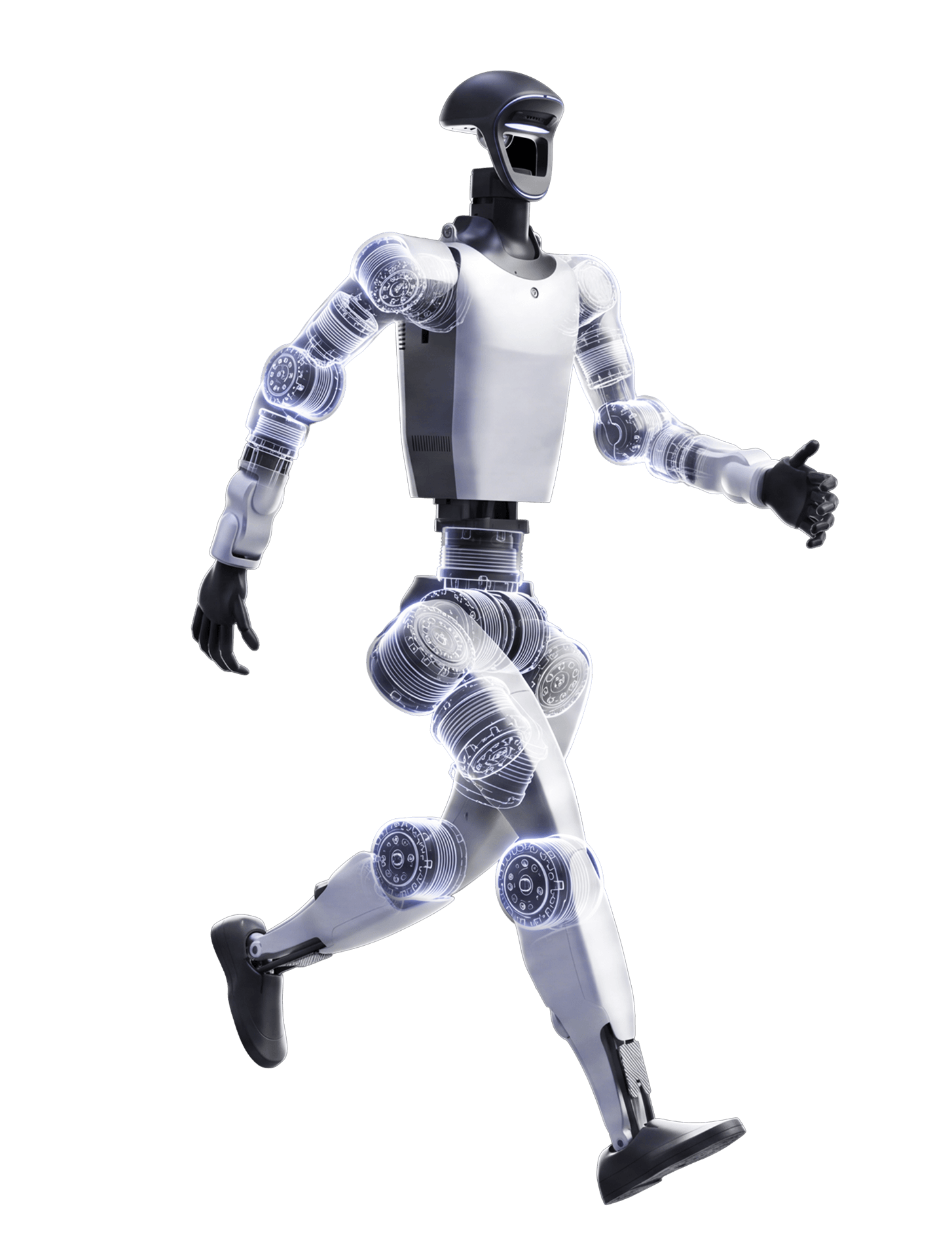
Unitree has officially launched G1+, an upgraded version of its widely used G1 humanoid. Instead of centering the update on another acrobatic demo, the company has changed areas that matter for sustained use: actuator thermal behavior, perception, interaction and external power. Unitree’s global page lists the standard G1+ at $15,000 before tax and shipping, while G1+ EDU remains a contact-sales product. Chinese outlets citing the company’s announcement also report a domestic price of RMB 95,000 including tax.
What actually changed from G1
- The standard model now has 25 degrees of freedom including a new 2-DOF neck; EDU can be configured from 25 to 45 DOF.
- Neck range is roughly -25° to 36° pitch and ±110° yaw.
- Unitree claims shoulder and waist peak motor torque is up 110%, with 72% less heat at the same torque.
- Arm peak torque is claimed to rise 43% with 30% less heat at the same torque; thigh motors are claimed to generate 28% less heat.
- Perception combines stereo vision, a wide-angle body camera and 3D LiDAR.
- The head gains touch sensing, while audio uses a six-microphone array with direction-of-arrival localization and two 10 W speakers.
- A rear connector enables continuous external power; the 9,000 mAh battery still carries a manufacturer-stated runtime of about two hours.
The least flashy upgrade may be the most important
The most interesting numbers are not running speed or jump height. In real humanoid work, a core problem is keeping actuators performing consistently for long periods, especially near their continuous-load limits. If Unitree’s thermal claims survive independent testing, G1+ could sustain manipulation and motion sequences with less thermal derating. A specification table cannot prove that. Useful evidence would include measured joint temperatures, throttling behavior, task cycle time, failure rate, intervention rate and performance after hours rather than minutes.
More sensing does not automatically mean more autonomy
Unitree has expanded the perception stack with stereo vision and a wide-angle camera while retaining 3D LiDAR. That gives developers a richer hardware base for depth, mapping and embodied-AI experiments. Hardware capability must still be separated from task autonomy. Unitree explicitly notes that some sample functions shown on the product page are still under development and testing. More sensors therefore do not prove that G1+ can autonomously complete an unfamiliar household or factory workflow.
$15,000 globally is not the deployment cost in Europe
The official international page lists $15,000 excluding tax and shipping. That is above the historical $13,500 entry point shown for the previous G1 in the RoboMorrow database, although the hardware configuration has changed enough to make a simple price comparison imperfect. The RMB 95,000 figure is a China-market tax-inclusive price and should not be converted directly into a European retail price. EU buyers also need to budget for freight, VAT or duties where applicable, integration, safety work, support, spare parts and conformity documentation.
G1+ EDU remains the deeper development route
The standard G1+ carries 25 DOF and an eight-core CPU but is not marked by Unitree for secondary development. G1+ EDU can reach 45 DOF, add seven-DOF dexterous hands and extra wrist motion, support higher-compute modules such as Orin and provide the manufacturer’s secondary-development path. That distinction matters for universities, startups and integrators: the lower base price does not automatically buy the interfaces and hardware configuration required for advanced Physical AI research.
Why continuous external power matters
The external power input looks like a small line item, but it is useful for labs, exhibitions, data collection and stationary training rigs. A robot can remain powered without constant battery swaps. It does not extend mobile battery runtime, which Unitree still states at around two hours. We also do not yet know how the machine behaves thermally during very long high-load sessions while externally powered.
What it means for Europe and Poland
G1 was already one of the more accessible humanoid platforms for research and development. G1+ moves that reference point again: roughly $15,000 buys a platform with more standard DOF, revised thermal management, richer sensing and a more complete interaction layer. That will add competitive pressure, but European buyers still need to verify conformity documents, importer responsibility, warranty handling and local service. A public manufacturer price is not the same as a deployment-ready machine for an EU workplace.
G1+ does not erase the existing G1 record
RoboMorrow treats G1+ as a distinct product revision, not a silent firmware update. The existing Unitree G1 record remains relevant to installed machines and historical comparisons. The new model does, however, change the current buying benchmark. Readers comparing Unitree’s lower-cost platforms should also revisit our G1 vs R1 comparison with the understanding that the G1 side describes the earlier generation.
What we still do not know
- the final delivered price and official sales channel for Poland and other EU markets;
- European stock availability and lead times;
- independent thermal, runtime, MTBF and intervention-rate results;
- G1+ EDU pricing and default configuration;
- whether existing G1 owners receive any official hardware upgrade path;
- which software capabilities shown by Unitree are available now versus planned for later release.
RoboMorrow editorial assessment
This is a more meaningful update than another acrobatics clip. Unitree has changed layers that actually constrain usefulness outside a short demo: actuator cooling, sensing, interaction and long-duration power. It is still not proof of autonomous productive work. The real test is whether independent deployments show longer stable operation, higher repeatability and fewer human interventions.
Sources and methodology
Unitree — official G1+ page · TechNode — launch and China pricing. Technical specifications are manufacturer-provided; the China price is reported from the company announcement. RoboMorrow verification: 15 September 2026.