Universal Robots Gen 7: Physical AI Does Not Have to Wait for Humanoids
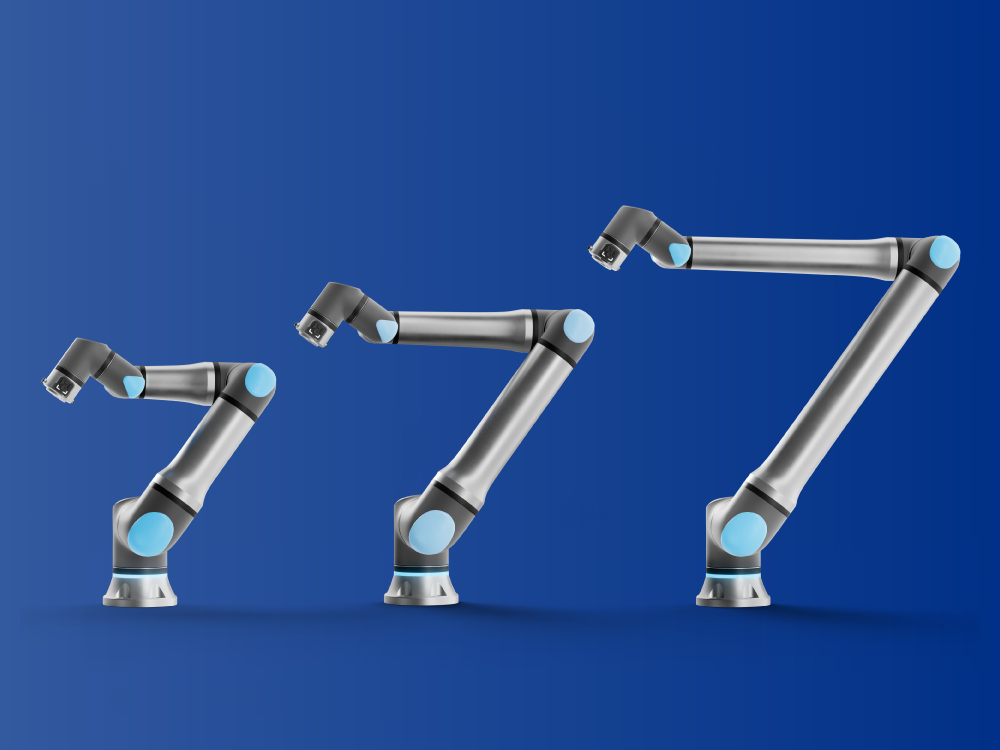
Physical AI does not have to start with a humanoid. Universal Robots Gen 7 takes a different route: give an industrial arm better connections to cameras, sensors and tools. For a factory, the important question is not whether the platform is described as AI-ready. It is whether the new architecture reduces the work needed to integrate a useful production cell.
Gen 7 changes more than the arm
The platform brings the arms together with a CB7 Core controller, TP7 Core pendant, new tool flange and PolyScope X software. UR identifies open APIs and ROS 2 as routes to external industrial computers and AI applications. Its claims of 40% more controller processing power and a 30% smaller footprint do not yet measure the performance of a complete production application.
Our assessment is that the important opportunity lies between devices. An integrator connects a gripper, camera, machine, safety system and exception-handling workflow. Each connection can add cost during commissioning and again when the process changes. A platform upgrade earns its value by simplifying that combined system, rather than merely making a trade-show demonstration easier.
UR10g-1750, UR17g-1300 and UR18g-950: the specifications
| Model | Nominal payload | Extended payload | Reach | Max. TCP speed |
|---|---|---|---|---|
| UR10g-1750 | 8 kg | 10 kg | 1750 mm | 5 m/s |
| UR17g-1300 | 15 kg | 17.5 kg | 1300 mm | 5 m/s |
| UR18g-950 | 18 kg | Not separately listed | 950 mm | 4 m/s |
The UR10g-1750, UR17g-1300 and UR18g-950 product pages expose an important distinction: the number in the model name is not always the nominal payload. Tool mass, centre of gravity and the conditions attached to extended payload all need to enter the engineering calculation.
Start the reach-versus-payload decision with the geometry of the cell. A longer arm does not necessarily finish a cycle sooner. Maximum tool-centre-point speed also says little about grasp verification, machine waiting time or part inspection. Ask for a simulation using the actual tool, followed by a process trial.
What changes at the wrist?
The g-Series specifications list 1 Gb Ethernet, 24/48 V power and 3 A continuous or 5 A peak current at the flange, alongside force-torque sensing. For the system designer, this creates a clearer route to a wrist-mounted camera or a more demanding end effector without starting from a separate external cable arrangement.
It does not make every sensor plug-and-play. Protocols, calibration, latency, power budgets and responsibility for software updates still have to align. In a contact process, the response to unexpected resistance matters as much as the ability to detect it. The application needs a defined recovery state, not unlimited retries.
AI-ready is not the same as ready to work alone
Separate perception, action selection and safe execution. A model that recognises a component does not replace trajectory validation. An open interface makes integration possible; it does not prove that a particular model is fast or reliable enough for the job.
Likewise, additional CB7 compute should not be translated into a promise that a large vision-language-action model will run locally without an external computer. A good quotation should identify what runs on the controller, what runs on an industrial PC, what needs connectivity and what remains functional when that connection disappears. Software licensing and maintenance responsibilities belong in the same discussion.
Should a small manufacturer delay its cobot purchase?
We would not postpone an otherwise well-justified project solely because a new platform has launched. A mature configuration may remain the better choice for straightforward transfer of a consistent part. If the project instead requires wrist-mounted vision, variable components and frequent changeovers, Gen 7 deserves a place on the shortlist.
Compare quotations for the same finished task. Include the arm, gripper, vision system, base, safeguards, machine connection, training, acceptance testing and service. Only then calculate payback. Robot operating hours are not automatically equivalent to labour hours removed from the process.
Our guide to cobots for small businesses takes the same application-first approach. A newer interface can improve a project, but it does not automatically make an existing, validated cell obsolete. Reusing knowledge, spares and operator training can have substantial value in a small plant.
European pricing, deliveries and the missing comparison
The checked product pages direct buyers to request pricing. The materials used here do not provide a public euro or Polish price list, or a binding first-delivery date for Poland. Nor do they provide an independent comparison of integration cost for the same application on the old and new platforms.
RoboMorrow’s assessment: Gen 7 is worth watching as infrastructure for easier Physical AI integration. A purchasing decision should still depend on a demonstration using the buyer’s own parts and a comparable quotation for the complete cell. The interface is promising; the working process remains the correct unit of evaluation.
Sources and method
Based on manufacturer documentation and the reporting identified below. Editorial verification: 14 September 2026. News and analysis; not a RoboMorrow hands-on test.
Five questions to ask before a Gen 7 pilot
If Gen 7 makes the shortlist, require the integrator to answer five practical questions: where vision and AI inference actually run, how much power and bandwidth are available at the tool flange, what happens if the camera or network is lost, what the safe fallback state is, and who owns software updates across the complete stack. That quickly separates “AI-ready” as an integration architecture from a promise of autonomy that the robot arm alone cannot deliver.
The second test should be even simpler: use the same part, gripper and task on the competing configurations. Measure total cycle time, successful-pick rate, interventions, recovery time after a fault and the work required for changeover. If Gen 7 genuinely reduces integration friction, the difference should appear in those operational metrics rather than only in controller specifications.