Best cobots for small businesses 2026: UR, ABB, FANUC, Techman or DOBOT?
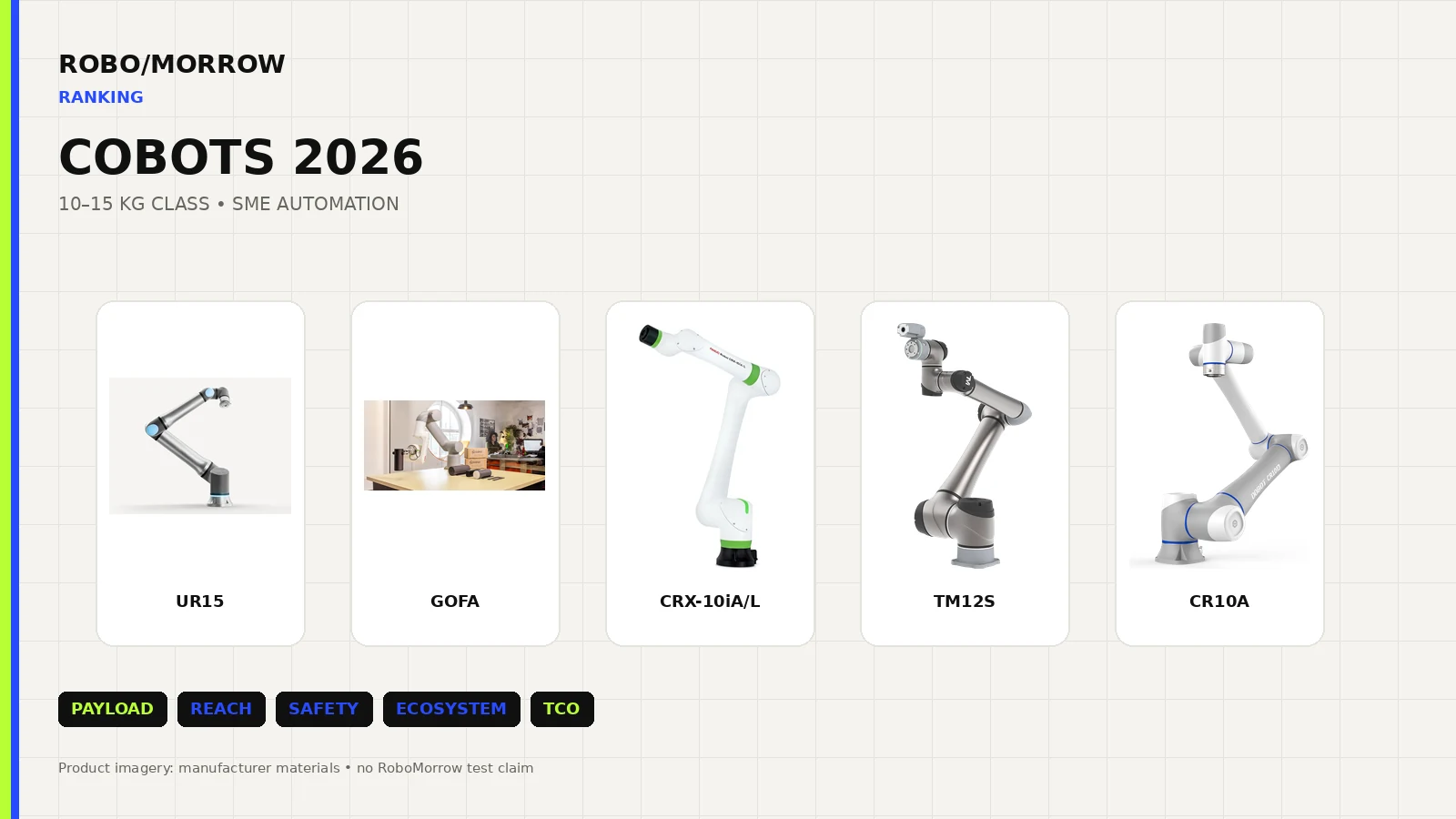
Short answer: there is no single “best cobot” for a small or midsize manufacturer. Around the 10–15 kg class, the differences that matter increasingly sit outside the arm itself: programming environment, gripper and vision ecosystem, local integrator, service response, risk assessment and the ease of reusing the cell for a new product.
That is why RoboMorrow’s 2026 ranking is not a “highest payload wins” table. Universal Robots UR15, ABB GoFa 12, FANUC CRX-10iA/L, Techman TM12S and DOBOT CR10A represent five different ways to reach the same goal: flexible automation of repetitive work without building a large, rigid production line. All are real industrial products, but they will not be equally suitable for a business automating CNC tending, palletising, welding, inspection or simple pick-and-place for the first time.
Best cobots for small businesses in 2026 — quick comparison
| Model | Payload | Reach | Strongest angle | What to verify |
|---|---|---|---|---|
| Universal Robots UR15 | 15 kg; up to 17.5 kg under specified conditions | 1300 mm | very high speed, broad UR+ ecosystem | whether the application can use the 5 m/s capability and extra payload without additional guarding |
| ABB GoFa 12 | 12 kg class; current ABB page states up to 14 kg in wrist-down configuration | 1270 mm wrist / about 1370 mm flange | precision, RobotStudio, OmniCore, IP67 | exact variant and whether Ultra Accuracy is included |
| FANUC CRX-10iA/L | 10 kg | 1418 mm | long reach, simple teaching, mature FANUC service ecosystem | tooling, integration and real cycle time for your process |
| Techman TM12S | 12 kg | 1300 mm | integrated vision + AI, ±0.03 mm repeatability | whether integrated vision truly simplifies your project or an external vision stack is still needed |
| DOBOT CR10A | 10 kg | 1300 mm working radius | accessible architecture, interfaces and process packages | local service, integrator experience and final-cell compliance |
Specifications are manufacturer data, not one common benchmark. Application performance depends on payload centre of gravity, tooling, trajectory, safety limits and the process itself.
1. Universal Robots UR15 — for speed and a scalable ecosystem
UR15 is the newest machine in this group and shows where cobots are heading: less of a trade-off between collaborative capability and industrial performance. Universal Robots lists 15 kg standard payload, an extended 17.5 kg capacity under specified conditions, 1300 mm reach and up to 5 m/s TCP speed. The 5 m/s number does not mean the arm can safely run at that speed next to a person. A risk assessment may impose much lower collaborative speeds. The higher dynamic capability matters when the cell is appropriately protected or when people are outside the high-speed operating zone.
For an SME, UR15’s biggest advantage may be the surrounding platform. UR+ covers grippers, vision, palletising, welding and machine-tending components, while PolyScope is one of the best-known cobot interfaces. A manufacturer without a large internal automation team may gain more from a deep partner ecosystem than from a small difference in repeatability.
UR15 weighs 40.7 kg, has a Ø204 mm footprint, IP65 rating and ±0.05 mm stated repeatability. It is a strong fit for compact palletising, machine tending, packaging and fast material transfer. Best for: a business that wants one cell today but may replicate the concept later. Watch: do not buy extra payload simply “for the future” if the tool, workpiece and centre of gravity already fit comfortably inside a lighter class.
View the Universal Robots UR15 database card →
2. ABB GoFa 12 — when precision and ABB integration matter more than headline speed
GoFa takes a different approach. ABB’s current page groups 5, 10 and 12 kg variants and lists up to 2.2 m/s TCP speed and 0.02 mm repeatability for the family. For GoFa 12, ABB gives 1.27 m wrist reach and roughly 1.37 m to the flange; the current product page also states up to 14 kg in a defined wrist-down configuration. This is exactly why buyers should read configuration notes rather than compare only model names.
The most interesting option is Ultra Accuracy. ABB states path accuracy down to 0.03 mm and absolute positioning accuracy of 0.1 mm. That may be irrelevant to simple box handling but important in gluing, sealing, laser welding, cutting and processes where the trajectory itself matters. RobotStudio offline programming and OmniCore control add another layer for factories already using ABB equipment.
Best for: ABB environments and applications where path accuracy and simulation matter. Watch: compare the exact GoFa variant and option set in the quotation.
View the ABB GoFa 12 database card →
3. FANUC CRX-10iA/L — long reach and industrial service maturity
FANUC CRX-10iA/L combines 10 kg payload with 1418 mm reach, giving it a larger working envelope than several 10–12 kg competitors. FANUC emphasises manual guided teaching, a drag-and-drop tablet interface and underflip motion for tighter cells. Repeatability is stated at ±0.05 mm, mechanical weight is 39 kg and the arm is IP67.
For smaller manufacturers, FANUC’s stated eight years of zero scheduled mechanical maintenance for CRX is notable. We would not interpret that as “eight years with no costs”: grippers, dress packs, welding equipment, cameras and other cell components have their own maintenance. It still highlights FANUC’s focus on industrial reliability and service.
Best for: CNC tending, welding, pick-and-place and applications where extra reach helps. Watch: price the full peripheral and integration package in your country.
View the FANUC CRX-10iA/L database card →
4. Techman TM12S — when vision is part of the platform
TM12S combines 12 kg payload, 1300 mm reach and a 33 kg arm. Techman lists ±0.03 mm repeatability, IP65 and integrated vision with AI functions. The company describes object detection, semantic segmentation and anomaly detection, while TMflow2 lets users build tasks in a node-based graphical environment.
This does not make every vision project automatic. Lighting, part variation, tolerances, inference time and validation still require engineering. But for inspection, vision-guided pick-and-place or high-mix production, having vision inside one environment can reduce integration layers.
Best for: electronics, inspection, vision-guided handling and machine tending. Watch: confirm which AI and vision functions are included in the configuration you are buying and what additional compute or licenses are required.
View the Techman TM12S database card →
5. DOBOT CR10A — a pragmatic entry for repeatable applications
CR10A belongs to DOBOT’s newer CRA generation. The manufacturer lists 10 kg payload, 1300 mm working radius, 40 kg weight, 2 m/s maximum linear speed and ±0.03 mm repeatability. The CRA platform uses DobotStudio Pro, EtherCAT at the drive layer and multiple standard interfaces; DOBOT also describes virtual fences, PLd Cat.3 safety architecture and optional process packages for welding, palletising and CNC.
DOBOT can be attractive when entry cost matters, but local integration is especially important. A cheaper arm does not create a cheaper cell if gripper, safety, programming, commissioning and support are fragmented across several vendors.
Best for: straightforward pick-and-place, CNC tending, packaging and sites with an experienced local DOBOT integrator. Watch: confirm exact CRA version, warranty and local support.
View the DOBOT CR10A database card →
Do not start with a brand. Start with the task
The most common first-cobot mistake is choosing the arm before defining the process. Record workpiece mass, gripper and cable mass, furthest point, tool orientation, required cycle time, accuracy, product change frequency and part presentation. A “10 kg cobot” may stop being a 10 kg solution when the gripper weighs 3 kg, cables add torque and the centre of gravity sits far from the flange.
Collaborative does not automatically mean fence-free
All five manufacturers describe force/contact sensing, safety functions or operation near people. The final application still requires risk assessment. A sharp workpiece, hot torch, cutting tool, heavy gripper or high speed may require scanners, curtains, reduced-speed zones or physical guarding. Collaborative capability is not an exemption from designing a safe machine.
What do you buy beyond the arm?
- gripper or process tool;
- pedestal, table or mobile base;
- vision and lighting when required;
- sensors, PLC and machine communication;
- safety components;
- programming, validation and documentation;
- operator training;
- spares and service SLA.
That is why “cobot price” and “automation price” are two different numbers. We break this down in Cobot for a small business: cost, safety and ROI →.
How RoboMorrow would shortlist four common applications
CNC tending and fast changeovers
UR15 or FANUC CRX-10iA/L are natural candidates, while TM12S may simplify architecture when vision-guided part recognition is central. Verify door control, blow-off, part presentation and changeover frequency.
High-mix welding
ABB GoFa and UR have strong application ecosystems; FANUC also offers a mature stack. Ask for a demo on your actual part, welding source and changeover pattern rather than a generic showroom weld.
Palletising
Payload matters, but pallet height, vertical travel and gripper mass matter just as much. UR15 provides payload headroom, but taller stacks can require a linear axis or dedicated palletising structure. Sometimes reach beats payload.
Inspection and sorting
TM12S is a strong starting point when integrated vision matters; ABB Ultra Accuracy may help for metrology-like paths. In this scenario camera, optics and algorithm can matter more than maximum payload.
FAQ
How much does a cobot cost?
Most manufacturers in this class quote projects rather than publish one universal price. For investment decisions request the complete commissioned cell price including gripper, safety, programming and service.
Can a cobot run unattended?
Yes, if the application is designed for it. “Collaborative” describes the platform’s ability to share space safely under defined conditions, not a requirement for a worker to stand next to it.
Is a cobot always safer than a traditional industrial robot?
Not automatically. Safety depends on the application, tool, speed, workpiece and cell. A power-and-force-limited arm can still need guarding.
What matters more: payload or reach?
Calculate both together with tool mass and centre of gravity. Reach may dominate a two-machine tending cell; payload headroom may decide whether a box-palletising application is feasible.
Which cobot is easiest for a beginner?
UR, FANUC, ABB, Techman and DOBOT all offer graphical environments and hand guidance. In practice, ease of use also depends on local integrator quality, training and ready-made components for your task.
RoboMorrow verdict
If you want a fast, scalable ecosystem and payload headroom, UR15 is a strong benchmark. If precision paths and an ABB environment are priorities, GoFa belongs on the pilot list. FANUC CRX-10iA/L brings reach and service maturity. TM12S is especially interesting when vision is central. DOBOT CR10A can be an economical route when backed by a strong local partner. In every case, buy the process solution—not just the arm.