Cobot for a small business in 2026: cost, safety, ROI and deployment
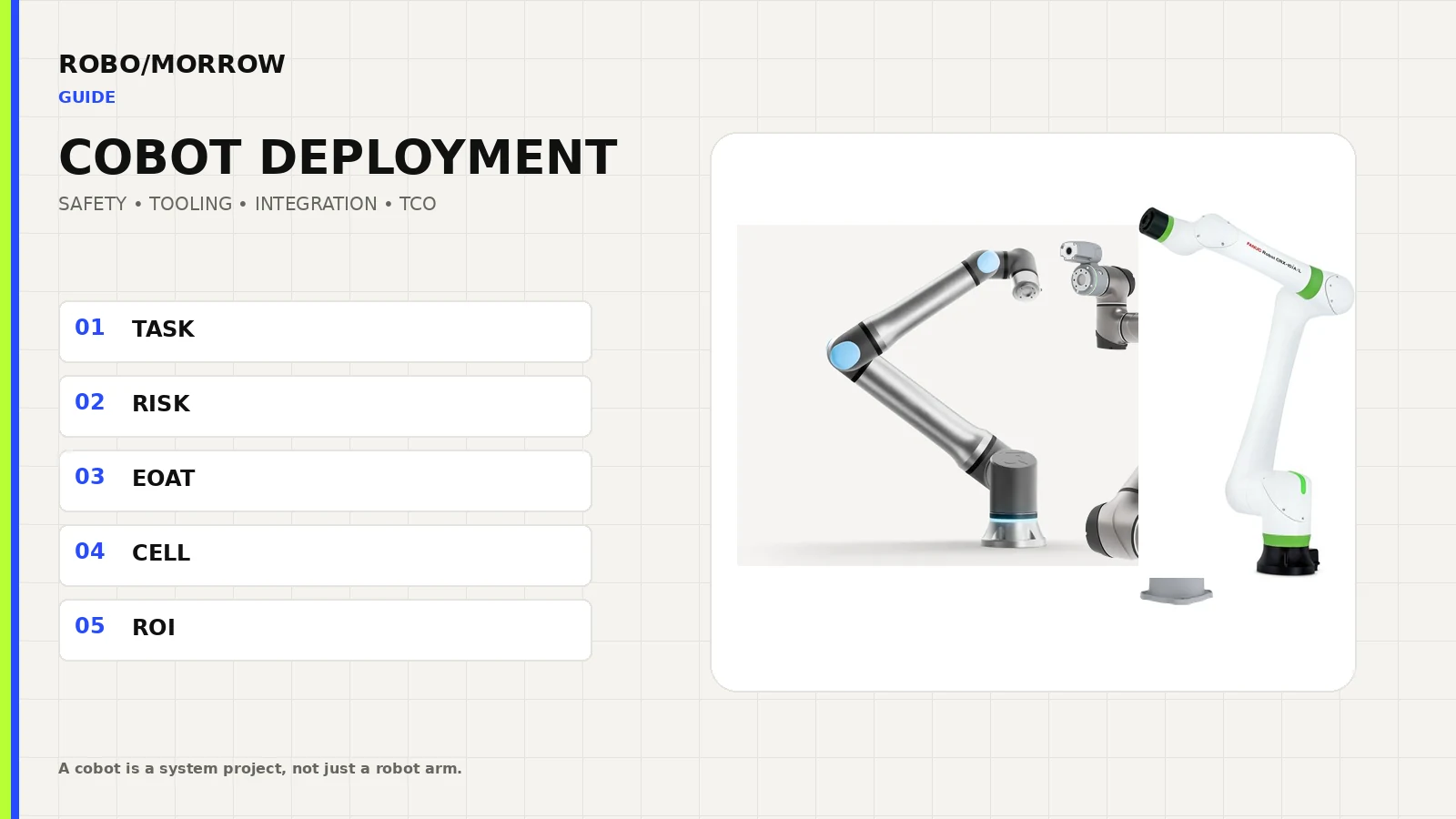
Short answer: a first cobot project in a small business should be a process project, not an arm purchase. The robot price alone tells you little. Total cost includes gripper or process tool, pedestal, safety, machine communication, programming, documentation, training, commissioning and service. The best first project is usually not the most impressive demo; it is a stable, measurable task with a simple way to recover from errors.
Cobots have genuinely lowered the barrier to automation. Hand guiding, graphical programming and packaged application kits let smaller manufacturers automate processes that never justified a rigid traditional line. But “easy to deploy” does not mean “robot from a box”. The arm is one component of the final machine.
1. Start with one task, not “we want a robot”
The best first projects share three properties: the task repeats, inputs and outputs are measurable, and variability can be controlled. Good candidates include CNC loading, placing parts into a tray, palletising a defined box range, repeatable high-mix welding or camera inspection. A poor first scope is “the robot should move around the factory and do whatever we need today”.
Before speaking to an integrator, record several full manual cycles and note workpiece mass, dimensions, manual cycle time, units per shift, product variants, operator actions, downtime, common errors and quality issues. This lets you test the business case before choosing a brand.
2. Payload: calculate workpiece + gripper + adapter + cables
An 8 kg workpiece does not automatically fit a 10 kg cobot. A gripper can weigh 2–3 kg, adapters add mass and the workpiece centre of gravity may sit far from the flange. Manufacturers publish centre-of-gravity and configuration limits; some robots reduce dynamic performance at higher loads.
Build a minimum and maximum workpiece case and size the robot for the worst valid case. Payload margin should come from calculations, not intuition.
3. Reach: draw the complete path, not just the furthest point
Quoted reach does not equal useful workspace in every orientation. A cobot can reach a point but fail to hold the tool at the required angle. For CNC tending, check the path through the door, drop-off point, tray and any part rotation. For palletising, check height and far pallet corners. For welding, verify joint configurations along the seam.
4. A cobot does not automatically mean fence-free operation
This is one of the most important lessons in a first deployment. The arm may have certified force and speed limiting, but safety applies to the whole application. A sharp part, heavy gripper, hot torch, rotating spindle or fast-moving workpiece may require physical separation. Other projects can use reduced-speed zones, safety scanners or curtains.
Do not ask only “is the cobot safe?” Ask the integrator which protective method is proposed for your task and what assumptions are built into the risk assessment.
5. The gripper often decides whether the project works
The arm can perform perfectly while the cell fails because of end-of-arm tooling. Vacuum is excellent on flat sealed surfaces but weak on porous cartons or dirty parts. Electric grippers are flexible but can be heavier and slower. Pneumatics are fast but require compressed air and valves. Magnetic gripping simplifies steel handling but raises safety and residual-magnetism questions.
Evaluate not only “can it grip?” but grip time, part-presence sensing, power-loss behaviour and recovery after a failed pick.
6. Vision: do not buy a camera if mechanics can locate the part
Vision adds flexibility and complexity. If a simple fixture or feeder places each component repeatably, mechanical organisation may be cheaper and more robust than AI vision. A camera earns its keep when part pose truly varies, variants must be identified, quality inspected or the robot must follow part features.
Techman integrates vision into the platform; ABB, FANUC, UR and DOBOT all support broad camera ecosystems. Let the process—not the showroom demo—decide.
7. Machine communication matters more than arm motion
In machine tending, the cobot must know whether the machine is ready, whether the door is open, whether the chuck released the part, whether the cycle finished and what should happen after an alarm. The best applications define error states and a safe restart procedure that an operator can perform without calling the integrator.
Before purchase define communication protocol, I/O, PLC roles, required signals and responsibility for modifying the machine.
8. What does the first cobot really cost?
RoboMorrow does not publish one “average price” because 2026 configurations, discounts, integrators and scope vary too much. Instead, ask every supplier to split the quote into eight blocks:
| Block | What should be included |
|---|---|
| Arm + controller | exact model, software, teach pendant, warranty |
| EOAT | gripper/tool, adapter, cables, sensors |
| Mechanical | table, pedestal, frame, guarding, feeder |
| Safety | risk assessment, scanners, curtains, E-stop, safety PLC if needed |
| Integration | robot program, PLC, machine communication, HMI |
| Commissioning | FAT/SAT, testing, documentation, process parameters |
| Training | operator, maintenance, administrator |
| Service | SLA, travel, spares, remote support, replacement policy |
This lets you compare complete solutions rather than arms. A more expensive cobot can create a cheaper cell when an integrator has a mature application package and needs fewer engineering hours.
9. ROI: do not count a full salary if the robot does not replace a full role
A common spreadsheet error is assigning the entire operator salary to the cobot when it automates 40% of that person’s work. Calculate hours genuinely released, extra production margin, scrap reduction and unattended-shift value. Add annual service, tooling, energy, spare-part and planned downtime costs.
A simple model is: annual benefit = released labour hours + extra contribution margin + quality savings − annual system costs. Calculate payback from the complete deployment investment.
10. Choose the integrator as carefully as the robot
For a first project, the integrator can be more important than the brand. Ask for three similar deployments, FAT/SAT process, safety documentation, scope-change rules, service rates and response time. Clarify who owns the code and whether your team can change recipes and points independently.
A strong partner should also be willing to say “this process should not be robotised”. An integrator that tries to force a cobot into every task increases the risk of an expensive pilot with little value.
11. How to run a pilot
- choose one stable product or product family;
- define cycle-time and quality targets before the trial;
- count every human intervention;
- test the worst valid workpiece, not only the easiest;
- simulate missing parts, misplacement, open doors and machine alarms;
- verify restart by an ordinary operator;
- measure changeover to a second product;
- do not stop at a polished demo—run a production-length series.
12. Which cobot class should you choose?
3–7 kg: electronics, light packaging, laboratory, small components. 10–15 kg: a versatile class for CNC, welding, packaging, larger grippers and lighter palletising. 20 kg and above: heavier palletising, larger parts and applications where a traditional industrial robot increasingly becomes an alternative. As mass and speed increase, foundation, safety and the question “do we actually need collaborative operation?” become more important.
13. Five models for an initial shortlist
In the 10–15 kg class, our current shortlist includes UR15, ABB GoFa 12, FANUC CRX-10iA/L, Techman TM12S and DOBOT CR10A. See use-case differences in our best cobots for small businesses 2026 →.
FAQ
Does a small manufacturer need a robot programmer?
Not necessarily for daily operation. Initial commissioning and safety should be handled by competent professionals, while recipes, points and simple changes can later be managed by trained operators.
Can a cobot move between machines?
Yes, but a “mobile cobot” needs repeatable positioning, a safe base, quick connectors and recipes for every cell. Design portability from the start.
Can a cobot weld?
Yes, but welding requires assessment of fumes, radiation, hot parts and personnel protection. A cobot welding package may be easier to program than a traditional cell, but it remains a welding machine.
Can a cobot run a night shift unattended?
It can when the process is stable and includes automatic feeding, buffering, error handling and safe recovery. Peripherals—not the arm—usually decide whether true unattended operation works.
RoboMorrow verdict
The best first cobot project is boring: a stable part, simple flow, measurable cycle and easy error recovery. That is a strength. Success on the first cell builds internal capability for the second and third. Start with the task, calculate complete TCO and select the arm last. If an integrator starts the presentation with a cobot brand rather than your process, ask more questions.
13. Palletising, CNC tending and welding have different economics
There is no single ROI model for “a cobot”. In palletising, the key variables are usually a repeatable box flow, pallet height, gripper mass and the ability to run for long periods without intervention. In machine tending, the machine tool may be the bottleneck: door time, fixturing, chip removal and ready signals. Welding adds part preparation, positioning, source parameters, fume extraction and process safety.
Compare projects at complete-application level. A cobot that excels at fast handling is not automatically the best platform for accurate path work. Likewise, a highly accurate arm will not fix a welding process where the workpiece arrives in a different position every cycle. Good automation removes the dominant source of variation instead of hiding it behind more expensive technology.
14. Changeovers and recipes are critical in high-mix production
Flexibility is supposed to be a cobot advantage, so changeover time deserves the same attention as cycle time. Define which parameters an operator can change through a recipe: CNC program, drop positions, gripper width, pallet pattern, product variant or vision program. The more changes that require an integrator to edit code, the less flexible the finished cell becomes.
During FAT, ask an operator who did not write the program to switch to a second product. Measure the time from the last good part of variant A to the first good part of variant B. If changeover needs tools, manual cable changes and many points to be retaught, put that time into the business case. In high-mix production, changeover can determine ROI.
15. FAT, SAT and documentation: what should be delivered with the cell
Factory Acceptance Testing should define the required cycle time, number of consecutive successful cycles, allowed interventions, product quality and fault scenarios before final handover. Site Acceptance Testing then confirms that the same outcome is achieved with the real machine, utilities and production environment.
Documentation should include electrical and pneumatic drawings, current program backups, parameter lists, restart instructions, consumable and spare-parts lists, risk assessment, documentation required for the finished machine and a register of service accounts. If the integrator is the only party holding the administrator password or current backup, the customer has accepted unnecessary operational risk.
16. Service and SLA: calculate the cost of one day of downtime
Look beyond warranty length. Where is the nearest technician? Does the integrator hold common spares? Can faults be diagnosed remotely? What response time is promised and what travel time is realistic? Is a replacement arm available for a longer repair?
In a smaller plant, one stopped automated operation can block the entire flow. When comparing two proposals, estimate the cost of eight or 24 hours of downtime. The difference in purchase price may be smaller than the cost of one serious failure without support.
17. Cybersecurity, remote access and data ownership
A modern cell may communicate with a PLC, MES, vision system, manufacturer cloud or an integrator laptop. Define which connections are required, who administers them and whether production can continue without internet access. Remote service is valuable, but it should be controlled through dedicated accounts, access logging, an approved VPN or equivalent method, and the ability to disable the connection.
Also ask where logs, camera images and process data are stored. In a quality-inspection application, images may reveal customer product information. A small cobot cell is still an industrial IT asset.
18. Illustrative ROI model — not a market price claim
For illustration only, assume a complete cell costs about €55,000 and releases an average of four operator hours per day for 230 working days. If the company uses a fully loaded internal labour cost of about €15 per hour, the labour value is about €15,000 per year. If extra machine availability creates about €8,750 in annual contribution margin and fewer rejects save about €3,000, gross annual benefit is about €26,750.
If service, consumables and incremental maintenance cost about €4,000 per year in this example, net annual benefit is about €22,750 and the simple payback is roughly 2.4 years. These figures are deliberately illustrative; they are neither a cobot price forecast nor a performance promise. The point is that ROI comes from cell utilisation and process value, not the arm list price.
19. Pre-order checklist
- current cycle time and interventions are measured;
- maximum workpiece plus EOAT mass is known;
- reach has been checked in all required orientations;
- safety method covers the complete process;
- quotation includes FAT, SAT, documentation and training;
- operators can recover from common faults;
- changeover to a second product has been measured;
- SLA, program backup and spare-parts plan are defined;
- remote access meets IT requirements;
- ROI uses the full cell cost and realistic utilisation.