Waiter robots in 2026: cost, capabilities and when they pay
BUYING IN YOUR MARKET
Availability in your country
Sales, delivery and support can differ by country and exact model. Choose your market to see the evidence we have checked.
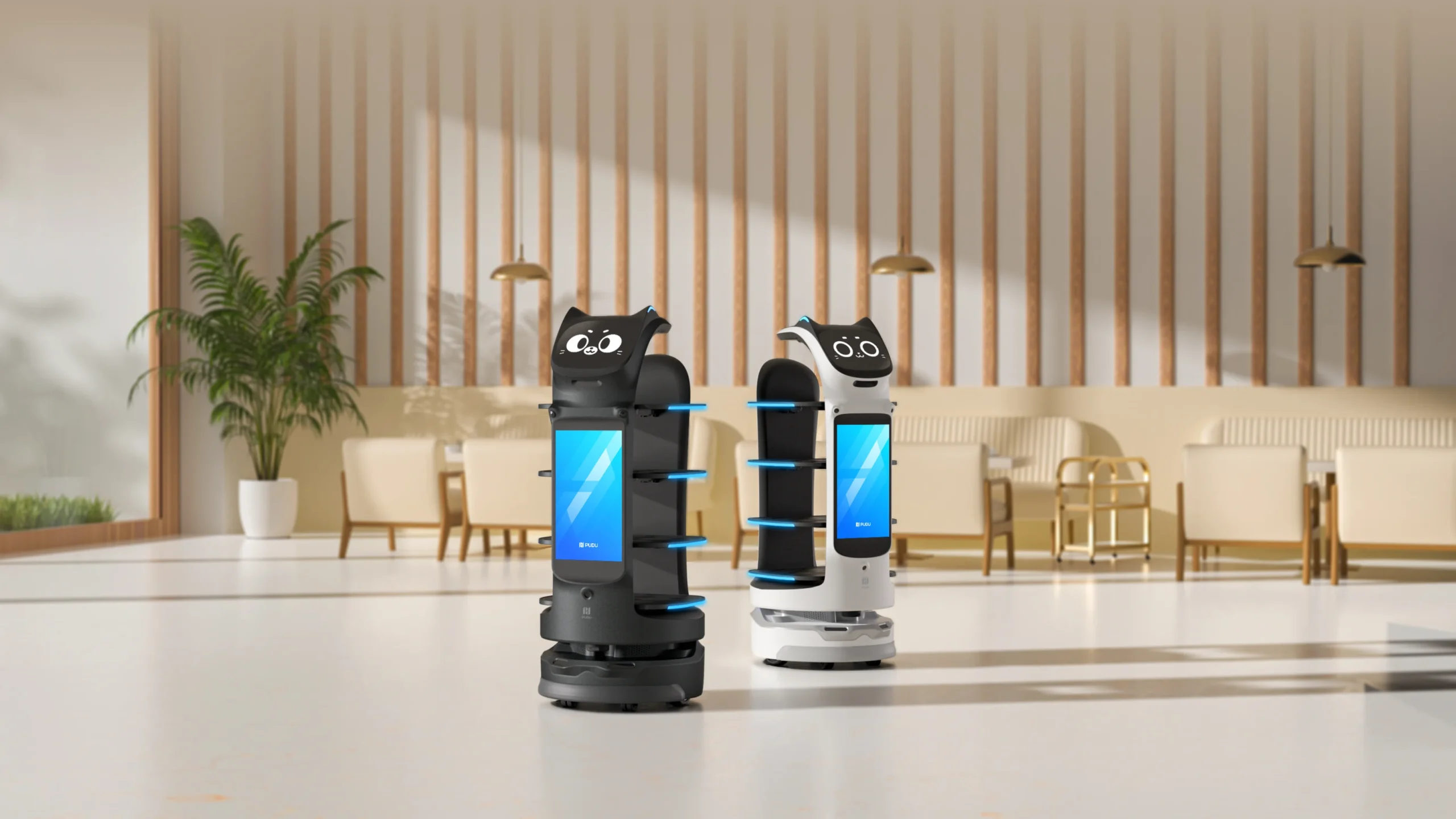
PUDU BellaBot Pro: 40 kg payload, VSLAM and 65 cm clearance
United States
Local sales channel — request a quote
- Seller / sales channel
- Inland Global
- Price
- Individual quote; no verified public local price
- Delivery
- Confirm stock and the delivery date for your address with the seller
- Warranty and service
- Confirm written warranty terms, parts and service coverage for your address
Inland Global lists this model in its US sales catalogue with a quotation route. Confirm the exact configuration and fulfilment before payment.
Evidence checked: · Not a live stock feed
Inland Global: request a quote ↗Germany
Local sales channel — request a quote
- Seller / sales channel
- GIOBOTICS
- Price
- Individual quote; no verified public local price
- Delivery
- Confirm stock and the delivery date for your address with the seller
- Warranty and service
- Confirm written warranty terms, parts and service coverage for your address
GIOBOTICS lists this exact model for this market. A listing is evidence of a buying route, not a delivery commitment.
Evidence checked: · Not a live stock feed
GIOBOTICS: request a quote ↗Netherlands
Local sales channel — request a quote
- Seller / sales channel
- Fulin Robots
- Price
- See the linked offer for the current price, configuration and taxes
- Delivery
- Confirm availability and delivery to your address with the seller
- Warranty and service
- Confirm warranty territory, local service and return shipping with the seller
This supplier lists the exact model. Request a written offer with the exact configuration, delivery date and service coverage.
Evidence checked: · Not a live stock feed
Fulin Robots: model offer ↗No verified local offer in this dataset
No country-specific offer for this exact model has been established in our current sources. This is a gap in our research, not a statement that the robot cannot be bought here. Use the manufacturer’s sales contact to request a supplier serving your address; confirm configuration, imports, warranty and service.
- Price
- No verified local price in this dataset
- Delivery
- No confirmed date for your address
- Warranty and service
- Local coverage not verified
KEENON DINERBOT T10: 40 kg, 59 cm aisles and 23.8-inch display
Germany
Local store offer — check checkout availability
- Seller / sales channel
- Reichelt
- Price
- See the local offer for the current price and exact bundle
- Delivery
- Confirm stock and the delivery date for your address with the seller
- Warranty and service
- Confirm written warranty terms, parts and service coverage for your address
Reichelt lists this exact model for this market. A listing is evidence of a buying route, not a delivery commitment.
Evidence checked: · Not a live stock feed
Reichelt: check local offer ↗No verified local offer in this dataset
No country-specific offer for this exact model has been established in our current sources. This is a gap in our research, not a statement that the robot cannot be bought here. Use the manufacturer’s sales contact to request a supplier serving your address; confirm configuration, imports, warranty and service.
- Price
- No verified local price in this dataset
- Delivery
- No confirmed date for your address
- Warranty and service
- Local coverage not verified
“Listed” confirms a product page or sales route, not stock, delivery to every address or local service. “Pre-order” is not immediate availability. Unverified means we lack evidence; it does not mean unavailable. Prices belong to the named market and currency. Confirm the exact version, tax, shipping and support before ordering.
A waiter robot in 2026 is not a “mechanical waiter.” The strongest deployments automate one narrow part of hospitality work: repetitive transport between the kitchen, pass, tables and dish-return area. That distinction determines whether the robot becomes useful infrastructure or an expensive novelty parked against a wall.
This guide uses PUDU BellaBot Pro and KEENON DINERBOT T10 as current reference platforms. We do not declare a winner without a common physical test. The goal is to show how to calculate cost, throughput and deployment fit.
Short answer: when does a waiter robot pay?
Usually when a venue has long routes, many trips per shift and peak periods in which staff spend meaningful time walking from A to B. It is least convincing in a tiny café where the counter sits next to a handful of tables. The robot should remove repetitive transport, not pretend to replace selling, hospitality, complaint handling and human judgement.
What can a waiter robot actually do?
| Task | Robot contribution | Human work remains |
|---|---|---|
| Meal delivery | moves trays from pass to table zones | loading, order verification and often final handoff |
| Dish return | moves used dishes back to a washing point | sorting, hygiene and exception handling |
| Marketing | shows promotions while moving | campaign strategy, selling and guest conversation |
| Guest guidance | can guide to a programmed destination | non-standard requests and judgement |
| Multi-robot work | fleet software can coordinate routes | traffic design, monitoring and operational ownership |
The most important metric: how much walking do you remove?
Before asking for a quote, count kitchen-to-floor and floor-to-dishwash trips for several days. Measure average distance and time. If a team performs 120 ninety-second transport trips, that is about three hours of distributed walking work. It does not automatically equal three hours of cash savings or one reduced position. It is time that might be redirected to guests, selling, preparation or reducing overload at peak.
ROI should value released time and process change, not the slogan “one robot equals one employee.” Some venues will not reduce headcount at all and can still benefit if transport pressure falls during the busiest period.
Minimum aisle width matters more than many headline features
BellaBot Pro carries a 65 cm path-clearance specification. KEENON quotes 59 cm minimum passage width for T10. Neither number should be copied to the floor plan as a recommended operating lane. Guests move chairs, strollers appear, queues form and staff carry hot plates. A pilot must include the worst realistic period of the day.
BellaBot Pro vs DINERBOT T10: practical differences
| Feature | PUDU BellaBot Pro | KEENON DINERBOT T10 |
|---|---|---|
| Payload | 40 kg; 10 kg per tray | 40 kg total |
| Quoted passage | 65 cm | 59 cm |
| Quoted runtime | 11 h no-load | 9–12.5 h |
| Marketing display | 18.5" | 23.8" |
| Navigation | VSLAM + Marker + LiDAR SLAM | stereo vision + VSLAM + RGB camera |
| Distinctive layer | PUDU interaction and delivery modes | large display, tray detection and fleet functions |
Do not buy from one table cell. A six-centimetre aisle difference may matter enormously, but local integration, crowd behaviour, spare parts and pickup-point configuration can matter even more.
How much does a waiter robot cost?
There is no single honest market price. B2B manufacturers frequently route buyers to partners or quote forms. Deployment cost can include hardware, charger, shipping, mapping, configuration, training, warranty, service package, parts, networking, integrations and accessories. Comparing only the device line item is often misleading.
A three-year TCO model
- CAPEX or monthly payment: purchase, lease or rental.
- Deployment: site audit, mapping, training and configuration.
- Service: maintenance, travel, response time and parts.
- Battery and consumables: wear and possible replacement over several years.
- Downtime: what happens if the robot fails on Saturday evening?
- Venue changes: remodels, new tables and changed traffic flows.
- Internal handling: somebody still charges, cleans and checks the robot.
A simple ROI model without creative accounting
Calculate the value of transport hours the robot can genuinely take over. Subtract robot-handling time and deployment cost. Do not count a full employee wage as “savings” if staffing remains unchanged. Better metrics can be trips shifted from staff to robot, minutes recovered during peak hour or additional tables served without degrading guest experience.
Method example: if transport uses 2.5 staff-hours per day and a robot takes over 70%, the potential is 1.75 hours per day. Then determine whether that becomes lower overtime, better service, higher sales or simply lower physical load. Those outcomes have different financial values.
Advertising display: bonus or separate business case?
BellaBot Pro has an 18.5-inch advertising display; T10 uses a 23.8-inch screen. In a mall or food court a moving display can support promotions. Keep marketing ROI separate from delivery efficiency until you can measure impressions, offers, codes or conversion. A display can improve economics, but it should not rescue a weak transport process.
Safety and operational ownership
The robot moves between people, food, hot drinks and children. Routes should avoid forcing staff and robots through the same critical bottleneck. Define who responds to a stop, who may move the robot manually, how faults are logged and how trays are sanitised.
Network, cloud and data
Ask which functions require internet access, how fleet management works, where operational data is stored and what happens when Wi‑Fi fails. A restaurant should understand the system architecture before the first network outage. Larger fleets also need clear administrator roles and software-update procedures.
How to run a useful pilot
- Map the two busiest traffic corridors.
- Run the robot during real peak, not an empty-room demo.
- Log trips, stops and interventions.
- Measure staff time before and after.
- Track guest reaction separately from operating efficiency.
- Review 2–4 weeks of data before scaling.
Common mistakes
- buying without measuring aisle width;
- assuming a robot automatically eliminates a job;
- having no internal process owner;
- no service SLA or fallback plan;
- judging a demo in an empty venue;
- ignoring battery and service costs;
- choosing mainly by appearance or screen size.
Can a waiter robot work in a small restaurant?
Sometimes. A small venue can still have a long route to a terrace, event room or separate level. Conversely, if six tables are three metres from the pass, a robot may be an expensive way to perform a task a person completes in seconds. Geometry, not seat count alone, is the deciding factor.
What to demand from a European integrator
Ask for an on-site demo, warranty terms, service response, spare-parts availability and a backup-robot policy. Confirm whether the quote includes mapping, staff training and later map corrections. For a restaurant, one busy weekend of downtime can matter more than a small difference in purchase price.
RoboMorrow verdict
A waiter robot is most convincing as an autonomous transporter inside a well-designed hospitality process. It can reduce physical load and improve peak-hour throughput, but it is not a shortcut to a people-free restaurant. Measure trips, aisles and time first; compare platforms second.
Purchase, lease or robot-as-a-service?
Financing changes the risk profile. Purchasing gives ownership but requires more upfront capital and leaves residual-value risk with the operator. Leasing or rental spreads cost over time. Robot-as-a-service can bundle hardware, software and service into one fee, but buyers should check usage limits, replacement conditions, price indexation and what happens at contract end.
Normalize offers to one horizon—36 months, for example—and calculate total net deployment cost. A lower monthly payment can be more expensive if installation, transport, service visits or mandatory software are separate. A higher-cost package with a guaranteed replacement unit can be economically stronger where a busy-weekend outage has a real cost.
KPIs worth recording from day one
| KPI | Why it matters |
|---|---|
| robot trips per shift | measures actual utilisation rather than ownership |
| average trip time | creates a before/after transport benchmark |
| human interventions per 100 trips | reveals friction hidden by specifications |
| downtime minutes per day | measures operational availability |
| staff walking time or distance | shows whether workload is actually reduced |
| overtime and peak pressure | connects automation to process cost |
| route-blocking incidents | shows whether floor layout must change |
You do not need complex business intelligence at first. A simple sheet completed consistently by a shift manager is enough. Without a “before” benchmark, enthusiasm can easily be mistaken for process improvement after one month.
Three venues, three different outcomes
1. Small restaurant with a short route
The robot can be a marketing attraction while transport time remains small. The business case needs a specific pain point: a distant terrace, a long corridor or a staffing constraint at a defined time. Forty tables alone do not create ROI.
2. Food court or large dining floor
Long repetitive routes and many trips are a more natural fit, but crowds, children and crossing traffic increase complexity. Passage width, robot visibility and traffic design can matter more than headline maximum speed.
3. Hotel, buffet or multi-zone venue
Value can come from transport between back-of-house and multiple service zones. Doors, lifts, thresholds and handoff design then become critical. If lift or building-automation integration is required, price it as a separate project element rather than assuming it is standard.
People: automation without process sabotage
A robot that staff reject will be underused. Strong deployment begins by identifying the dull, physical transport loops the platform will remove—not by telling employees that a machine will replace them. Staff need to know when to dispatch the robot, when not to wait for it and how to respond safely to a stop.
During the first weeks, assign one person to own the operating standard. That prevents mapping, task-queue and charging problems from being lost between shifts. Broaden responsibility only after the workflow stabilises.
30-day acceptance criteria
After a month the decision should be “scale / improve / stop,” not “the robot looks cool.” Set a minimum utilisation target, acceptable intervention rate and expected peak-time recovery before the pilot starts. Low utilisation may indicate a process-design problem. High utilisation with frequent blockage may point to geometry. Stable operation with a meaningful share of transport transferred to the robot is when a second unit becomes a rational discussion.