Amazon invests more than $100M in a manufacturing plant for its robotics network
NEWS + ANALYSIS | 24 September 2026
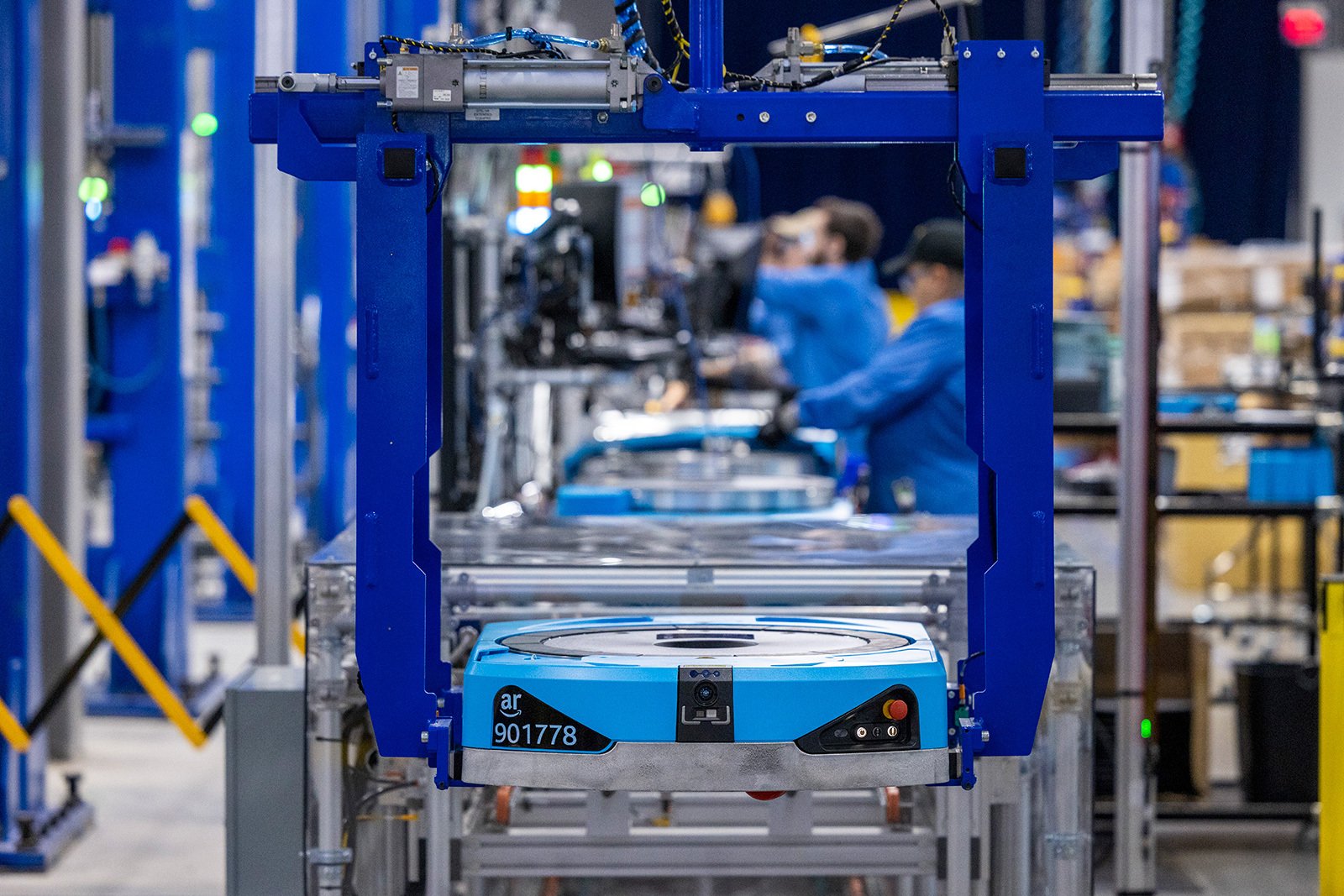
Amazon has announced an investment of more than $100 million in a new manufacturing facility in Greenwood, Indiana. The roughly 585,000-square-foot site is intended to produce equipment for the company's North American fulfillment and robotics network. The bigger signal is industrial: scaling Physical AI requires manufacturing capacity, quality systems and service infrastructure, not only better models and software.
- Amazon will invest more than $100 million in the Greenwood, Indiana facility.
- The site will cover about 585,000 square feet and is expected to create 300 manufacturing and engineering jobs.
- Operations are planned to begin by 2028; this is not a factory already producing today.
- The facility will combine fabrication, robotic welding, automated powder coating and assembly, supported by AWS and AI-enabled manufacturing systems.
- Amazon says it has manufactured more than 1 million robots in the US and deployed robots across more than 300 facilities globally.
- The company says robots assist with roughly 75% of customer orders worldwide; that is an Amazon-reported metric, not an independent audit.
| Item | Confirmed | Status / caveat |
|---|---|---|
| Investment | >$100M | Announced 24 Sep 2026 |
| Location | Greenwood, Indiana, US | For the North American network |
| Size | ~585,000 ft2 | Planned manufacturing site |
| Launch | by 2028 | Target, not current production |
| Jobs | 300 | Manufacturing and engineering |
Why this is a robotics story rather than a real-estate story
The important part of the announcement is not simply another building. Amazon is expanding its internal manufacturing chain for equipment used across a huge fulfillment network. The planned site combines fabrication, robotic welding, coating and assembly in one environment, giving Amazon more control over how hardware moves from engineering into repeatable production.
That matters because the gap between a successful prototype and a fleet of hundreds of thousands of machines is usually created by manufacturing, reliability, spare parts and service. Amazon is unusually well positioned to learn at that scale: it deploys robots into its own workflows, collects operational data and can redesign hardware around real warehouse constraints.
One million robots is significant - with an attribution caveat
Amazon says it has already manufactured more than one million robots in the United States and deployed robotic systems across more than 300 facilities worldwide. The number covers multiple classes of systems and comes from Amazon itself rather than an independent fleet audit. The same applies to the claim that robots assist with about 75% of customer orders.
The scale is still notable. Even when individual machines perform specialized tasks, Amazon demonstrates what it looks like when physical automation becomes base infrastructure rather than an experiment isolated on one side of a warehouse.
What Amazon has not disclosed
The company has not identified the exact robot models or components to be produced in Greenwood, annual manufacturing capacity, or how much output will be transferred from other locations. It would therefore be misleading to convert the $100 million investment into a specific number of additional robots per year.
There is also no direct European deployment commitment attached to the announcement. The site is aimed primarily at North America. For the EU, the significance is indirect: systems proven and scaled in the US can later inform European deployments, but that depends on regulation, facility design and Amazon's regional plans.
The wider Physical AI lesson
Physical AI coverage often focuses on foundation models, humanoids and visually impressive demonstrations. Durable advantage may instead belong to companies that can design hardware, manufacture it at scale, supply spare parts, update software and measure ROI inside real workflows.
Greenwood is evidence of that industrial layer. It is not the launch of one new robot; it is an investment in the capacity to keep scaling Amazon's robotics network. For that reason it matters more to the market than another laboratory demo, even though the facility itself is not expected to operate until 2028.
The key metric is not simply "how many robots does Amazon have?"
The Greenwood investment should ultimately be judged by whether it shortens component lead times, expands service capacity and lets Amazon deploy systems faster across fulfillment sites. The "more than one million robots" figure is an Amazon-reported fleet statistic covering multiple machine classes. By itself it does not tell us how much work any one platform performs or how often a person intervenes during a shift.
The same logic applies to intralogistics. Our guide to pallet-transport robots and integration economics focuses on throughput, availability, recovery and WMS/MES integration rather than vehicle count alone. Universal Robots Gen 7 makes the complementary point: Physical AI scales when hardware, control and integration become repeatable. Greenwood is therefore primarily a story about industrial capacity to scale robotics.
What would justify an update
RoboMorrow will not create another story simply because a second publication covers the same event. A material update requires a real status change: commercial shipping or production, a new price, a signed customer, a major deployment, entry into a new market, independently verified performance data or a regulatory decision. Smaller clarifications should update this canonical owner instead.
Sources and methodology
RoboMorrow verification: 25 Sep 2026. Manufacturer specifications are treated as claims unless stated otherwise.