Atlas gets four fingers. Boston Dynamics explains why a fifth could be a mistake
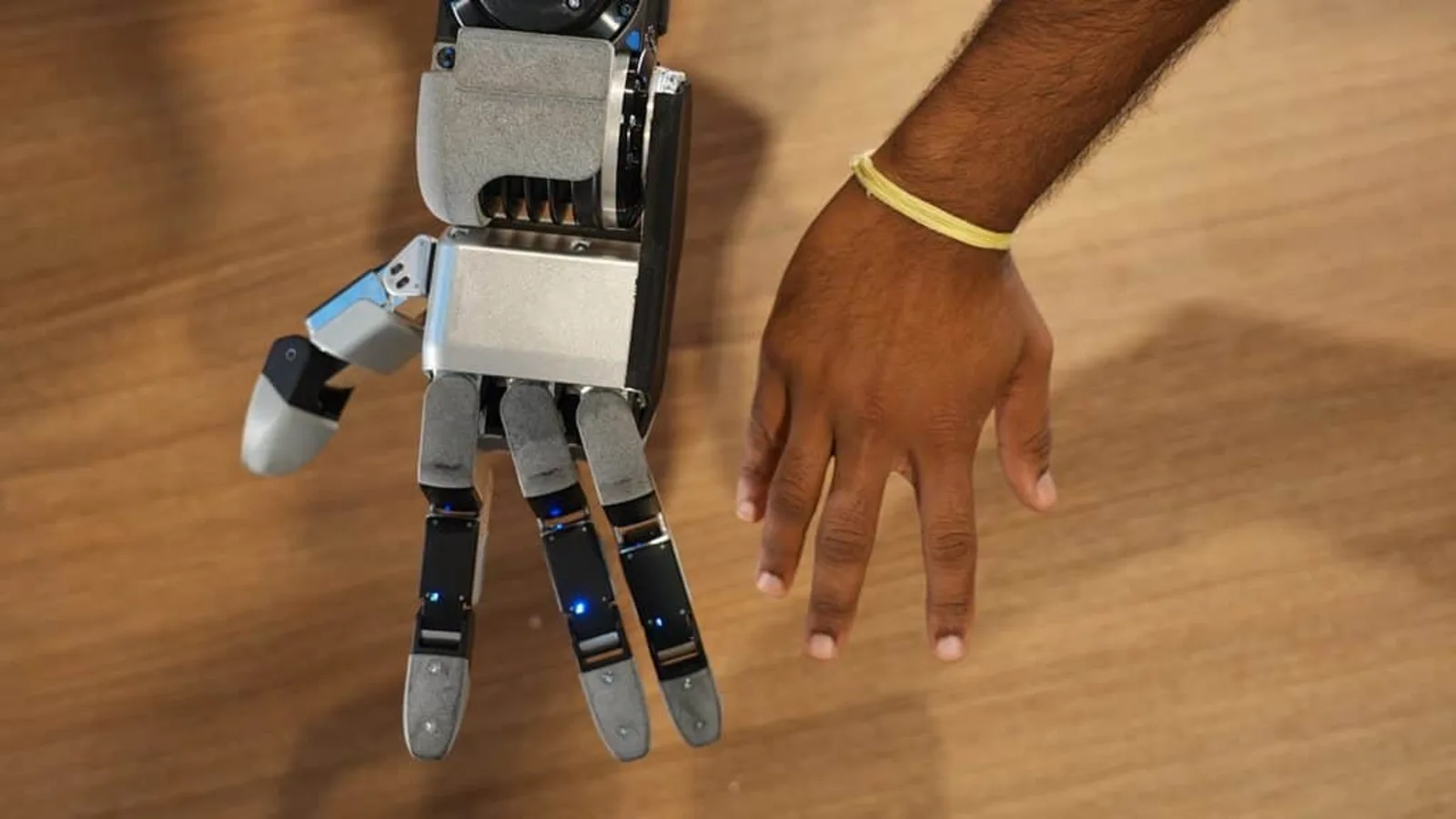
Boston Dynamics has made a choice that looks almost provocative in humanoid robotics: Atlas’s new hand has four fingers, not five, while its degrees of freedom rise from seven to thirteen. This is not a styling exercise. The company says the design targets real manipulation, AI training and a path toward high-volume manufacturing.
That makes the announcement more important than another spectacular whole-body demo. A humanoid hand sits at the collision point of dexterity, strength, durability, cost and serviceability. Boston Dynamics is making a product argument: a useful humanoid does not have to copy human anatomy one-for-one.
Thirteen degrees of freedom instead of seven
The previous hand generation was primarily intended to grasp a wide variety of objects. The new design is meant to manipulate them as well. Boston Dynamics describes 13 degrees of freedom: four in the opposable thumb and three in each remaining finger. The fingers can splay, while the thumb supports precise pinch and tripodal grasps.
The company shows triggered-tool grasps for equipment such as drills, torque drivers, grinders, nail guns and welding torches. A product video does not establish multi-shift reliability, but it does reveal the motions and geometries the mechanical design is now expected to support.
Why Atlas has no pinky
The four-finger decision is the most revealing part. Boston Dynamics says a fifth finger would add three actuators, more volume and cost, and more components that can fail. The team even tested the functional value of the pinky by taping engineers’ pinky and ring fingers together and asking what tasks they could no longer perform.
That is product engineering rather than anatomical imitation. Every additional robot joint brings potential capability, but also bearings, control, thermal load, mass, calibration, spare parts and another failure distribution. If four fingers can perform the target work, a fifth finger has to earn its place through process value.
Direct actuation and fewer fragile paths
The new hand uses direct joint actuation. Boston Dynamics highlights the absence of fragile tendons or cables crossing the joints and the use of a single actuator type. The architecture is intended to simplify the mechanism and make actuator packs easier to service.
The hand is also designed to preserve high strength. Boston Dynamics says Atlas can handle loads such as a loaded mini-fridge exceeding 100 pounds. That is a manufacturer design claim rather than a RoboMorrow measurement, but it makes clear that the hand is intended for physical industrial tools and payloads rather than delicate demonstrations alone.
A hand designed for simulation and reinforcement learning
The mechanical system is also being optimized for high-fidelity simulation. That matters for sim-to-real reinforcement learning: the closer simulated joints behave to physical ones, the more useful synthetic training can become and the less expensive on-robot iteration may be required.
Dense pressure tactile sensing across fingertips and palm complements proprioception. Small contact signals can help the controller detect and correct a grasp. Sensors, however, are an enabling layer, not proof of production reliability. The real test is repeatability under dirt, impacts, tool changes and long duty cycles.
The most important claim is about manufacturing
Boston Dynamics explicitly connects the hand to Atlas’s trajectory toward mass manufacturing. That changes the acceptance criteria. A research prototype can tolerate exotic parts and expert maintenance. A commercial industrial robot must be built repeatedly, repaired quickly and maintained across a fleet.
Four fingers therefore may say more about the product than five humanlike fingers would. Atlas must fit environments and tools designed for people, so reach and dexterity matter. It does not need every feature of human anatomy if that feature adds cost without improving the target workflow.
What this announcement does not prove
There is no public lifetime figure for the finger modules, no MTBF, no complete hand cost, no published field-service time and no months-long customer dataset for this new generation. Atlas itself still has no public list price. The material demonstrates a product direction and specific manipulation behaviors, not a common benchmark against rival humanoids.
For procurement, the decisive metrics will be operational: cycles between service, resistance to contamination and impacts, module-replacement time, tool-change performance and whether manipulation policies retain quality after station changes.
Why it matters
The humanoid race is moving from “can the robot do it?” to “can thousands of robots be built, taught and maintained economically?”. The hand is a concentrated example of that transition. Boston Dynamics removes an apparently obvious anatomical feature while increasing the useful motion envelope and reducing unnecessary complexity.
If this architecture reaches production fleets, the number of fingers will matter less than cost per completed operation, reliability and teaching speed. Those are the measurements RoboMorrow will track as Atlas moves from product engineering toward real deployment evidence.
What four fingers change in an industrial pilot
Finger count is not a deployment KPI. What matters is repeatable grasping, use of the exact tools required by the process, recovery from slip, module-replacement time and cost per completed operation. The new Atlas hand is interesting precisely because Boston Dynamics trades anatomical similarity for a simpler architecture: four fingers, 13 degrees of freedom and direct actuation are intended to preserve the manipulation envelope without adding three more actuators simply to reproduce a pinky.
A useful customer pilot should therefore run repeated cycles with the same tool, include tool changes without manual resets, introduce controlled grasp disturbances and count human interventions. Hand-service time should be measured separately, along with whether a manipulation policy retains performance after a station or part-geometry change. Those measurements—not the finger count—will show whether the design decision actually reduces maintenance burden and improves fleet availability.
Featured image: official Boston Dynamics imagery showing the new Atlas hand next to a human hand. Image source.
Sources and methodology
This article uses primary sources plus editorial cross-checking and was verified on 3 October 2026. Manufacturer claims are kept separate from independent evidence. This is not a RoboMorrow hands-on test.