Who steers NASA’s three CADRE rovers when each picks its own path?
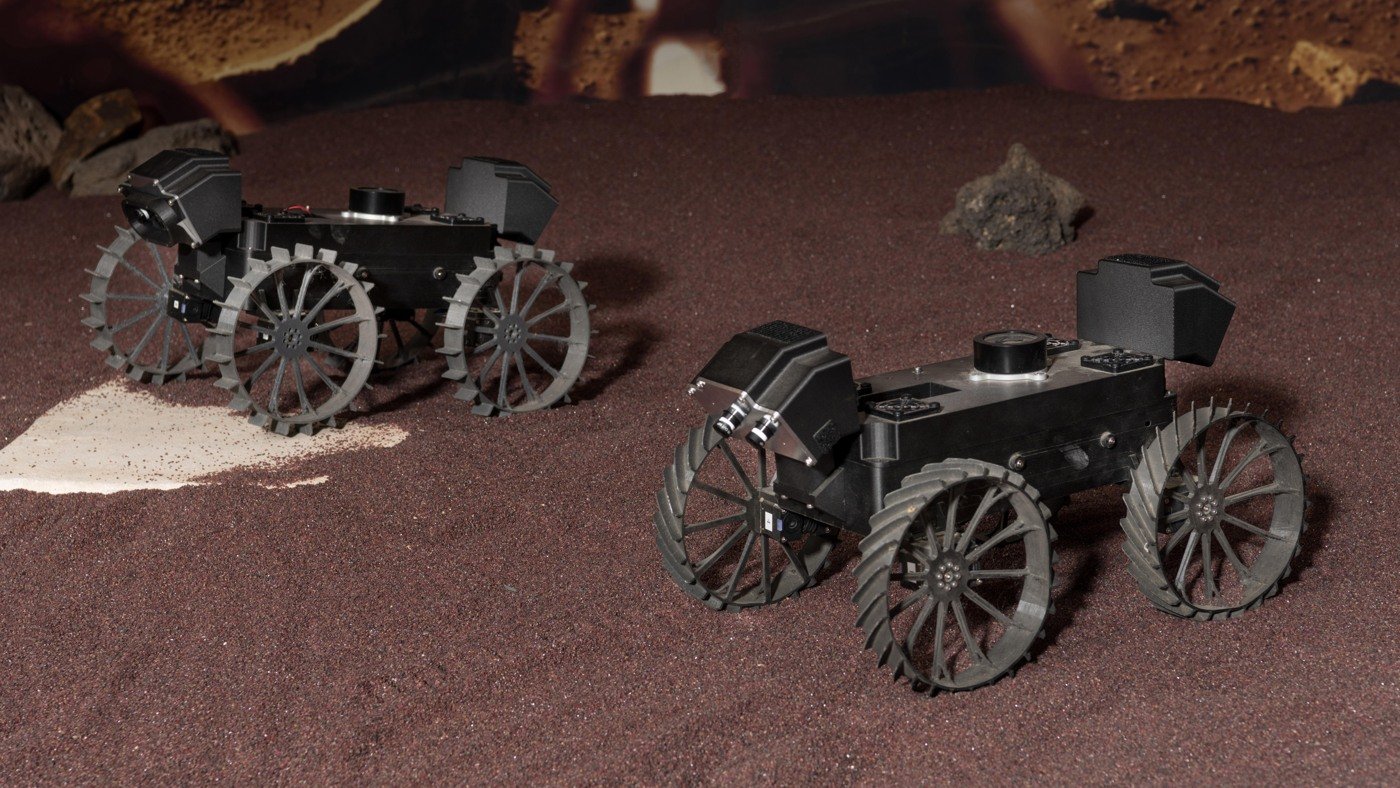
Two CADRE rover prototypes driving in formation in a JPL sandbox. NASA/JPL-Caltech.
An operator identifies an area to explore. Who goes around a rock and who should wait? NASA designed CADRE so that three small rovers can divide the work and choose routes they can actually drive.
Three decisions behind a single drive
| Decision | Who makes it |
|---|---|
| Identify the survey area | Ground team |
| Divide work across that area | Leader elected by the robots |
| Navigate past an obstacle | Rover doing the assigned work |
When does it pay to split up?
Imagine a ridge in the middle of the survey area. A rover on one side sees ground hidden from a rover on the other. In the exploration experiment described by JPL, each vehicle chooses its own path in its assigned area. Stereo cameras view the surroundings from two angles. The intended result is a shared map of surface relief, so where each image was taken matters long after the rover drives on.
Why come back into formation for radar?
One rover transmits a radar signal and the others can receive its reflection. The separation between vehicles becomes part of the measurement. If every rover chose its path solely for ease of driving, the group could lose the geometry the observation calls for. Formation driving therefore serves a different purpose from fanning out: the radar probes structure below the surface, while the cameras map the terrain that is visible above it.
What does the test photograph establish?
The photograph shows two smaller plastic prototypes in a sandbox at JPL in August 2022. Engineers could test whether the vehicles held formation there. It documents a ground test. A subsurface survey has a different success condition: several robots must collect useful signals at the same time from known positions. Simply driving together does not demonstrate that result.
Related reading
- Why Perseverance has different wheels from Curiosity
- How Astrobee works on the ISS and why it grips a handrail