Canadarm2 and Dextre: transport arm or servicing robot?
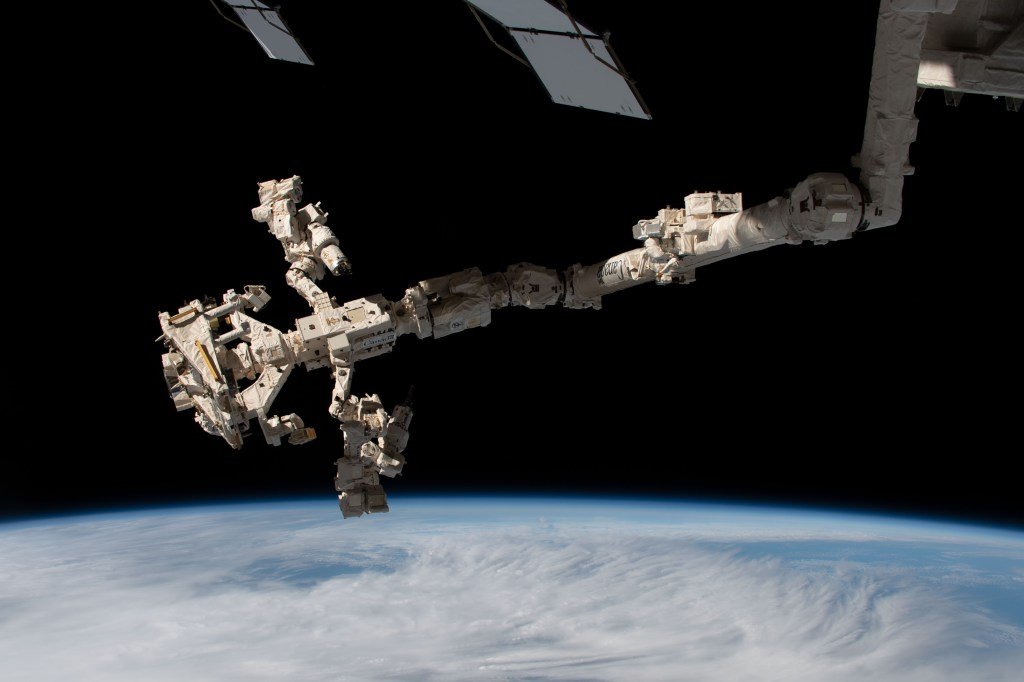
Dextre attached to Canadarm2 outside the ISS. NASA.
Canadarm2 moves payloads and positions equipment, while Dextre performs fine maintenance outside the International Space Station. They are complementary machines. Long reach and small service tools address different parts of the same job.
Compare the task first
| Task | Canadarm2 | Dextre |
|---|---|---|
| Moving equipment | Large transport arm | Can ride at the arm tip |
| Replacing cameras and components | Positions the worksite | Two arms and service tools |
| Moving along the structure | Changes anchor points | Uses the arm or mobile base |
| Supervision | Crew or ground controllers | NASA and CSA ground controllers |
Why does Canadarm2 have a gripper at each end?
Either end can anchor the arm or perform work. The arm moves between prepared station fixtures that also supply power and data connections. This is different from free flight: mobility depends on compatible infrastructure.
What does Dextre add?
Each of Dextre’s two arms has seven joints. Its end tools include a powered wrench, camera and lights. CSA describes replacing small external equipment; NASA lists cameras and batteries as maintenance examples. Dextre can travel on Canadarm2 or on the Mobile Base System, which moves on rails along the station truss.
The human remains part of the operation
Precise manipulation in orbit does not establish independent authority to select every task. The agencies describe ground operation, with astronaut control also available for Canadarm2. The ability to execute a motion and authority to decide an entire operation are separate questions. This is a documentation-based comparison, not a RoboMorrow hardware test.
How to use this comparison
Identify the action first: move a payload, position a tool or replace a component. Then compare the machines. Our editorial conclusion is that asking which robot is better without specifying a task misses the system’s defining feature: cooperation. We do not translate orbital capabilities into a terrestrial lifting rating or calculate unsupported savings.
Related reading
- How Astrobee works on the ISS and why it grips a handrail
- ASTRA: Caltech Robot Assembles a Truss Bay in Orbit