Commercial cleaning robot types: 4-in-1, scrubber, vacuum or sweeper?
BUYING IN YOUR MARKET
Availability in your country
Sales, delivery and support can differ by country and exact model. Choose your market to see the evidence we have checked.
PUDU CC1
United States
Local sales channel — request a quote
- Seller / sales channel
- Inland Global
- Price
- Individual quote; no verified public local price
- Delivery
- Confirm stock and the delivery date for your address with the seller
- Warranty and service
- Confirm written warranty terms, parts and service coverage for your address
Inland Global lists this model in its US sales catalogue with a quotation route. Confirm the exact configuration and fulfilment before payment.
Evidence checked: · Not a live stock feed
Inland Global: request a quote ↗Germany
Local sales channel — request a quote
- Seller / sales channel
- JK Robotik
- Price
- EUR 18,950 excluding VAT and shipping
- Delivery
- Confirm stock and the delivery date for your address with the seller
- Warranty and service
- Confirm written warranty terms, parts and service coverage for your address
JK Robotik lists this exact model for this market. A listing is evidence of a buying route, not a delivery commitment.
Evidence checked: · Not a live stock feed
JK Robotik: request a quote ↗Netherlands
Local sales channel — request a quote
- Seller / sales channel
- Fulin Robots
- Price
- See the linked offer for the current price, configuration and taxes
- Delivery
- Confirm availability and delivery to your address with the seller
- Warranty and service
- Confirm warranty territory, local service and return shipping with the seller
This supplier lists the exact model. Request a written offer with the exact configuration, delivery date and service coverage.
Evidence checked: · Not a live stock feed
Fulin Robots: model offer ↗Spain
Local sales channel — request a quote
- Seller / sales channel
- Intec Robots
- Price
- See the linked offer for the current price, configuration and taxes
- Delivery
- Confirm availability and delivery to your address with the seller
- Warranty and service
- Confirm warranty territory, local service and return shipping with the seller
This supplier lists the exact model. Request a written offer with the exact configuration, delivery date and service coverage.
Evidence checked: · Not a live stock feed
Intec Robots: model offer ↗Portugal
Local sales channel — request a quote
- Seller / sales channel
- Intec Robots
- Price
- See the linked offer for the current price, configuration and taxes
- Delivery
- Confirm availability and delivery to your address with the seller
- Warranty and service
- Confirm warranty territory, local service and return shipping with the seller
This supplier lists the exact model. Request a written offer with the exact configuration, delivery date and service coverage.
Evidence checked: · Not a live stock feed
Intec Robots: model offer ↗No verified local offer in this dataset
No country-specific offer for this exact model has been established in our current sources. This is a gap in our research, not a statement that the robot cannot be bought here. Use the manufacturer’s sales contact to request a supplier serving your address; confirm configuration, imports, warranty and service.
- Price
- No verified local price in this dataset
- Delivery
- No confirmed date for your address
- Warranty and service
- Local coverage not verified
PUDU CC1 Pro
United States
Local sales channel — request a quote
- Seller / sales channel
- Inland Global
- Price
- Individual quote; no verified public local price
- Delivery
- Confirm stock and the delivery date for your address with the seller
- Warranty and service
- Confirm written warranty terms, parts and service coverage for your address
Inland Global lists this model in its US sales catalogue with a quotation route. Confirm the exact configuration and fulfilment before payment.
Evidence checked: · Not a live stock feed
Inland Global: request a quote ↗Germany
Local sales channel — request a quote
- Seller / sales channel
- JK Robotik
- Price
- EUR 20,950 excluding VAT and shipping
- Delivery
- Confirm stock and the delivery date for your address with the seller
- Warranty and service
- Confirm written warranty terms, parts and service coverage for your address
JK Robotik lists this exact model for this market. A listing is evidence of a buying route, not a delivery commitment.
Evidence checked: · Not a live stock feed
JK Robotik: request a quote ↗Netherlands
Local sales channel — request a quote
- Seller / sales channel
- Fulin Robots
- Price
- See the linked offer for the current price, configuration and taxes
- Delivery
- Confirm availability and delivery to your address with the seller
- Warranty and service
- Confirm warranty territory, local service and return shipping with the seller
This supplier lists the exact model. Request a written offer with the exact configuration, delivery date and service coverage.
Evidence checked: · Not a live stock feed
Fulin Robots: model offer ↗Spain
Local sales channel — request a quote
- Seller / sales channel
- Intec Robots
- Price
- See the linked offer for the current price, configuration and taxes
- Delivery
- Confirm availability and delivery to your address with the seller
- Warranty and service
- Confirm warranty territory, local service and return shipping with the seller
This supplier lists the exact model. Request a written offer with the exact configuration, delivery date and service coverage.
Evidence checked: · Not a live stock feed
Intec Robots: model offer ↗Portugal
Local sales channel — request a quote
- Seller / sales channel
- Intec Robots
- Price
- See the linked offer for the current price, configuration and taxes
- Delivery
- Confirm availability and delivery to your address with the seller
- Warranty and service
- Confirm warranty territory, local service and return shipping with the seller
This supplier lists the exact model. Request a written offer with the exact configuration, delivery date and service coverage.
Evidence checked: · Not a live stock feed
Intec Robots: model offer ↗No verified local offer in this dataset
No country-specific offer for this exact model has been established in our current sources. This is a gap in our research, not a statement that the robot cannot be bought here. Use the manufacturer’s sales contact to request a supplier serving your address; confirm configuration, imports, warranty and service.
- Price
- No verified local price in this dataset
- Delivery
- No confirmed date for your address
- Warranty and service
- Local coverage not verified
Gausium Omnie
No verified local offer in this dataset
A current local sales offer, exact regional variant, delivery date and service coverage have not been verified for this country in the regional dataset. This does not mean that the robot is unavailable.
- Price
- No verified local price in this dataset
- Delivery
- No confirmed date for your address
- Warranty and service
- Local coverage not verified
PUDU MT1 Vac
United States
Local sales channel — request a quote
- Seller / sales channel
- Inland Global
- Price
- Individual quote; no verified public local price
- Delivery
- Confirm stock and the delivery date for your address with the seller
- Warranty and service
- Confirm written warranty terms, parts and service coverage for your address
Inland Global lists this model in its US sales catalogue with a quotation route. Confirm the exact configuration and fulfilment before payment.
Evidence checked: · Not a live stock feed
Inland Global: request a quote ↗Germany
Local sales channel — request a quote
- Seller / sales channel
- Rabotics
- Price
- Individual quote; no verified public local price
- Delivery
- Confirm stock and the delivery date for your address with the seller
- Warranty and service
- Confirm written warranty terms, parts and service coverage for your address
Rabotics lists this exact model for this market. A listing is evidence of a buying route, not a delivery commitment.
Evidence checked: · Not a live stock feed
Rabotics: request a quote ↗Netherlands
Local sales channel — request a quote
- Seller / sales channel
- Fulin Robots
- Price
- See the linked offer for the current price, configuration and taxes
- Delivery
- Confirm availability and delivery to your address with the seller
- Warranty and service
- Confirm warranty territory, local service and return shipping with the seller
This supplier lists the exact model. Request a written offer with the exact configuration, delivery date and service coverage.
Evidence checked: · Not a live stock feed
Fulin Robots: model offer ↗Spain
Local sales channel — request a quote
- Seller / sales channel
- Intec Robots
- Price
- See the linked offer for the current price, configuration and taxes
- Delivery
- Confirm availability and delivery to your address with the seller
- Warranty and service
- Confirm warranty territory, local service and return shipping with the seller
This supplier lists the exact model. Request a written offer with the exact configuration, delivery date and service coverage.
Evidence checked: · Not a live stock feed
Intec Robots: model offer ↗Portugal
Local sales channel — request a quote
- Seller / sales channel
- Intec Robots
- Price
- See the linked offer for the current price, configuration and taxes
- Delivery
- Confirm availability and delivery to your address with the seller
- Warranty and service
- Confirm warranty territory, local service and return shipping with the seller
This supplier lists the exact model. Request a written offer with the exact configuration, delivery date and service coverage.
Evidence checked: · Not a live stock feed
Intec Robots: model offer ↗No verified local offer in this dataset
No country-specific offer for this exact model has been established in our current sources. This is a gap in our research, not a statement that the robot cannot be bought here. Use the manufacturer’s sales contact to request a supplier serving your address; confirm configuration, imports, warranty and service.
- Price
- No verified local price in this dataset
- Delivery
- No confirmed date for your address
- Warranty and service
- Local coverage not verified
“Listed” confirms a product page or sales route, not stock, delivery to every address or local service. “Pre-order” is not immediate availability. Unverified means we lack evidence; it does not mean unavailable. Prices belong to the named market and currency. Confirm the exact version, tax, shipping and support before ordering.
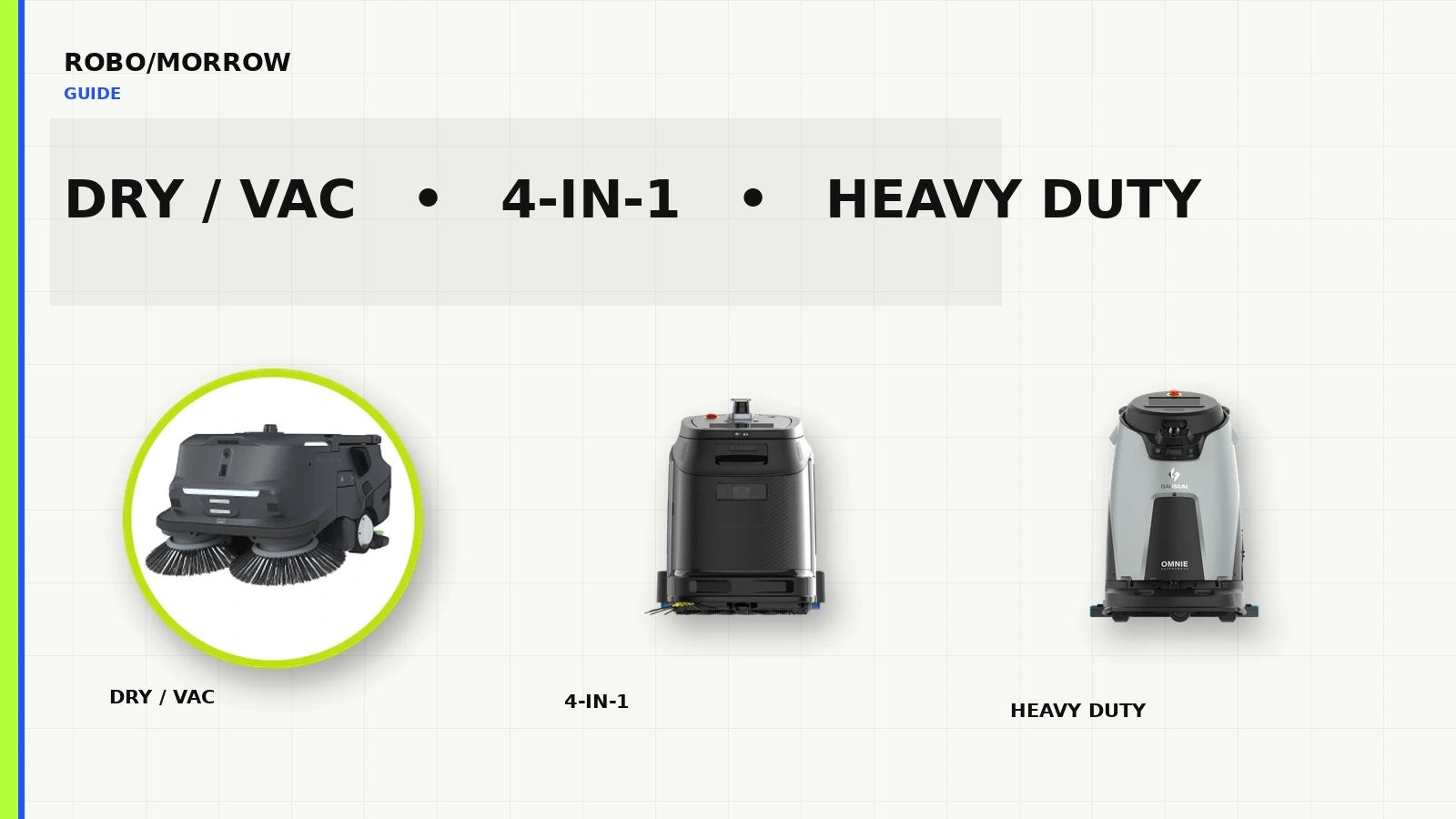
The most important rule: choose the type of cleaning process before choosing a brand. A 4-in-1 robot is useful when one facility combines carpet, hard floors and occasional wet contamination. An autonomous scrubber wins on large regular hard floors. A dry vacuum robot is usually better for a carpet-heavy hotel or office. A sweeper makes sense in a warehouse, production hall or parking area dominated by dry debris. Trying to buy one machine for all four jobs often creates an expensive compromise whose extra functions are rarely used.
Commercial robots use familiar words—vacuuming, mopping, AI—but the operating model is different from domestic cleaning. A 65–75 kg machine with water tanks and an optional plumbed workstation is part of facility infrastructure. Routes, service, consumables, safety and staff time must be designed around it. This guide helps define which class of machine to shortlist before asking suppliers for quotations.
Four main types of commercial cleaning robot
| Type | Best for | Main advantage | Typical downside |
|---|---|---|---|
| 4-in-1 | office, retail, hospitality, clinics with mixed floors | one platform covers several tasks | more components and daily service |
| Autonomous scrubber | large hard floors | strong wet cleaning and wider working path | size, water infrastructure, poor fit for carpet |
| Vacuum / dry-cleaning robot | carpet, hotels, offices, dry debris | simpler operation without water | does not remove sticky or wet contamination |
| Autonomous sweeper | warehouses, factories, parking, larger debris | large debris capacity and wide coverage | usually does not replace scrubbing |
1. 4-in-1: best when the site is genuinely mixed
A 4-in-1 machine combines several functions on one platform. PUDU CC1 and CC1 Pro, Gausium Phantas and KEENON C40 provide different combinations of sweeping, vacuuming, scrubbing and dust mopping. For a smaller business, the core benefit is reducing the number of machines while assigning different tasks to different zones.
This is particularly relevant to a hotel, clinic or store where the lobby is tiled, corridors are carpeted and back-of-house zones occasionally need wet cleaning. But “4-in-1” does not mean every mode is equally capable. PUDU says CC1 needs a separate assembly to vacuum soft carpet. Phantas uses 330 mm scrubbing/dust-mopping width versus 465 mm for vacuuming/sweeping. C40 also has different working widths by mode. Compare the function you will use every day, not the largest number in the brochure.
The second cost is maintenance. More water, brushes, squeegees and filters create more parts to inspect and wash. An optional workstation can reduce water handling, but it does not remove the need to clean tanks and working components. During a pilot, measure human minutes after every shift because this figure is rarely visible in specifications.
2. Autonomous scrubber: when the floor is large, hard and regular
If the main task is wet cleaning several thousand square metres of hard floor, a compact 4-in-1 machine may be undersized. That is where a larger autonomous scrubber or a machine such as Gausium Omnie becomes relevant. Gausium positions Omnie for dynamic sites including airports, metro, logistics, manufacturing and large retail, with a 780 mm cleaning width, 3D LiDAR and 360-degree camera coverage.
This architecture offers more throughput for repeated wet work but has an infrastructure cost. It needs parking/workstation space, safe routes and a water-management plan. For a 180 m² restaurant it is clearly excessive; for a transport hub or hypermarket a compact machine may spend too much time servicing tanks and travelling.
View the Gausium Omnie database card →
3. Vacuum and dry-cleaning robots: the simplest automation for carpet
Carpet changes the economics. There is no need to carry water, drain waste tanks or wash wet components after each mission. What matters is consistent pickup of fine dust, hair and crumbs, useful filtration, bag capacity and navigation through long corridors. PUDU MT1 Vac illustrates this approach with 55 cm vacuuming width, 70 cm sweeping width, 14 litres of dust-bag capacity, a six-litre bin and H11 filtration with optional H13.
In a hotel this can be a better investment than a wet robot if housekeeping still handles lobbies and bathrooms separately. In a carpeted office, a dry robot can run after hours without leaving a damp floor. Periodic extraction cleaning and stain treatment are still necessary; daily robotic vacuuming does not replace the entire carpet-care programme.
View the PUDU MT1 Vac database card →
4. Autonomous sweeper: when debris is larger than dust
A sweeper is the right tool when the floor receives cardboard fragments, labels, plastic film, sand, production debris or heavier dust. A conventional vacuum robot can fill a small bin quickly or overload its filter. Industrial sweepers use larger debris storage, side brushes and layouts designed for wider aisles.
This distinction is important in warehouses and manufacturing. Dry debris is often removed first and wet scrubbing follows only where needed. Some modern machines combine steps, but the larger and more difficult the facility becomes, the more likely a specialist fleet will outperform one all-purpose compromise.
Choose by making a 'soil map'
Do not describe a site only by its floor area. For one week, record what actually appears on the floor. How much is dry dust? Where do drink spills occur? Does the entrance bring in sand? Is 70% of the site carpet? Does a kitchen leave grease film? This audit is more useful than saying “we have 1200 m²”. Two facilities of the same size can require completely different robots.
Geometry and aisle width can eliminate a robot before any demo
Measure permanent narrow points, table spacing, turning areas, thresholds, doorways and lift entrances before speaking to a supplier. Gausium specifies around 650 mm minimum passage for Phantas, PUDU around 700 mm for CC1 Pro and 750 mm for MT1 Vac. If your aisle is 620 mm, app features and AI are irrelevant—the machine does not fit.
Height also matters. MT1 Vac lists a 52 cm minimum operating clearance. A professional commercial robot will still leave some under-furniture zones to the manual cleaning process.
Water is one of the most underestimated deployment issues
A wet robot needs clean water and somewhere to put dirty water. Manual tank handling is simple at first but becomes operator labour on a daily multi-hour schedule. An automated workstation reduces interventions but needs space and often plumbing or at least a managed mobile water station. Mobile options reduce installation work but still contain tanks somebody must service.
During a pilot, do not allow a demonstrator to make preparation disappear. Ask the employee who will actually own the process to fill, drain and clean the robot. Time the work.
Carpet: vacuuming is not the same as carpet cleaning
A robot can collect dust every night without replacing periodic extraction, stain treatment and edge work. When a brochure says “carpet cleaning”, check whether that means vacuuming or a wet process. PUDU CC1 requires an additional assembly for soft-carpet vacuuming, while MT1 Vac is designed from the beginning around vacuuming and floor-type recognition.
Autonomy: missions without intervention matter more than m²/h
A claimed 1000 m²/h is impressive until the robot stops three times for a moved chair. Use operational KPIs: percentage of missions completed without help, interventions per 1000 m², post-mission service time, zone coverage and quality rework. Only then does a productivity figure become meaningful.
Workstation or swappable battery?
Two automation models can create similar uptime. A workstation recharges without staff and is excellent for unattended night work. A swappable battery lets an operator continue immediately but requires spare batteries and manual action. KEENON strongly emphasises the rapid battery swap on C40. That may be valuable in a two-shift staffed operation; a night-time empty office may benefit more from autonomous docking.
Local service: the most important feature that is not on the brochure
Commercial robots contain pumps, brushes, sensors, batteries and software. Eventually something will need a part or diagnosis. Ask for a written SLA before buying: response time, replacement-unit policy, service location, common parts held in stock and travel cost. A regional sales claim does not establish local service at your address. Confirm the service provider and coverage in the country of deployment.
Purchase, lease or RaaS?
For a first robot, a subscription/RaaS structure can reduce technology risk if service and exit terms are clear. Purchase can be efficient once the process is stable and the expected useful life is understood. Leasing spreads cash flow but does not fix a poor match between robot and site. Pilot first, finance second.
How to read stated m²/h — and why a demo can mislead
Brochure productivity is useful for early screening, but it is not a forecast for your building. A manufacturer may measure a wide, empty route while a real site contains chairs, people, lifts, restricted zones, turns and service stops. During a pilot, record active cleaning time separately from non-cleaning travel, charging or tank service, and human interventions. Use those numbers to calculate your own effective m²/h. That is the figure that belongs in an ROI model.
Use the same test scenario for competing suppliers: the same route, similar soil level, comparable time of day and identical quality criteria. Otherwise you may compare one integrator's carefully prepared demonstration with another robot's normal operation. A useful pilot should include multiple full cycles and at least one period with normal human traffic.
Data, cloud services and IT security
A commercial cleaning robot is a connected device. It may use Wi‑Fi or 4G, transmit maps, reports, errors and location data, while some fleet-management features depend on the manufacturer's cloud. Before deployment, ask for documentation covering data location, administrator accounts, encryption, software updates, support lifetime and the process after a contract ends. In a hotel, clinic, office or manufacturing site, IT should join the project before the pilot rather than after the purchase.
If reporting is part of the sales promise, verify whether data can be exported and whether you retain access if the integrator changes. A dashboard nobody opens creates no value. Reporting should answer practical questions: how much area was completed, how many missions needed help, which zones were missed and how much staff time was spent servicing the machine.
Checklist before requesting a quotation
- Floor area by zone, not only total building size.
- Percentage of carpet versus hard floor.
- Narrowest aisles, thresholds, lifts and doors.
- Soil type: dry dust, debris, liquids, grease.
- Hours in which the robot can operate.
- Water, drainage and workstation location.
- Named person responsible for daily care.
- Required service response time.
- Purchase, lease or RaaS preference.
- Pilot KPIs: interventions, quality, coverage, time and cost.
Verdict
If the facility has mixed surfaces and you want one platform, shortlist a 4-in-1 class such as Phantas, CC1/CC1 Pro or C40. If carpet and dry debris dominate, a specialised MT1 Vac may be simpler in daily operation. If you have thousands of square metres of hard floor with heavy traffic, consider a larger autonomous scrubber such as Omnie. For a warehouse dominated by dry debris, start with sweeping rather than mopping.
The first decision is therefore not “PUDU or Gausium?” but “which cleaning process am I automating?”. Only after that should you compare models. Before signing, calculate the return against real labour and service: RoboMorrow guide to cleaning-robot ROI →.