CoreWeave and Nebius target the setup work behind robotics
In robotics, preparing an experiment can consume as much attention as improving the AI model. On 21 October 2026, CoreWeave and Nebius described tools intended to reduce the work of connecting simulation, data, compute and evaluation. CoreWeave offers prepared workloads through Physical AI Launchables; Nebius offers the open-source Physical AI Workbench. These are development infrastructure products, not new robots for purchase.
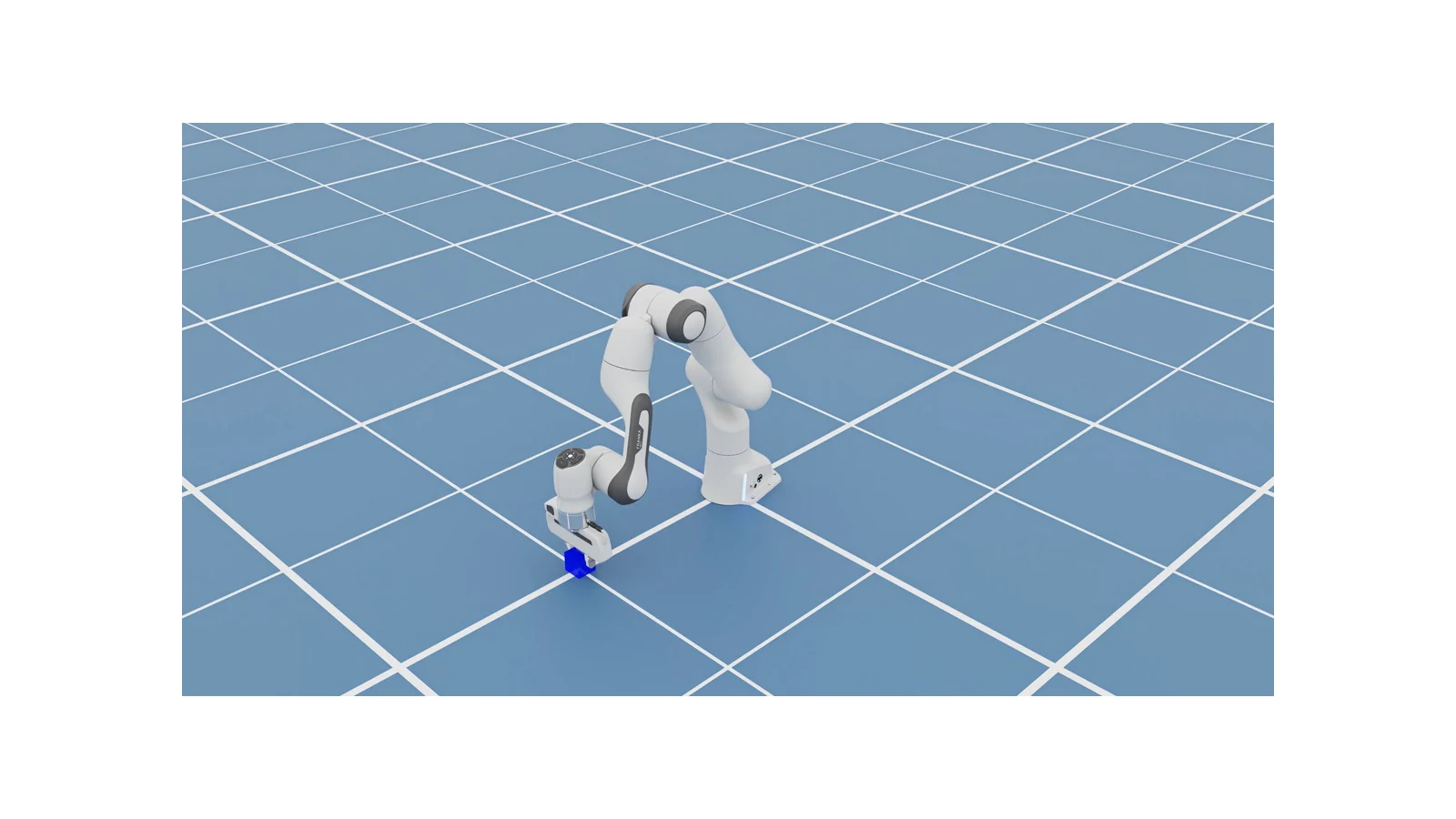
Official CoreWeave image: Franka in Isaac Sim. This is simulation, not a physical deployment or RoboMorrow hardware test.
Two offers addressing the same bottleneck
Before comparing two grasping policies, a team needs an environment, data, resources and a record of results. Rebuilding that stack for every experiment makes it harder to tell whether the model improved or the configuration changed. Our view is that these tools should be judged by reproducibility and engineering time, not simply by the number of software brands supported.
| Question | CoreWeave Physical AI Launchables | Nebius Physical AI Workbench |
|---|---|---|
| Starting point | Supplier-tested workload and environment templates | Open framework organising workflows and agent operations |
| Scope described on 21 October | Isaac Sim, CARLA, MuJoCo, AlpaSim and Cosmos 3 | Data generation, simulation, training and evaluation; NVIDIA and partner tools |
| Team responsibility | Own scenes, data, parameters and interpretation | Task definition, data, configuration and validation on hardware |
| First evaluation | Can the same run be reproduced with its output artifacts? | Is the workflow inspectable, controllable and reproducible? |
CoreWeave: begin with an environment that runs
CoreWeave says Launchables provides templates launched with one command. Teams can change parameters or application code within a prepared environment. Examples include Franka manipulation, warehouse scene generation and driving-scenario evaluation. The package also includes skills for coding agents. That is the supplier description, not our speed benchmark.
One command simplifies launch; it does not establish experimental quality. During a demonstration, request a single-parameter change, a recorded dataset version and a replay of the previous run. Inspect a failed run too: does the report distinguish task failure, missing resources and process completion? A finished computation is not necessarily a successful robot task.
Nebius: an open workflow with a European use case
Nebius describes Workbench as an open framework for the physical-AI lifecycle. Its announcement connects NVIDIA tools with partner software and names collaboration with Sereact on a sim-to-real workflow for Zalando returns handling. It reports customer claims of up to 40% less engineering time. That is not a common, independently published benchmark against Launchables.
Returned products, packaging and labels illustrate the challenge. A convincing training scene may still omit a deformed carton or an occluded label. Infrastructure success therefore needs a policy evaluation using representative cases. Exporting a model does not complete the journey from simulation to a working warehouse.
RoboMorrow has covered robotic returns handling for Zalando in Świebodzin. The new announcement concerns development tools and collaboration. It does not confirm that the entire described infrastructure is operating at that particular Polish site. A shared customer name is not proof of an identical deployment.
What to check before selecting the cloud
Start with the complete cost of one useful iteration: data preparation, resource waiting, compute, storage, retrieving results and engineering time. A cheaper GPU hour can produce a more expensive experiment if errors are difficult to reproduce. We provide no price ranking because we have not obtained comparable quotations for the same workload.
Next, test portability. Can you retain scenes, configurations, datasets and results in a usable form? Open orchestration code does not automatically mean free compute, unrestricted access to every component or effortless migration of the complete system. Look for answers specific to the tools your team uses.
Third, inspect agent control. Engineers should be able to see what changed, which resources were launched and which data was accessed. A useful experimental record distinguishes a new result from an accidental environment change. Deploying a model on a physical robot still requires validation appropriate to the task and surroundings.
Our assessment: compare evidence rather than the launch slogan
Launchables and Workbench address an unglamorous robotics problem: time between an idea and a result that can be trusted. We do not name a winner without running the same workload on both. Bring a small set of your own scenes, a required output format and a failure case that the system must identify correctly.
Our earlier CoreWeave Physical AI Field Engineering report concerned services and support. Workload templates are a different part of the offer. Our data and fleet analysis explains why the hardware alone is insufficient.
Sources and methodology
Redakcja RoboMorrow. Verified 26 October 2026. Analysis of documentation and source material; no physical hardware test. Manufacturer statements are not independent measurements.