CUEBUS and Yazaki Link an Automated Warehouse to a Humanoid in New Pilot
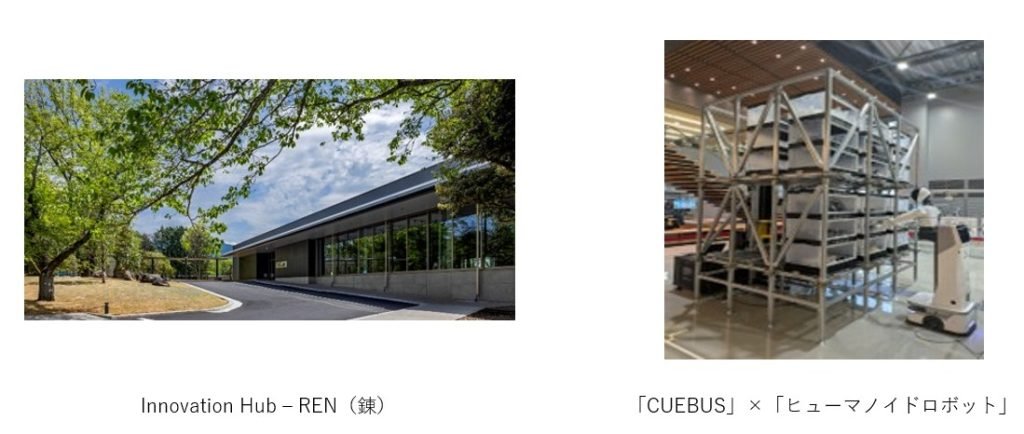
CUEBUS, Yazaki and Yamazen have announced a trial that connects a linear-motor automated warehouse with an autonomous humanoid at the new Innovation Hub – REN in Susono, Japan. In a September 10 release, the companies said the relevant demonstration would begin on September 21, 2026. During RoboMorrow’s same-day scan we did not find a separate September 21 confirmation of physical start, so we describe that date as the scheduled start of the pilot rather than independently verified operation. Source: CUEBUS.
The warehouse-to-humanoid interface is the interesting part
CUEBUS is not presenting a humanoid that performs an entire factory process by itself. The warehouse is supposed to retrieve a part or material automatically, the humanoid receives it, and the robot then transfers it into the next stage. The partners want to test the chain between different classes of automation: storage logistics, an autonomous humanoid and a physical-AI data layer.
That is a more practical problem than a single robot performing a scripted stage demonstration. Factory autonomy is a chain of dependencies. If the warehouse presents a container in the wrong pose, an identifier does not match, or the humanoid lacks current context, the process stops. The value of the experiment may therefore lie as much in data exchange and exception handling as in manipulation itself.
What CUEBUS contributes
CUEBUS describes its system as a high-density robotic warehouse using linear motors to move carriers quickly. At Innovation Hub – REN it is intended to store and automatically retrieve parts and materials. Yamazen participates as the partner associated with the humanoid and robotic integration, while Yazaki provides the test environment in its new innovation facility.
The announcement does not identify the humanoid model, robot count or gripper configuration. It also does not specify the parts, their weight, positioning tolerances, or whether the transfer is a direct handoff or uses a prepared pickup point. Those details would determine how difficult the manipulation problem really is.
What the partners say they will evaluate
The CUEBUS release highlights inter-process coordination, route efficiency and inventory-management optimization. Those are sensible targets for intelligent intralogistics. A humanoid does not need to be the fastest machine in a plant if it can serve several existing workstations without building a dedicated conveyor or fixed robot for each one.
No KPI, success threshold, pilot end date or cycle count has been published. Without those figures, it is impossible to know whether the project is intended to move quickly toward production or primarily to collect data and develop integration. After the scheduled start, the useful evidence would be completion rate, cycle time, human interventions and failures at the interface between systems.
Why heterogeneous robot cooperation matters
Factories already use many kinds of automation: AGVs, AMRs, conveyors, automated storage, cobots and fixed manipulators. A humanoid has an economic case only if it can enter that ecosystem without forcing a complete redesign. The CUEBUS/Yazaki trial therefore targets one of the more valuable physical-AI scenarios: connecting a flexible robot to an existing material flow.
The same lesson appears in RoboMorrow’s AMR versus AGV guide: the vehicle is only part of the system. Fleet management, communications, safety zones and WMS/MES integration can matter more to ROI than the maximum speed of one machine. A humanoid adds manipulation and more complex perception on top of that stack.
What Europe can learn
European automotive plants face a similar problem: many processes are already partly automated, but manual bridges remain between them. If a flexible robot can take over those transfers without rebuilding the whole line, it could unlock tasks where conventional automation has not produced an acceptable return. The conditions are safety, predictable behavior and integration with existing quality systems.
RoboMorrow therefore treats this as a promising pilot announcement, not proof of success. September 21 is the organizer-stated start date. Confirmation of operation and later performance data will determine whether CUEBUS and the humanoid can maintain a stable material flow in practice.
How we will know whether the pilot moves beyond a demonstration
After the scheduled start, the useful evidence will be completed cycle count, part-handoff time, failure rate and exception handling. It will be especially revealing whether the humanoid can adapt to a shifted load position or a warehouse delay, or whether the whole process depends on a tightly prepared environment. In manufacturing, those small deviations often separate an impressive demonstration from a system that can survive a full shift. A second strong signal would be a Yazaki decision to extend the trial into real production processes, additional workstations or a larger robot fleet.
What should happen when the handoff fails?
The most informative trial is not necessarily the one in which everything works perfectly. Consider a container placed slightly differently from the demonstration setup. The warehouse has completed its task, but the humanoid cannot confirm a successful grasp. The integrated system should recognize that state, prevent further feeding and leave an unambiguous message for the operator. This is an illustrative test of integration quality, not a function already verified in the Yazaki pilot.
Restart behavior matters just as much. If a part remains between two systems after an interruption, restarting should not lose its identifier or issue the same order twice. Recording task initiation, retrieval, handoff and acceptance creates a history for each individual job. That history makes later fault analysis possible. A video of one successful transfer cannot establish how the system handles a restart or a communication failure between components.
There is also an architectural choice. A humanoid should not automatically be considered superior to a fixed arm, conveyor or mobile manipulator. If pickup and delivery positions never change, a simpler arrangement may be sufficient. The argument for a more general-purpose robot becomes stronger only when tasks, locations or manipulation requirements change. A comparable question appears in our reporting on preparing Atlas for Hyundai’s manufacturing processes: where does flexibility create measurable value beyond what purpose-built automation can already deliver?
A useful final report could present average transfer time alongside the slowest cycles, reasons for failed attempts and time spent restoring operation manually. Separating training time from normal order execution would be particularly valuable. For companies preparing a related project, our business robotics section offers a starting point for defining the operating problem before selecting hardware. In the Yazaki case the concrete information is still the integration plan and scheduled trial. Published results would be needed to decide whether the partners simplified material flow or built an interesting but operationally narrow demonstration. The distinction protects the value of the experiment without announcing success in advance.
Sources and verification
CUEBUS’s September 10 release schedules the start for September 21. Same-day trial execution and results were not separately confirmed. Failure scenarios are editorial examples.