A robot did an hour of laundry uncut. Dyna 2.1 targets the whole workflow
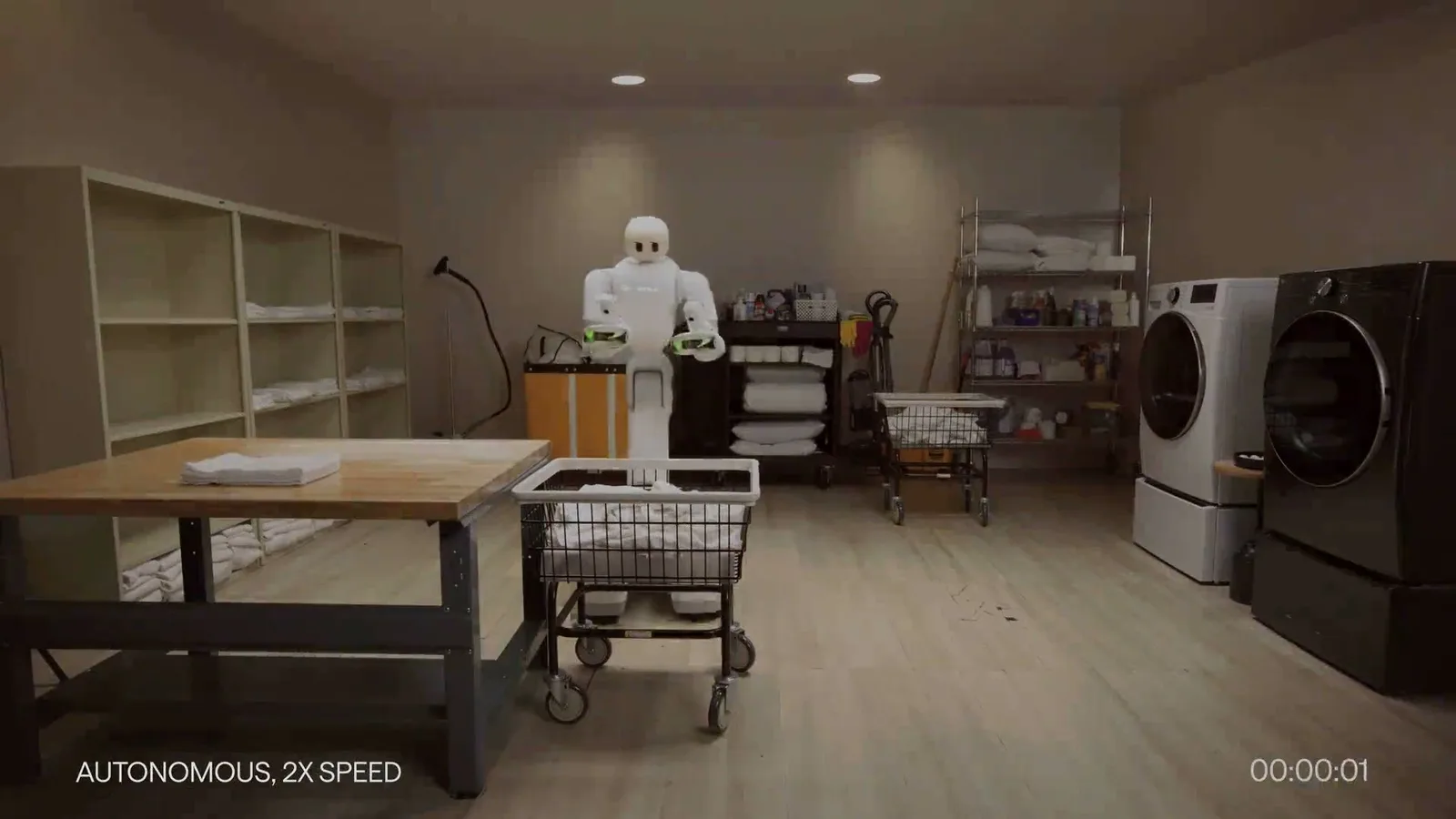
Dyna Robotics has shown something more useful than an isolated trick: an hour-long, continuous video of its Taku robot running a laundry workflow. The company calls Dyna-2.1 a “physical agent” and argues that customers do not buy autonomy for one grasp—they pay for an entire process to be taken over.
That makes this one of the more interesting launches of the week because it attacks a weak point in robotics demos. A machine can be excellent at one action and still need a person to refill bins, move between stations, start the next machine or recover the process after an error. Dyna is trying to change the product unit from a task to a workflow.
Taku is a wheeled semi-humanoid, not another biped
Taku has a human-shaped upper body, two seven-DOF arms, a folding lower body and a stable base on four steerable wheels. Dyna’s argument is that hotel laundry work requires reach, manipulation and travel between stations more than it requires legs.
The robot is intended to reach into washers and dryers, work at a folding table, place stacks on low and high shelves and move between those stations. The logic resembles other semi-humanoid systems: keep arms and human-compatible workspace geometry while using wheels when floors are flat and energy efficiency matters.
One uncut hour matters more than the best 30 seconds
Dyna publishes a one-hour laundry workflow that it says is uncut and autonomous. It describes the run as the first hour-long non-linear loco-dexterous workflow by a physical agent. That “first” is a company claim; RoboMorrow does not have an independent industry benchmark that can verify priority.
The value is different: long runs surface problems that disappear in highlight clips. A robot may grab two towels, a stack may lean, the washer and dryer finish at different times, and folding may need to be interrupted for a higher-priority machine. Small deviations like these are what often break real automation.
About 79 steps and unforgiving reliability math
Dyna estimates that one laundry cycle chains roughly 79 steps. It illustrates the compounding effect: even a 95% per-step success rate makes uninterrupted completion of the whole chain extremely unlikely. That is not a RoboMorrow test result, but it correctly frames why workflow reliability is harder than task reliability.
The system therefore needs recovery, not merely high nominal accuracy. Dyna shows examples of recovering after external interference and a double-towel grasp. A real deployment will need statistics on how often such events occur, how many are recovered autonomously and how many still become human interventions.
Three control layers
Dyna-2.1 uses a hierarchy. A whole-body controller trained with reinforcement learning in simulation tracks targets for wrists, elbows, chest and base at 100 Hz. Above it, an improved DYNA-2 policy converts the current step into whole-body target trajectories. A vision-language orchestrator tracks the workflow and selects what should happen next.
The split is sensible: a fast control loop should not wait for slower vision-language reasoning. The orchestrator can remember which machine is running, which load is where and how many towels were folded while lower layers keep executing physical motions.
A shared motion representation for people and robots
Dyna describes a Unified Robot Representation that records hand, elbow, torso and footprint poses in task space. The goal is to reuse teleoperation, human recordings and older robot data without redefining the action space whenever hardware changes.
The company says its policy pretraining mixes one million hours of human video with robot fleet data. That is a statement about Dyna’s training pipeline rather than an independently audited dataset. The business rationale is compelling: teach a customer-specific procedure with less robot time and preserve previous task data when the mechanical platform evolves.
What remains unknown
One uncut hour does not show that Taku can own an eight-hour shift across hundreds of days. There are no public distributions for attempts, interventions per day, MTBF, total system price, service burden or supervision requirements. Dyna itself says its next milestone is to bring the new system to real customer sites.
Generalization between laundries is another open question. Different machines, carts, shelf heights, textiles and operating rhythms can turn a successful lab workflow into a new integration project. That is where the gap between a strong demonstration and a scalable product will become measurable.
Why Dyna-2.1 matters
The most important idea is how success is defined. Robotics has long emphasized single-task success rates. Dyna proposes looking at the time horizon of a workflow a system can execute without intervention. That maps much more directly to what a customer buys: reduction in human workload.
If that evaluation style spreads, humanoid and semi-humanoid demos will have to show continuity, recovery and intervention counts rather than dexterity alone. Dyna-2.1 does not yet prove an unattended full shift. It does point toward a more useful way to test whether physical AI is becoming a product.
An hour-long workflow is a better test than one isolated skill
The useful part of Dyna’s demonstration is not that Taku can put a towel into a machine. Individual manipulation skills have appeared in many robot demos. The harder problem is keeping track of the whole process, choosing the next action, recovering from mistakes and completing a chain of dependent steps without an operator resetting the scene after every failure. Dyna’s own reliability example explains why: across roughly 79 steps, even a high per-step success rate compounds into a much lower probability of completing the full mission without recovery.
Procurement therefore needs more than a grasp success rate. A customer pilot should measure complete-workflow success, interventions per operating hour, mean time between interventions, recovery success, time lost after a failure and sensitivity to changes in laundry-room layout or textile mix. The next meaningful evidence threshold is sustained operation at a customer site over multiple shifts—not another carefully prepared video.
Featured image: frame from Dyna Robotics’ official workflow material showing Taku in the laundry environment. Image source.
Sources and methodology
This article uses primary sources plus editorial cross-checking and was verified on 3 October 2026. Manufacturer claims are kept separate from independent evidence. This is not a RoboMorrow hands-on test.