Jungheinrich opens EAC 212a sales. This is order intake, not another demo
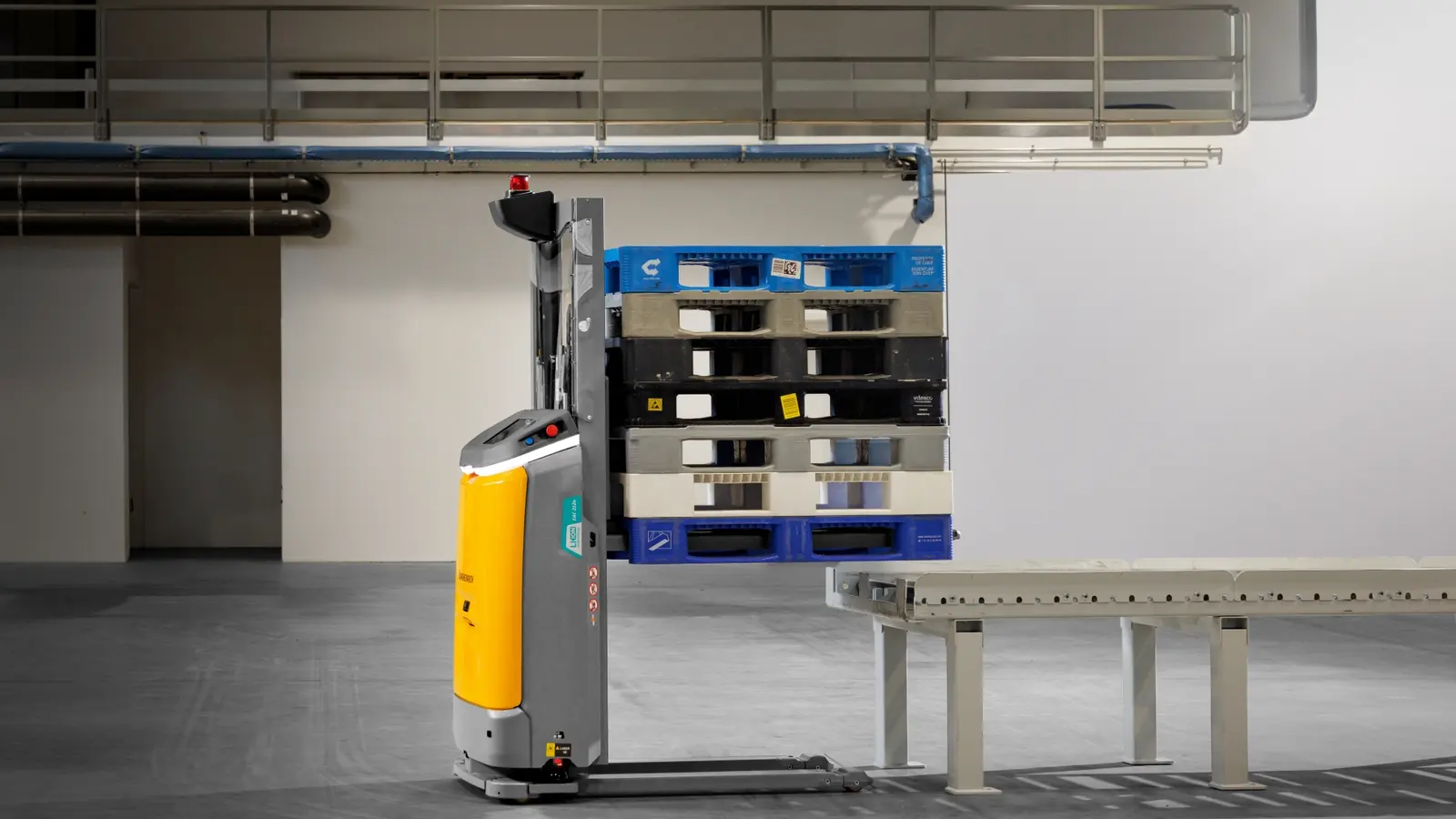
The EAC 212a is not a fresh trade-show prototype. Jungheinrich had already introduced it in 2026; on October 1 the company officially opened sales. That is the more meaningful market threshold: the product moves from “here is a new AMR” to something intended for actual warehouse, production and dispatch projects.
The robot is designed for autonomous pallet transport and includes integrated lifting. Jungheinrich positions it as a link across goods receipt, warehousing, production and shipping, with an implementation model that can start with one vehicle and scale later.
Sales are open—a different proof point from a reveal
EAC 212a had been presented before October, including around LogiMAT 2026. October 1 should therefore not be framed as the birth of a new robot. The new event is the official opening of sales and order intake.
That distinction matters for business readers. A demo shows what a supplier intends to build. An open sales channel allows concrete questions about quotation, deployment, SLA, schedule and integrator responsibility.
What EAC 212a is intended to automate
Jungheinrich describes material flow from goods receipt through storage and production to dispatch. The robot can connect floor storage, lanes and block storage with conveyor systems, automated storage and retrieval systems, and production or packaging equipment.
Integrated lifting is central. Earlier launch material specified transfer heights up to 1,200 mm and loads up to 1,200 kg. That lets the AMR perform tasks where a simple cart-towing platform would not be sufficient.
AI pallet recognition is less flashy than a humanoid—and easier to value
In its earlier product introduction, Jungheinrich described AI-supported 3D pallet recognition intended to compensate for pallet offsets of ±100 mm and rotation of ±10°. It also described contour-based autonomous navigation designed to reduce infrastructure modifications.
Those details are practical because a warehouse rarely maintains perfect CAD geometry. Pallets sit slightly off position, people move loads and traffic is mixed. A pilot still needs to measure the site’s actual distribution of misalignment and edge cases rather than assuming brochure limits cover every situation.
The company says demand was strong before order intake
Jungheinrich reports strong interest in EAC 212a before the formal sales start. Frederik Brantner, Vice President Robotics, points to ease of integration and the range of applications. The company does not publish an order count in the release.
“Strong demand” should therefore not be converted into a claim of proven market success. Meaningful evidence will be unit sales, deployed sites, commissioning time and operational availability.
Start with one robot, then scale
Jungheinrich emphasizes that many applications do not require extensive infrastructure changes. Its go-to-market logic is to begin with a single robot and later add vehicles, process zones and system connections.
That is a sensible deployment model when a pilot has explicit acceptance criteria. One AMR should prove a defined material flow: safe pallet missions, cycle time, interventions, downtime, blocked routes and mixed-traffic behavior. Fleet expansion should follow that evidence.
Recovery software matters more than perfect demo driving
At sales launch, EAC 212a inherits functions developed for EAE 212a, including automated block-storage handling, intelligent pallet-position management, higher storage/retrieval speeds and optimized recovery functions designed to resolve some disruptions autonomously.
This category is critical. In a real warehouse, ordinary navigation is rarely the only cost driver. Economics deteriorate when every unusual pallet placement or interrupted mission requires a technician. Manual recoveries per 100 missions should be part of a serious pilot dashboard.
Physical AI is a roadmap layer, not proof every feature ships today
Jungheinrich says the software architecture creates a foundation for future Physical AI capabilities such as camera-based recognition and handling of different load carriers. “Foundation” is the operative word: the announcement does not establish that every future capability is available in every configuration now.
Procurement should separate functions included at delivery from roadmap items. In logistics, the difference between “supported now” and “planned” directly changes ROI and project risk.
What to verify before buying
The practical checklist includes WMS/WCS and automation interfaces, route mapping, mixed traffic, charging, recovery, safety, service and the exact pallet-transfer envelope. Buyers should measure both throughput and active human minutes required to keep the system operating.
EAC 212a is also a reminder that the robotics market is much larger than humanoids. A system that reliably links several existing material-flow stages may create value sooner than a more general robot. With sales now open, that proposition can be tested in real projects rather than judged from a trade-show floor.
What an EAC 212a acceptance test should include
In a pallet project, end-to-end transfer repeatability matters more than navigation alone. Site acceptance should cover different pallets and load carriers, real placement tolerances, pickup from floor locations and conveyors, mixed traffic with people, and recovery after a load is obscured or displaced. Jungheinrich specifies an integrated lift, connections across multiple process areas and recovery functions, but the local layout determines how much of that capability becomes usable throughput.
Operators should measure missions completed without intervention per 1,000 orders, average recovery time, vehicle availability, queues at transfer points, charging impact and the amount of human work required to resolve exceptions. WMS/WCS integration should be tested against a normal order stream rather than a prepared demo route. Those data make it possible to compare the EAC 212a with a simpler AMR, an AGV or retaining part of the process in conventional automation.
Featured image: official Jungheinrich press photo showing the EAC 212a carrying pallets. Image source.
Sources and methodology
This article uses primary sources plus editorial cross-checking and was verified on 3 October 2026. Manufacturer claims are kept separate from independent evidence. This is not a RoboMorrow hands-on test.