MAMMOTION LUBA 4 AWD vs LUBA 3 AWD: buy now or wait for 2027?
BUYING IN YOUR MARKET
Availability in your country
Sales, delivery and support can differ by country and exact model. Choose your market to see the evidence we have checked.
MAMMOTION LUBA 3 AWD 3000
Mammotion EU — supported destinations
Regional store lists this model — delivery country supported
- Seller / sales channel
- Mammotion EU
- Price
- See the linked offer for the current price, configuration and taxes
- Delivery
- Seller lists this country as a delivery destination; confirm postcode, model stock and dispatch at checkout
- Warranty and service
- Confirm warranty territory, local service and return shipping with the seller
Delivery countries: Sweden, Denmark, Austria, Belgium, Bulgaria, Croatia, Czechia, Estonia, Finland, Greece, Hungary, Ireland, Latvia, Lithuania, Luxembourg, Portugal, Romania, Slovakia, Slovenia, Poland, Netherlands, Switzerland
Exact model listing and the store’s delivery policy are linked separately. Supported delivery is not proof of current stock or local service.
Evidence checked: · Not a live stock feed
Mammotion EU: model offer ↗Supported delivery countries ↗No verified local offer in this dataset
No country-specific offer for this exact model has been established in our current sources. This is a gap in our research, not a statement that the robot cannot be bought here. Use the manufacturer’s sales contact to request a supplier serving your address; confirm configuration, imports, warranty and service.
- Price
- No verified local price in this dataset
- Delivery
- No confirmed date for your address
- Warranty and service
- Local coverage not verified
MAMMOTION LUBA 4 AWD: Quad-Vision, active steering and 12,000 m²
No verified local offer in this dataset
A current local sales offer, exact regional variant, delivery date and service coverage have not been verified for this country in the regional dataset. This does not mean that the robot is unavailable.
- Price
- No verified local price in this dataset
- Delivery
- No confirmed date for your address
- Warranty and service
- Local coverage not verified
“Listed” confirms a product page or sales route, not stock, delivery to every address or local service. “Pre-order” is not immediate availability. Unverified means we lack evidence; it does not mean unavailable. Prices belong to the named market and currency. Confirm the exact version, tax, shipping and support before ordering.
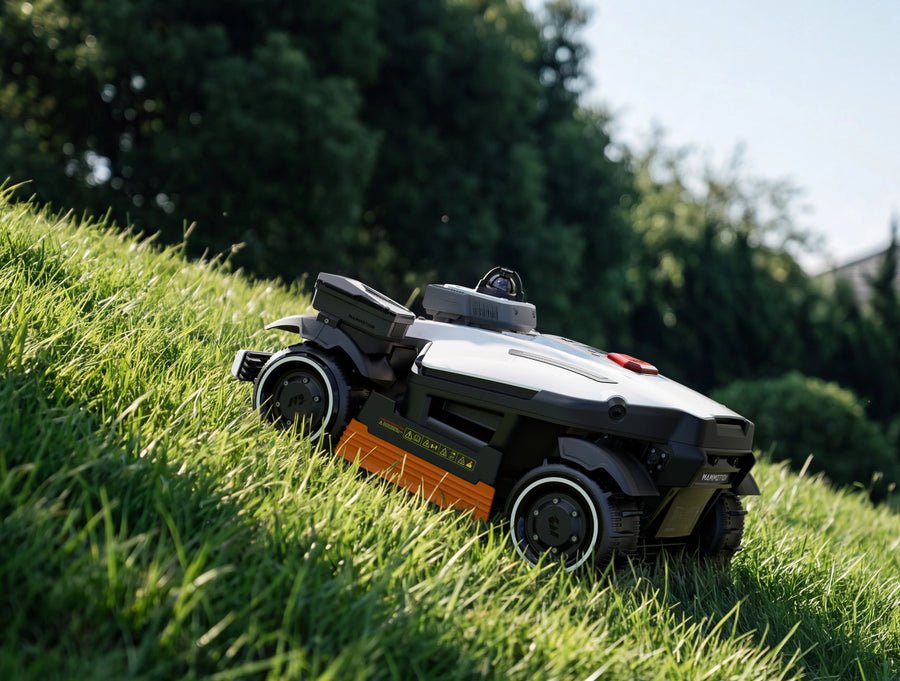
MAMMOTION LUBA 4 AWD is not a LUBA 3 with one larger number. Both generations offer AWD rated to 80% slopes and hybrid navigation built around 360° LiDAR. The real change is how the mower sees its surroundings while travelling in both directions and how it physically turns. LUBA 4 adds four cameras, independent front-wheel steering, bidirectional driving and an optional edge trimmer.
That creates a clear buying question: should you buy LUBA 3 now, or wait for LUBA 4? On 3 September 2026 the answer depends on the garden and purchase timing because LUBA 3 is a shipping commercial product while LUBA 4 is a 2027-generation preview without public pricing.
30-second verdict
| If your priority is… | Choice today | Why |
|---|---|---|
| buying this season | LUBA 3 AWD | shipping product with known variants and retail channels |
| minimum turn marks | LUBA 4 AWD on paper | independent front steering + bidirectional driving |
| mature configuration | LUBA 3 AWD | specification, app and market are established |
| 360° perception while driving both ways | LUBA 4 AWD | four cameras instead of two |
| very large lawn | LUBA 4 AWD 12000F | family extends to 12,000 m² |
| automated border finishing | LUBA 4 AWD | optional edge trimmer, except 12000F |
| best value today | cannot judge LUBA 4 yet | new-generation pricing is still unknown |
LUBA 4 AWD vs LUBA 3 AWD — key differences
| Feature | LUBA 4 AWD | LUBA 3 AWD |
|---|---|---|
| Generation | 2027 / IFA 2026 preview | 2026 commercial model |
| Navigation | 360° LiDAR + NetRTK + Quad-Camera AI Vision | 360° LiDAR + NetRTK + Dual-Camera AI Vision on main variants |
| Cameras | 4 — front, sides, rear | 2 |
| AWD | yes | yes |
| Slope | up to 80% / 38.6° | up to 80% / 38.6° |
| Direction change | active steering + bidirectional driving | omni-wheel / conventional LUBA manoeuvres |
| Family coverage | 3,000–12,000 m² | roughly 1,500–10,000 m² depending on market/variant |
| Cutting system | 2×165 W or 3×165 W | dual-disc on typical variants; spec varies by version |
| Terrain obstacle | up to 60 mm per MAMMOTION | check exact variant |
| Edge trimmer | optional; not for 12000F | no equivalent integrated family accessory |
| Charging | 210 W + adaptive “charge enough to finish” | fast/adaptive; variant dependent |
| Price 3 Sep 2026 | not announced | retail product; pricing varies by variant and promotion |

1. The biggest difference is not LiDAR
Both generations use 360° LiDAR and hybrid positioning. LUBA 3 already has Tri-Fusion with LiDAR, NetRTK and cameras, up to ±1 cm manufacturer positioning, automatic mapping and multi-zone management. Simply adding “LiDAR” to LUBA 4 is not an upgrade reason.
The upgrade starts where the new mower needs to see its surroundings while travelling either way. Quad-Vision places cameras at the front, sides and rear. That is not merely “more AI”; it is the sensing foundation for a different driving architecture.
2. LUBA 4 targets a weakness of heavy AWD mowers: turns
Current LUBA 3 family models weigh around 19 kg and use powerful AWD. Heavy machines can leave marks when repeatedly pivoting in the same location. MAMMOTION explicitly markets LUBA 4 around “No U-Turn. No Damage.”
The front wheels have independent steering motors and are designed to roll through an arc rather than scrub sideways. The mower can also reverse its logical travel direction and start the next lane without a conventional U-turn. On delicate turf this could matter more than another mapping accuracy claim.

3. Quad-Camera vs Dual-Camera: are four always better?
No. A camera matters only when software uses the extra field of view. On LUBA 4 this has architectural logic because the machine is designed for bidirectional travel. Side cameras can also see moving objects earlier during manoeuvres.
LUBA 3 already recognises 300+ obstacles under MAMMOTION definitions and uses LiDAR as a geometric sensing layer. In an open, regular garden the camera-count difference may be minor. In a garden full of trees, toys, beds and narrow passages the potential benefit grows.
4. Slopes: an 80% tie
Both generations are marketed for maximum slopes up to 80% / 38.6°. That matters because LUBA 4 is not arriving to “finally handle hills”. LUBA 3 is already one of the stronger machines in this area.
If a steep slope is your only buying reason, the new model has no paper advantage in the headline number. Differences may appear in line control, turning on slopes and obstacle traversal, but that requires side-by-side testing.
5. 12,000 m² changes the top of the range
LUBA 4 12000F uses three 165 W cutting discs and targets very large properties. That extends beyond the typical LUBA 3 range sold through current European channels. For a 2,500–4,000 m² property this may mean nothing; near 8,000–12,000 m² it can be decisive.
Do not directly compare 12000F with LUBA 3 AWD 3000 simply because both say LUBA. They are different area classes and may have very different pricing.
6. Edge trimmer: the biggest “last five percent” difference
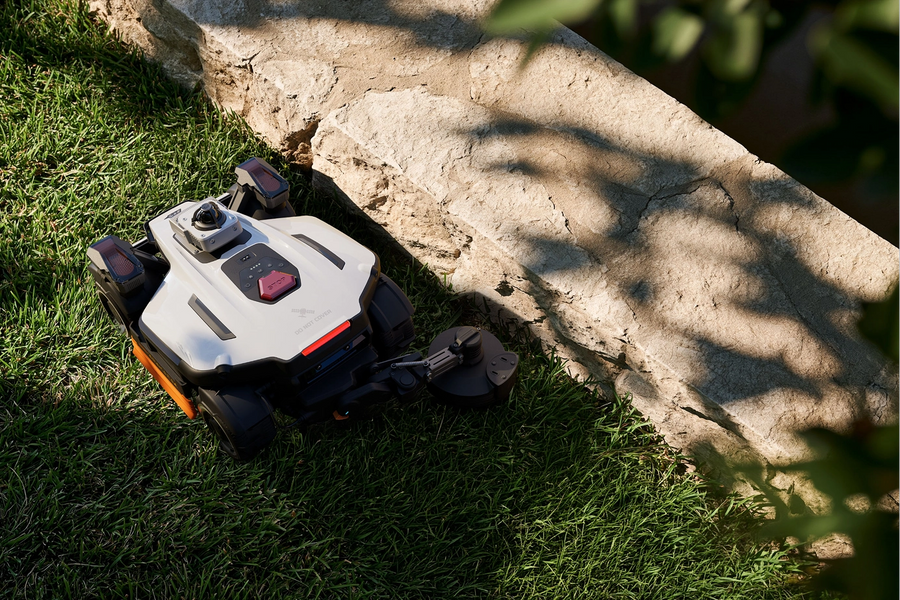
LUBA 4 can use a side-mounted edge-trimming accessory designed for walls, fences and borders where the main disc is limited by chassis width. LUBA 3 has no equivalent accessory in the current family.
It is not a free standard feature. The trimmer is optional and does not fit 12000F. Buyers should compare the price of the complete configuration, not only the base mower.
7. LUBA 3 has one huge advantage: it exists as a retail product
LUBA 3 AWD is already sold, with known variants, user feedback, manuals, accessories and service conditions. Buyers can check Network RTK coverage, compare prices and put the mower to work this season.
LUBA 4 is officially revealed but detailed pricing and regional retail plans come later. The best IFA feature does not mow a lawn until the machine can actually be purchased.
8. LUBA 3 is not technologically “old”
360° LiDAR, NetRTK, Dual-Camera AI Vision, up to 215 minutes runtime and up to 1,700 m² per charge on higher variants, 80% AWD and sophisticated map editing keep LUBA 3 highly advanced. A regular lawn may not benefit enough from waiting.
The wrong assumption is that LUBA 4 automatically turns LUBA 3 into a bad purchase. If the new model carries a large premium, the current generation may become better value.
9. When should you wait for LUBA 4?
- you are buying for the 2027 season;
- your current mower damages turf during repeated turns;
- automated edge finishing is a high priority;
- your garden has many obstacles and benefits from full-surround sensing;
- you need a variant close to 12,000 m².
10. When does LUBA 3 still make more sense?
- you need a mower now;
- you already have proven service and parts access for the current generation;
- turn marks are not a problem in your garden;
- LUBA 4 turns out to be substantially more expensive;
- 3,000–5,000 m² and current LUBA 3 throughput fully cover your needs.
Where to buy
| Model | Official | Amazon | Status 3 Sep 2026 |
|---|---|---|---|
| LUBA 4 AWD | MAMMOTION — official product page | No exact verified Amazon listing | 2027 generation; price not announced |
| LUBA 3 AWD | MAMMOTION EU — LUBA 3 AWD | Amazon.com — exact LUBA 3 AWD 5000 US (ASIN B0GWLG3D39) | retail product; pricing/stock vary by variant |
The Amazon.com affiliate link is for the exact verified LUBA 3 AWD 5000 US variant. It is not a LUBA 4 listing and not the Polish 3000 variant. RoboMorrow did not verify an exact Amazon.pl LUBA 4 offer.
11. Cutting system and throughput: LUBA 4 may pull away on very large properties
LUBA 4 3000F and 6000F use two 165 W cutting-disc motors, while 12000F uses three. MAMMOTION is therefore scaling not only battery or declared coverage but the cutting system itself. On a large property this makes sense: more working width and power reserve can maintain higher speed through denser grass instead of slowing down or repeating passes.
LUBA 3 still has a very capable wide dual-disc system, and higher variants can cover roughly 1,700 m² per charge according to the manufacturer. If a property is 2,500–4,000 m² and the mower can work regularly, that may not be a practical limitation. LUBA 4 becomes more compelling when the goal is shortening the total mowing window or the property approaches the upper end of the new family.
12. Charging: the new generation tries to reduce downtime, not just enlarge the battery
MAMMOTION specifies a 210 W charger for LUBA 4 and an adaptive algorithm that estimates how much energy is required to complete the remaining area. Instead of always charging to 100%, the mower can top up only enough to finish and return to work. This could matter on large properties where the last 10–20% of a task does not justify a full charge cycle.
LUBA 3 also uses fast and adaptive charging, but its behaviour and runtime are already documented more fully through the current product range. LUBA 4 still lacks complete battery-capacity figures for 3000F, 6000F and 12000F, so it is too early to calculate how many hours per day the new charging logic actually saves in a specific garden.
13. Cost of ownership: base price is only the beginning
A flagship robot mower should be compared on total ownership cost, including blades, garage, accessories, connectivity, service and any border module. LUBA 4 may require purchasing the edge trimmer separately, and 12000F does not support it at all. On the other hand, MAMMOTION says iNavi / Network RTK is free for the life of the product where coverage exists, potentially reducing infrastructure cost.
LUBA 3 has a predictability advantage because accessory prices, replacement parts and current retail conditions are already known. New-generation launches also often create a period when the outgoing model is discounted faster than the new model can justify its premium. If LUBA 4 launches at a large price gap, a discounted LUBA 3 could become one of the strongest value buys of the 2027 season.
14. Who should actually upgrade from LUBA 3 to LUBA 4?
An owner of a working LUBA 3 should not replace it simply because a new generation exists. The most logical upgrade case is someone with a real problem in one of three areas: repeated turf marks during turns, substantial manual border trimming or a property with enough obstacles that full-surround perception could reduce human interventions.
If LUBA 3 already maintains the lawn without visible turn damage, reaches every zone and rarely needs rescue, the benefit of LUBA 4 may be small. New sensors and active steering are valuable when they solve a specific garden problem, not merely because they look impressive in a specification table.
15. How RoboMorrow should test LUBA 4 vs LUBA 3 once both are available
The useful comparison should run on the same property with the same mowing schedule. We would measure human interventions, total task time, turf marks after one week and one month, the uncut strip beside several border types and obstacle-avoidance performance against the same objects. Adaptive charging should also be measured for time and energy saved.
Only that kind of test can show whether active steering and bidirectional driving are a real generational change or mainly an elegant mechanical concept. Until then, this RoboMorrow comparison remains an analysis based on official manufacturer information rather than a simulated hands-on review.
RoboMorrow verdict
If you need a mower now, LUBA 3 AWD remains a rational purchase. If you are buying for 2027 and your garden suffers from turn marks or manual border finishing, LUBA 4 is worth waiting for until pricing is announced.
The biggest upgrade is not the 80% slope rating or LiDAR — LUBA 3 already has both. It is the change in movement mechanics: active steering and bidirectional driving, supported by four cameras. If it works as advertised, LUBA 4 may mow not only autonomously but more gently. Price will decide whether that upgrade makes economic sense.
Sources
- MAMMOTION — LUBA 4 AWD
- MAMMOTION — IFA 2026 launch
- MAMMOTION EU — LUBA 3 AWD
- RoboMorrow — LUBA 3 AWD 3000 database profile
- RoboMorrow — IFA 2026 Live Desk
Where to buy models from this article
We show only exact verified Amazon product pages. Before purchase, confirm the variant, seller, warranty and box contents.
Exact Amazon links. Where a verified RoboMorrow marketplace tracking ID is active, the link is an affiliate link and we may earn from qualifying purchases. Price and availability can change after you click.
Before buying: variants, offers and further comparisons
- Compare variants in the appropriate area class and check regional availability for each generation.
- Keep LUBA 3 AWD 3000 and 5000 offers separate: a listing for one does not establish availability of the other.
- Before paying for a newer model, request a demonstration on your route and confirm service, parts and connectivity terms.