Maniformer Passes 1M Hours of Physical AI Data and 20,000 MEgo Devices
The Physical AI race increasingly looks less like a contest over who can build the most eye-catching humanoid and more like a race to produce enough useful experience for models. Robots need data about grasping, moving, opening, sorting, preparing, carrying and interacting with objects across homes, offices, shops, factories and warehouses. Maniformer is trying to build that infrastructure layer. On August 31 the company said it had passed one million hours of real-world data and delivered its 20,000th MEgo device.
The interesting part is that Maniformer is not relying entirely on conventional robot teleoperation. MEgo devices are designed to capture natural human behaviour directly in real environments without requiring a robot to be present for every demonstration. The company then processes those observations into structured spatial, motion and multimodal data intended for embodied-AI and vision-language-action models.
What the one-million-hour dataset actually contains
Maniformer says the accumulated data spans 22 major scene categories, more than 10,000 real-world environments, over 50,000 object categories and more than 500 fine-grained tasks. The company lists eight broad application areas: residential, office, retail, manufacturing, warehousing, food service, entertainment and transportation.
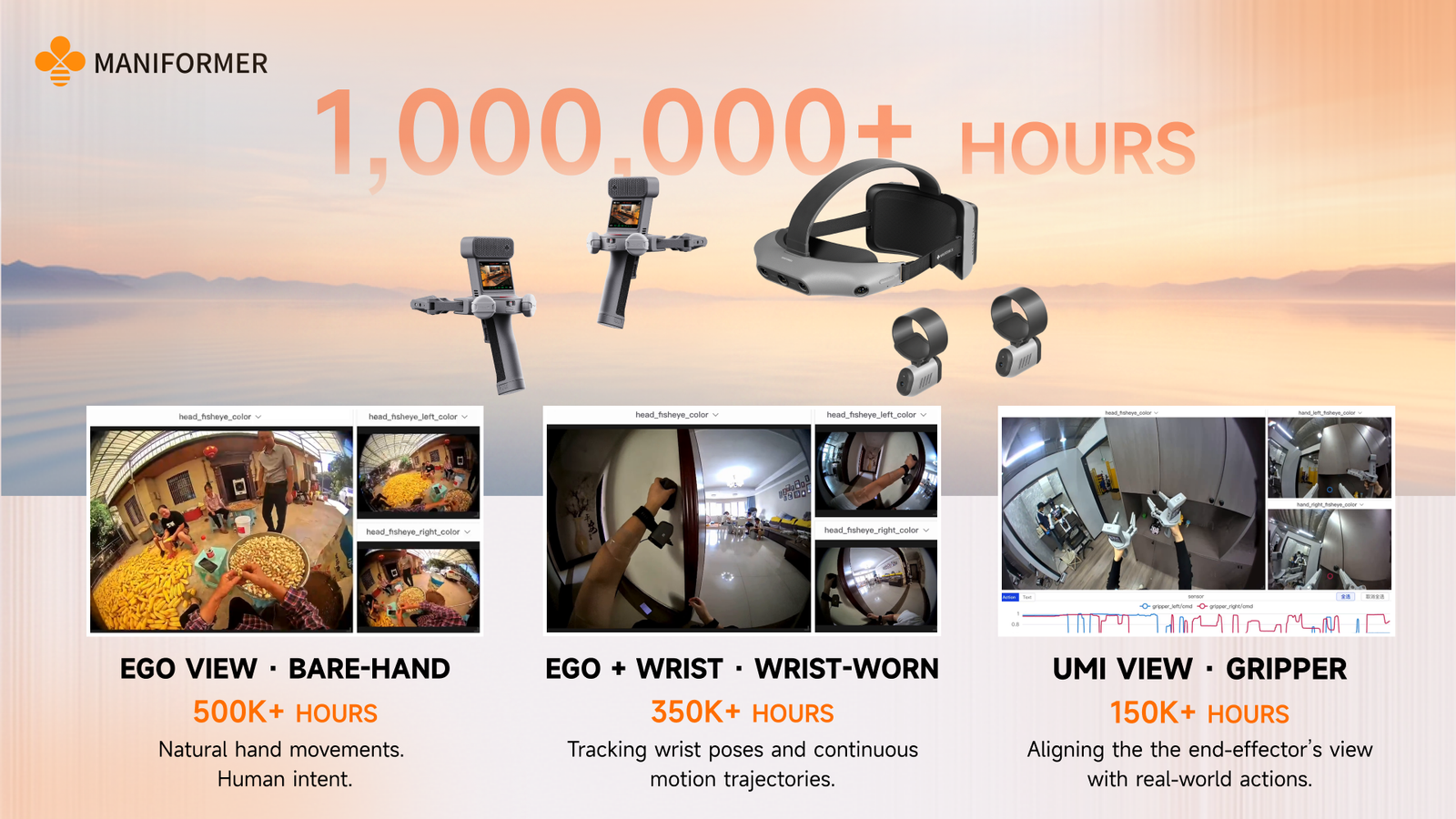
The dataset is not just ordinary video. Maniformer describes synchronized RGB, depth, IMU, tactile, audio and motion-trajectory signals. Roughly 500,000 hours come from Ego View first-person bare-hand capture, about 350,000 hours from Ego + Wrist with wrist-mounted motion sensing, and around 150,000 hours from UMI Gripper data that records end-effector and gripper trajectories.
This architecture targets one of robotics' most expensive bottlenecks: a robot does not have to be physically present for every demonstration. If human motion can be reconstructed accurately enough and transferred to different embodiments, a large dataset may be cheaper and faster to build. That is still a hypothesis that needs closed-loop robot evidence, but the infrastructure is already operating at a scale far beyond a typical academic collection project.
The 20,000th MEgo went to JD; Tencent Robotics X enters the picture
Independent Chinese reporting says the 20,000th MEgo unit was handed to JD and is expected to enter real business operations. The same reports say Maniformer has also reached a data-services collaboration with Tencent Robotics X to support embodied-AI model development. Those details matter because they connect the hardware milestone to named technology customers rather than leaving it as a production number in isolation.
Important commercial details remain missing. We do not know how many of the 20,000 units were sold to customers, how many operate in Maniformer's own collection network, how many are active concurrently, what a useful processed hour costs, or how much revenue is being generated from data services versus hardware. Device count is not the same as commercially valuable training data.
MEgo Engine, HandPose and the quality problem
Collecting a million hours is not enough if actions cannot be reconstructed accurately. Maniformer therefore pairs the hardware with MEgo Engine for processing, perception, annotation and quality evaluation, plus its HandPose reconstruction technology. The company says internal evaluations reduced PA-MPJPE reconstruction error by 62% versus the next-best solution and frame-to-frame jitter by 93%. Its MPR stack is claimed to reconstruct head, hand and gripper trajectories with less than 1 cm of error.
Those are Maniformer claims. RoboMorrow has not seen an independent reproduction of the benchmarks, the complete evaluation configuration or all comparison baselines. The more consequential metric is whether data collected with MEgo can reduce the amount of robot-specific teaching required while increasing task success and reducing human interventions in deployment.
Why this connects to Figure Index and Isaac 0.5
Maniformer is part of a broader shift. Days earlier, Figure disclosed Index, its crowdsourced physical-data network, while Perceptron released Isaac 0.5, a robot-brain model mixing experience from many robot systems with large amounts of general video. The common strategic idea is that defensibility may increasingly emerge from a loop of data engine → model → deployment → new data, not only from the mechanical platform.
Why Europe should care
European deployments add a regulatory layer. First-person video, audio, hand motion and workplace capture can include information about bystanders, customer environments and proprietary industrial processes. GDPR, consent, anonymisation, retention, cybersecurity, cross-border transfer and dataset provenance all become important when data collection moves from controlled labs into thousands of real locations.
For European robotics companies, the practical question is whether specialised physical data can be purchased as infrastructure instead of recreated from scratch. If external datasets materially shorten integration time for a new manipulation task, companies like Maniformer could become an enabling layer for Physical AI in the same way specialised data providers became important to large-scale model development.
Sources
Maniformer / GlobeNewswire — primary announcement · Securities Times — 20,000th MEgo delivered to JD · Yangtzeer — JD and scale context · Maniformer — company site