$75M for a robotic drug factory. AstraZeneca invests—and already uses the system
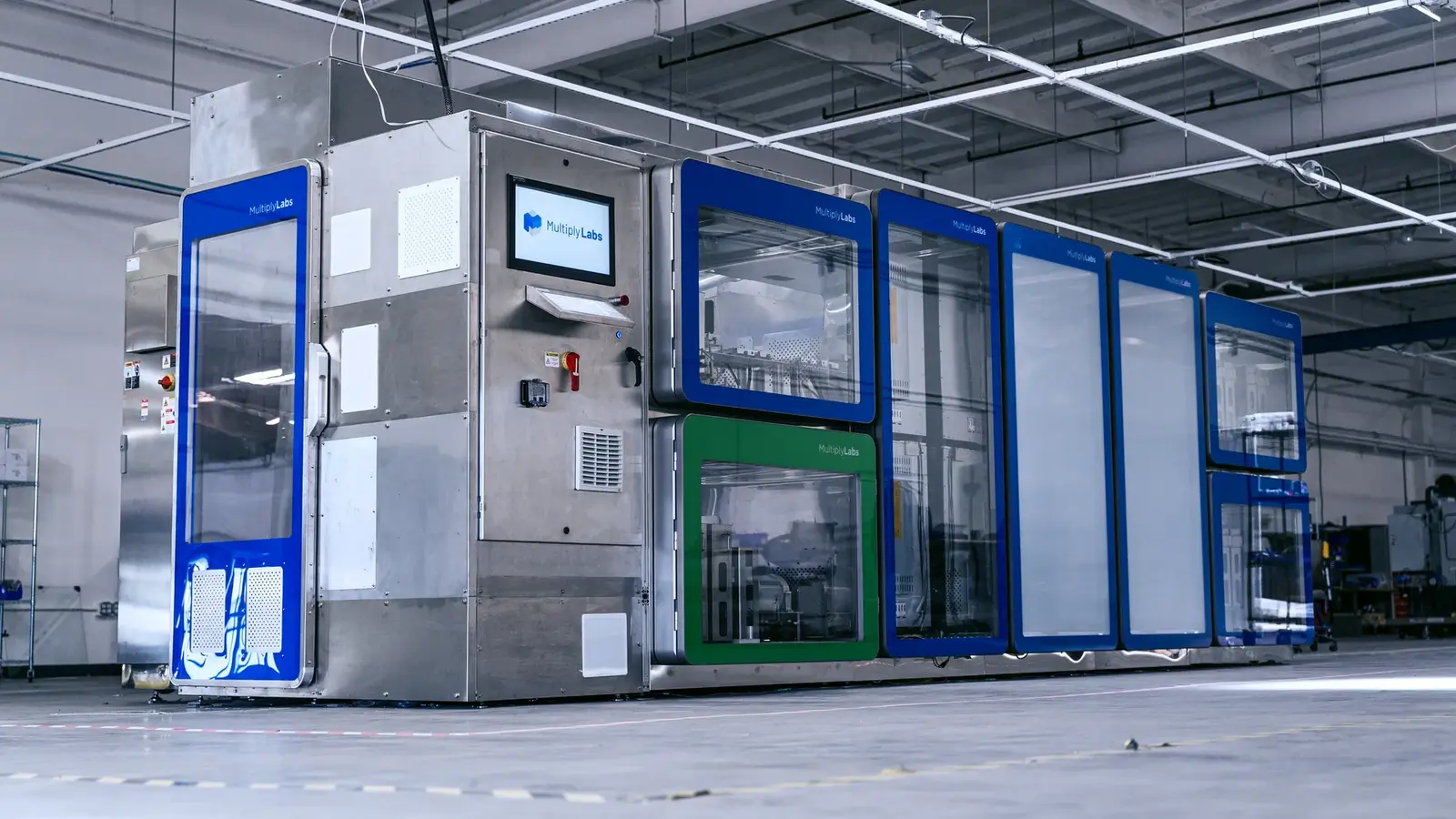
A robotic system that moves samples between instruments and executes multi-stage biological processes has secured new fuel for scale. Multiply Labs closed a $75 million Series B, with AstraZeneca and Teradyne among the new investors. The company says its clusters are already operating with pharmaceutical customers. This is not a prototype-only story—but it is not proof that autonomous drug factories have become standard infrastructure.
$75 million—and an investor that is also a customer
Multiply Labs announced the round on 6 October 2026. Dr Patrick Soon-Shiong and NantWorks led the financing. New investors include AstraZeneca, Lingotto, Teradyne and Strange Ventures, while Lux Capital, Founders Fund and Casdin Capital are among the returning backers. The company says it has now raised more than $100 million since it was founded in 2016.
The most useful signal is not the round size alone. AstraZeneca appears in the announcement as both an investor and one of the disclosed users of the technology. Multiply Labs also lists Legend Biotech and Kyverna Therapeutics. That reduces the risk that the funding supports only another laboratory demonstration. However, the value of those contracts, the number of systems at each customer and independently audited production results remain undisclosed.
What does the Multiply Labs robotic “factory” look like?
The product is not a single humanoid. It is an enclosed manufacturing cluster with a footprint of under 600 square feet, or roughly 56 square metres. Company specifications describe four robotic arms and twelve modular instrument towers. The arms perform repeatable operations around existing laboratory equipment: transferring materials, manipulating tubes and syringes, and coordinating the sequence of process steps.
Multiply Labs says the platform is designed around a customer’s existing instruments and procedures rather than requiring an entirely new factory. Its software records operations and process data, while the cluster is intended to run in a closed, GMP-compliant environment. For a drug manufacturer, the important qualities are not dramatic motion but repeatability, batch traceability, contamination control and a defensible record of what happened during production.
74% lower cost and 100 times the throughput are company claims
Multiply Labs publishes strong numbers: a 74% reduction in cost per dose, automation of 90% of cleanroom steps and up to 100 times more throughput per unit of floor space than manual manufacturing. It also gives a range of 2,000 to 10,000 or more doses per year for each cluster, depending on the process and its duration.
Those metrics matter, but they should not be presented as universal outcomes for every medicine. The funding announcement does not publish the full comparison methodology, customer-by-customer results, uptime, rejected-batch rates or operator interventions. A process for one therapy can differ substantially from another. RoboMorrow therefore treats these figures as manufacturer claims, not an independently verified benchmark.
Independent reporting shows an earlier commercial stage than the PR suggests
Business Insider reported that Multiply Labs currently has a “high single-digit” number of machines deployed and that each still costs several million dollars to build. This context is important. The company has real installations, but it remains at an early stage of commercialisation. Management wants to reduce manufacturing cost from millions to tens of thousands of dollars, yet the report does not establish that this target has been reached.
The new capital is intended to expand manufacturing capacity, accelerate the product roadmap and grow engineering, regulatory and commercial teams. Those are logical uses for a company whose challenge is no longer only to build a working station, but to manufacture expensive systems repeatedly and deploy them inside tightly controlled pharmaceutical facilities.
Why this funding matters for industrial robotics
Physical AI coverage often rewards general-purpose robots that look impressive in short videos. Multiply Labs takes the opposite route by targeting a specific, expensive and measurable workflow. If the platform reduces manual material handoffs, raises throughput and preserves procedural compliance, a customer can calculate value in doses, cleanroom time, rejected batches and labour.
That is why AstraZeneca’s presence on both sides of the table matters. A large pharmaceutical company can assess the platform as a user and then add capital to its scale-up. This is not evidence of robot mass production or blanket regulatory acceptance for every process. It is, however, a stronger commercial signal than a memorandum of understanding or a demonstration without a named customer.
What does it mean for Europe?
Multiply Labs is based in the United States, but the story has a European dimension. AstraZeneca is a global pharmaceutical company, and Multiply Labs says its supply chain spans Europe. For European manufacturers of cell and gene therapies, mRNA products and other biologics, the potential value is reducing the bottleneck between discovering a therapy and producing it with repeatable quality.
No EU deployment, European price, local service network or regional expansion timetable has been announced. A facility evaluating the system should ask about validation for the exact process, documentation for the relevant regulator, responsibility for integration, recovery time after faults and the cost of consumables. The robotic hardware is only one part of total deployment cost.
How should the promise be measured?
The most useful indicators are cost per good dose, throughput after downtime, rejected-batch rate, operator interventions, changeover time and completeness of process data. Only those measures can show whether the investment creates a repeatable production advantage instead of automating one visually impressive step.
RoboMorrow used the same process-first lens for RobotPlusPlus after two million operating hours, Universal Robots Gen 7 arms and JD Logistics’ specialised robot fleet. Hardware, integration, safety, data and economics must be evaluated together.
What remains unknown
Multiply Labs has not disclosed its post-money valuation, the exact number of clusters sold and commissioned, contract values, customer payback periods or public production results. There is also no independent confirmation of the advertised 74% cost reduction or 100-fold throughput increase. Those are the facts that should determine the next update to this story.
Sources and verification
- Multiply Labs — official Series B announcement, 6 October 2026
- Multiply Labs — cluster specifications and claimed performance
- Business Insider — CEO interview and deployment scale, 6 October 2026
- SiliconANGLE — independent account of the technology and round, 6 October 2026
Verified 7 October 2026. Featured image: official Andor cluster photograph from the Multiply Labs product page. Cost, throughput and automation figures are manufacturer claims, not a RoboMorrow hands-on test.