Robot weeding: mechanical tools, lasers or spot spraying?
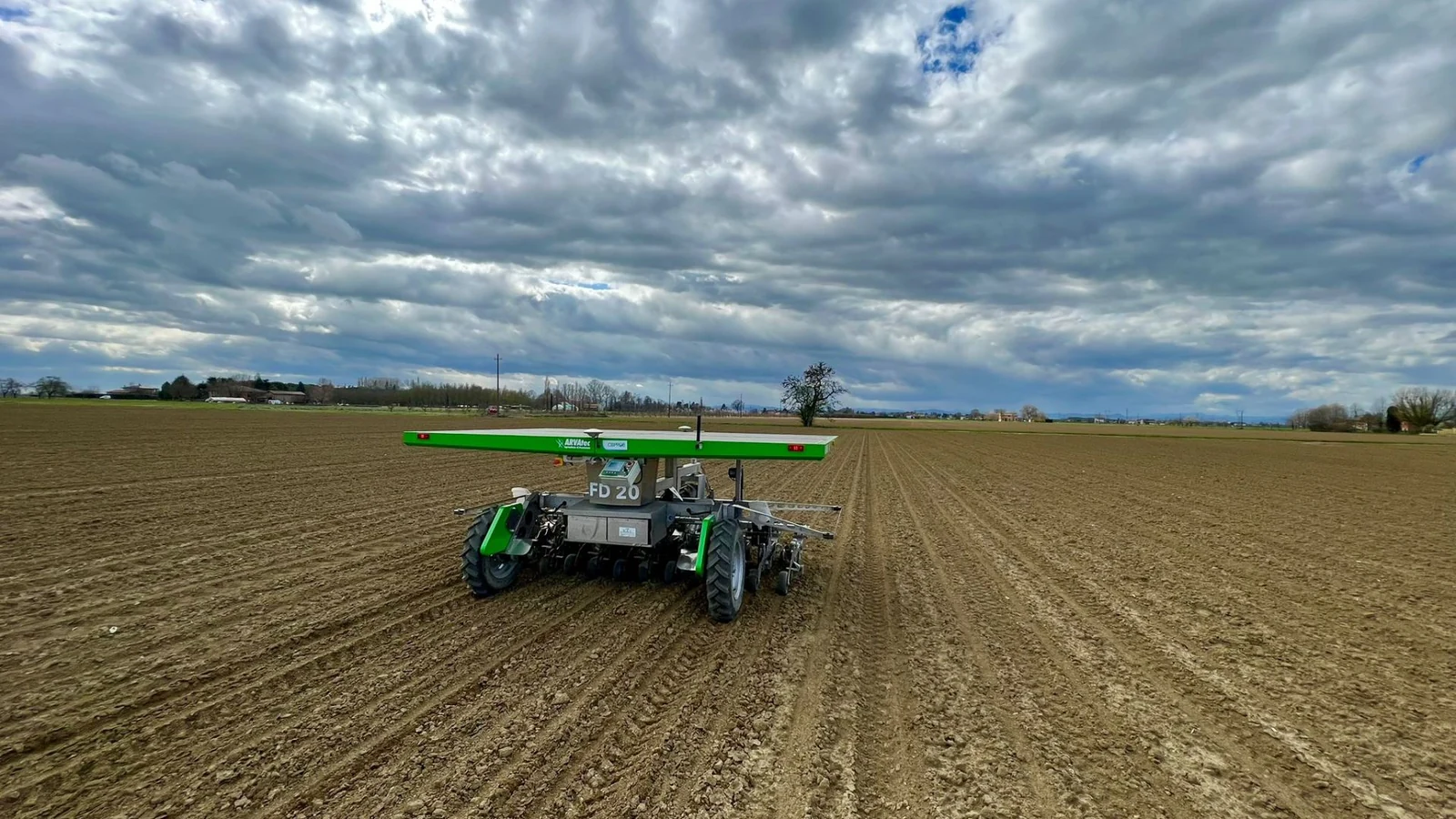
Manufacturer imagery: © FarmDroid.
There is no single best robotic weeding method. Mechanical tools work through contact with soil and plants, lasers direct energy at selected weeds, and spot sprayers apply a treatment to selected locations. The right choice depends on crop layout, weed species and size, weather and the available treatment window. Also distinguish an autonomous vehicle from an automated implement: precise treatment does not necessarily remove the tractor driver.
Three mechanisms, different operating requirements
Mechanical weeding removes or damages weeds through physical contact. Accurate guidance can support closer work around crops, but it does not remove the influence of soil conditions. FarmDroid FD20 combines seeding with later weeding using recorded seed positions. Naïo OZ and ORIO are tool carriers whose agricultural function depends on the chosen implement. FarmDroid mechanical weeding, OZ and ORIO.
Lasers provide a different mechanism for acting on the plant. Pixelfarming Robotics' Robot One is a mobile platform; Carbon Robotics' LaserWeeder G2 is an implement used with a tractor. Ecorobotix ARA620 uses vision and application control for spot spraying. These systems should not all be labelled “driverless robots” simply because part of the agricultural operation is automated. Robot One, LaserWeeder G2 and Ecorobotix.
| Question | Mechanical tools | Lasers | Spot spraying |
|---|---|---|---|
| Main action | Tool contact with soil and plants | Energy directed at weeds | Treatment applied at selected locations |
| Key compatibility check | Soil conditions and crop clearance | Recognition and treatment throughput | Recognition, dose and authorised application |
| Misleading shortcut | Guidance accuracy treated as weed-control efficacy | Laser count treated as whole-field performance | Volume reduction treated as guaranteed savings |
| Outcome to record | Surviving weeds and crop damage | Weed survival and crop condition | Treatment efficacy and product use |
Start with the crop and weeds
List the dominant weeds and their usual growth stage when treatment becomes possible. Include difficult cases: plants obscured by leaves, weeds close to the crop and areas where soil conditions differ. These should be represented in the trial. A demonstration on a uniform strip with small exposed weeds may show useful capability without representing the farm's hardest workload.
Crop establishment also matters. A system that uses recorded seed positions introduces requirements at sowing, not just at weeding. For a vision-based system, ask which crop, growth stage and conditions are supported, and what onboarding is required for a different crop. A successful demonstration in one vegetable does not automatically establish suitability for another vegetable with superficially similar rows.
What a laser study actually establishes
Sosnoskie and colleagues published a study in 2025 covering three experiments conducted in 2024 in beet, spinach and pea production in New York and New Jersey. Results varied between weeds, with purslane and annual grasses among the more difficult targets. The work was conducted with Carbon Robotics using an earlier platform, not the current LaserWeeder G2 range. Pest Management Science paper.
That is useful evidence about a treatment in specified production systems. It is not a promise that every European field will reproduce the same result. Separating the experiment date, machine generation and manufacturer involvement prevents results being transferred to a different product without justification. Apply the same discipline to efficacy charts supplied for mechanical tools and precision spraying.
Compare usable throughput
Travel speed, hectares per hour and seasonal hectares answer different questions. A slow-moving machine may operate for longer periods; a fast working pass may still require substantial transport, setup and attendance. Weed density can also affect laser treatment throughput, so a published output figure needs the conditions under which it was obtained.
Measure the complete operation from preparation through to readiness for the next job. Separate productive passes, headland turns, refilling, transport and interventions. For example, FarmDroid's FD20 claim of up to six hectares per day refers to a day, not an hour. Whether that figure fits a farm depends on configuration and the timing of repeated treatments. FarmDroid FD20.
Cost the successful programme
Purchase-price comparisons omit treatment frequency and follow-up work. Include the machine, implement, energy, consumables, supervision and any manual work needed to remove surviving weeds. Where methods require different numbers of passes, compare the final crop condition after the complete programme. The cheapest individual pass does not necessarily produce the cheapest satisfactory result.
Consider a calculation only, not a product quotation: 20 hectares visited six times produces 120 treatment-hectares. An annual programme costing €24,000 therefore costs €200 per hectare per pass, or €1,200 per hectare of field across the programme. Both figures can be correct. Clearly naming the denominator prevents an apparent sixfold cost difference caused by presentation alone.
Precision spraying still needs an application check
Targeted application does not make every crop-protection product appropriate for every crop or use. Check the label, permitted conditions and operating procedure with the supplier and a competent adviser. ARA620 in this comparison is ground-based equipment. Its operating context should not be transferred to spraying drones, which face separate restrictions and authorisation questions.
Similarly, removing herbicide from one weeding pass is not the same as removing all crop-protection inputs from production. Diseases and pests pose different problems. When discussing an advertised reduction, identify the product, treatment, area and measurement conditions. A percentage may describe a valuable trial result, but without that context it provides a weak basis for a farm-specific investment decision.
Design a comparison around your field
Choose representative areas, record their starting condition and agree an assessment method with an agronomist. Count human attendance and interventions for every option. Assess surviving weeds after an appropriate interval rather than judging only the immediate appearance of the pass. Include crop damage and the need for follow-up work in the final comparison.
The objective is to identify a system that can complete the required job within the farm's operating window. It is reasonable for two farms growing the same crop to reach different decisions because their weed pressure, layout, labour arrangements and support networks differ. A meaningful demonstration makes those differences visible instead of hiding them inside one average throughput figure.
Use the European availability and service guide to check the supply route and the seasonal cost model to organise the economic comparison. The agricultural catalogue links to individual machine profiles and makes the distinction between vehicle and implement explicit.
Verified 13 September 2026. Documentation and research review; no RoboMorrow comparative field test.
Sources and documentation
- FarmDroid — Mechanical weeding system
- FarmDroid — FarmDroid FD20
- Naïo Technologies — OZ Robot
- Naïo Technologies — ORIO Robot
- Pixelfarming Robotics — Robot One
- Carbon Robotics — LaserWeeder G2
- Ecorobotix — ARA620 UHP sprayer
- Sosnoskie i in. — Deep learning based laser weed control compared to conventional herbicide application across three vegetable production systems
Are you buying an implement, a robot or a complete system?
Added 14 September 2026. This compares operating arrangements, not results from a joint field test.
| System | Scope of comparison | What the quote must establish |
|---|---|---|
| FarmDroid FD20 | Seeding and mechanical weeding on one platform, using crop positions recorded during its seeding operation | Row layout, the full pass schedule, field-to-field transport and energy support |
| Carbon LaserWeeder G2 600 | A laser implement operating with a tractor; weed recognition alone does not make it a driverless vehicle | A compatible tractor, hitch, power, lift capacity and either an operator or a separately agreed autonomy system |
Carbon Autonomy is a separate tractor kit and service with remote supervision. Carbon describes initial availability in selected US regions and invites early-access applications. That is not confirmation of routine delivery of an autonomous package to Europe. Mark who drives, supervises, turns and transports the equipment in each proposal.
Sources: FarmDroid FD20, G2 600 and Carbon Autonomy. Compare the complete season and accepted treatment quality, not the implement price alone.