Farm robots in Europe: availability, demos and service
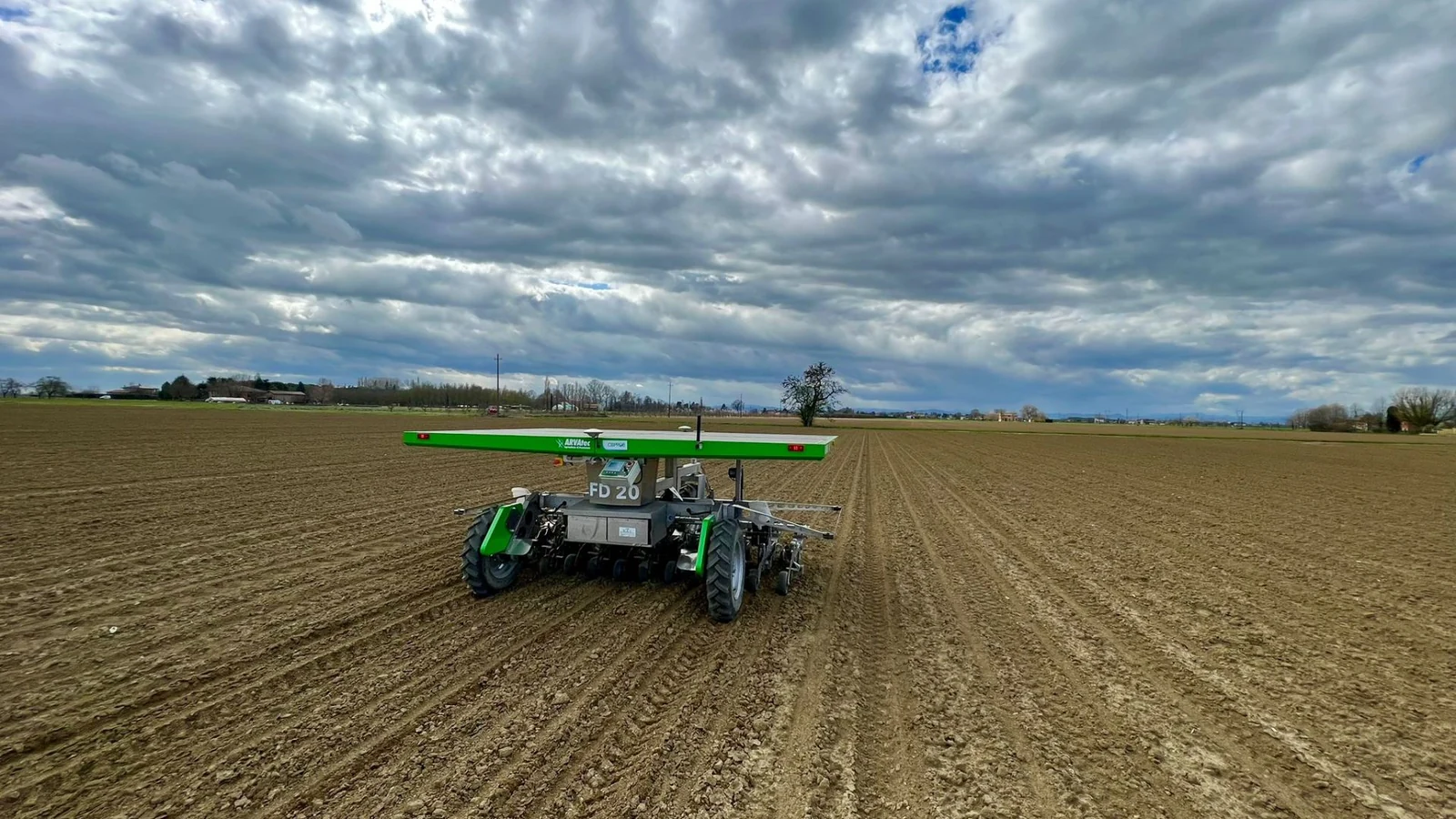
Updated: 18 September 2026. Farm robots already have sales routes in Poland, but a manufacturer logo on a distributor website does not yet answer the question that matters to a buyer: can this exact configuration be ordered, commissioned on the farm and supported through the season? A fresh check of the market shows three different maturity levels: systems with a confirmed Polish channel, products sold regionally in Europe, and autonomy that is being demonstrated or developed without a confirmed Polish purchase path.
This distinction is practical rather than semantic. A farm needs to know who selects and integrates the implement, prepares the job, responds to a stop, handles transport between fields, stocks parts and takes responsibility for commissioning the complete system. RoboMorrow therefore does not treat a working technology demonstration as equivalent to a deployable commercial offer.
The short answer: what can a Polish farm realistically start buying today?
| System | Poland / Europe status | What still needs confirmation |
|---|---|---|
| AgXeed AgBot | Agrihandler publicly lists AgXeed in its Polish portfolio and identifies product responsibility for the brand. | Exact model and generation, implement integration, transport, training, autonomy conditions and service responsibility for the full combination. |
| Naïo OZ / ORIO | Agrihandler lists Naïo in Poland, including OZ and ORIO. | Tooling, row geometry, field preparation, RTK conditions, supervision limits and local service scope. |
| Pixelfarming Robot One | Robot One is presented in Agrihandler's Polish offer. | Crop-model preparation, tool configuration, a relevant crop demonstration and post-deployment support. |
| FarmDroid FD20 | FarmDroid's official distributor directory lists Farmsystems in Kraków, Poland. | Seeding setup, crop compatibility, delivery date, demonstration and in-season service terms. |
| FarmDroid FD60 | Orders are open, but the manufacturer states that deliveries start in January 2027. | Do not treat it as immediate 2026 stock; obtain a written date for Poland and the requested configuration. |
| Kubota AX-1 / newer autonomy | Kubota announced sales of Kilter AX-1 through its network in Germany and the Netherlands from 2026. That does not confirm Poland. | Polish channel, timing, service and the exact regional configuration. |
| John Deere Gen 2 autonomy | John Deere is developing and introducing autonomous 9RX and 5ML configurations, but this check did not confirm a regular Polish commercial offer. | European and Polish commercial roadmap, required supervision, compatible implements and local operating conditions. |
A “Polish channel” does not mean stock is available or that every region receives identical support. A farm quotation should identify the exact model, configuration, delivery, commissioning and service scope.
AgXeed: autonomy is a product, but the buyer is purchasing a workflow
Agrihandler maintains an active Polish AgXeed section showing configurations including AgBot 5.115 T2 and 2.055 W3/W4 variants. That is a stronger purchasing signal than a global launch announcement because there is a local route into a commercial conversation. Regional naming can lag behind the manufacturer's current global line-up, however, so a request for quotation should use the full current model and implement specification. RoboMorrow describes these machines as autonomous tool carriers operating inside prepared working areas, not as “farms without people”.
A useful technical proof of compatibility with conventional implements comes from Kverneland and AgXeed's 24-hour ploughing challenge in the UK. A driverless AgBot 5.115T2 pulling a five-furrow Kverneland LO 300/85 covered 20.8 hectares. It demonstrates that an autonomous carrier can perform heavy field work with a conventional implement. It does not prove the same output on a Polish farm and it does not, by itself, establish that the identical complete package is commercially sold in Poland. Soil, field shape, headlands, transport, weather and supervision change the result.
If an AgBot is intended to replace tractor-driver hours, the quotation should explain which implements are supported, whether the system monitors implement operation, who approves the job map, how recovery after a stop works and which supplier owns an issue at the interface between vehicle and implement.
FarmDroid: one of the clearest local purchase paths
FarmDroid currently provides a particularly clear public channel signal for Poland: its official distributor directory lists Farmsystems in Kraków. FD20 is a commercial machine with an unusually easy-to-explain operating logic. It records seed positions while sowing with RTK, then uses that map for later mechanical weeding. This lets the buyer discuss a specific crop, row layout, treatment schedule and field area instead of abstract “AI in agriculture”.
FD60 needs a different availability label. The manufacturer is accepting orders and positions it for larger, more standardised field layouts, but its official page says deliveries start in January 2027. On 18 September 2026 the correct wording is therefore orders open / deliveries from 2027, not “available now”. This distinction avoids one of the most common robotics reporting errors: merging announcement, presale and current commercial availability.
Nominal capacity is not enough for an investment decision. Weather windows, the number of seasonal passes, field changes, transport, interventions and non-productive time all affect economics. These belong in a whole-season cost model, not in a simple hardware-price comparison.
Naïo and Robot One: a local listing still needs a crop-relevant demo
Agrihandler represents both Naïo and Pixelfarming Robotics in Poland. Its Naïo pages list OZ and ORIO among the active machines. OZ can fit smaller intensive operations and nurseries, while ORIO is a larger tool carrier. In both cases “autonomous robot” describes the platform; the agronomic result depends on the implement, crop and setup. A useful demonstration should therefore reproduce work that is close to the buyer's real use case.
Robot One requires another layer of validation. Agrihandler describes a “scan and act” workflow: the robot collects images, supports building a crop-recognition model, then controls selected tools, including a laser. A serious deployment quotation should therefore cover more than hardware and transport. It should include crop-model preparation, validation and responsibility for updates. The fact that a tool can target weeds with a laser does not answer the throughput and completed-treatment-cost question.
What about John Deere and Kubota?
Large manufacturers are advancing autonomy quickly, but global announcements must be read regionally. John Deere has shown second-generation autonomy for 9RX and an autonomous 5ML orchard tractor for spraying. These are important technology directions. This verification did not establish those configurations as a normal Polish purchase offer, however. The right question is not “does John Deere have autonomy?” but “which exact function, on which model, in which country, with what support, is commercial now?”.
Kubota provides an especially useful example of regional separation. In March 2026 it announced that Kilter's autonomous AX-1 ultra-precision spraying robot would begin selling through Kubota's network in Germany and the Netherlands during 2026. By contrast, the new Agri Robo Tractor MR series with remote-monitoring functionality is scheduled for Japan in April 2027, and Kubota explicitly says there are no plans to sell that product outside Japan. One announcement must not be projected onto another market.
AGRO SHOW 2026: three facts can be checked in a very short visit
The official exhibitor list for AGRO SHOW in Bednary, 18–20 September 2026, lists John Deere Polska in sector B, stand 181 and Kubota Polska plus Kverneland Group Polska in sector B, stand 185. Kverneland separately confirms its own B/185 presence. That creates an unusually efficient route for a visitor with only a few dozen minutes.
- John Deere, B181: ask for the actual European and Polish status of Gen 2 autonomy, 9RX and 5ML — not a general vision statement. The useful answer identifies a commercial name, date, market, supervision requirement, implement compatibility and service route.
- Kverneland, B185: ask whether the technically demonstrated AgXeed + Kverneland combination has a Polish purchase or demonstration route. Establish who integrates and services the complete package and where implement-maker responsibility ends and carrier-maker responsibility begins.
- Kubota, B185: ask about a Polish roadmap for Kilter AX-1 and which autonomy functions in Europe are products today versus concepts, pilots or region-specific offers.
The 6 September official exhibitor list does not show Agrihandler or Farmsystems under their own names. That does not prove that their people or represented brands cannot appear through partners, but a time-limited visit should not depend on finding dedicated stands that are not on the list.
Seven questions that separate a commercial offer from a demonstration
- What is the exact model, generation and configuration? A family name is not enough.
- Is there a written delivery date for Poland? Presale and exhibition presence are not inventory.
- Who commissions the system and can demonstrate it in a similar crop? A video from another country is not a field trial.
- What does the machine actually do without a person? Count planning, implement changes, transport, supervision, error recovery and corrective work.
- Who owns in-season service? Get response-time expectations, parts, remote diagnostics and an escalation process for a stop during a critical treatment window.
- Who is responsible for the implement interface? An autonomous carrier and tool act as one working system even when supplied by two companies.
- What is the cost of the completed job? Add configuration, software, energy or fuel, transport, supervision, parts and downtime to the hardware price.
Law and safety: machine conformity is not permission for every scenario
The EU Machinery Regulation 2023/1230 applies from 20 January 2027; until then, the existing machinery framework continues to apply within its scope. For a farm, the key point is that compliance of a particular machine does not automatically authorise every autonomous mode, every operating environment or every public-road transfer. Responsibilities and operating conditions must be checked for the exact system, country and use case.
Field autonomy should also be separated from logistics between fields. A system may perform a treatment with very little intervention inside a prepared area while still requiring conventional transport and setup for the next location. That time belongs in productivity and payback calculations.
How RoboMorrow labels availability
After this update we use three practical labels. Confirmed local channel means a manufacturer or Polish distributor publicly lists the brand or family, but an exact delivery still requires a quotation. Regional availability means a commercial product is sold in selected European countries without a confirmed Polish route. Announcement / demonstration means the technology exists and may have a working prototype or pilot, but there is not enough evidence to present it as a normal purchase for a Polish farm.
This is more useful than a generic “best farm robots” ranking. The useful system is the one that completes the right job in the required window and can be repaired when the window is closing. Only then does an economics comparison become meaningful.
Where to continue
For the full category, open Agricultural robots. For an autonomous tool carrier, see the AgXeed AgBot analysis inspired by Clarkson's Farm. For seeding and mechanical weeding, read FarmDroid FD20 and the FD20 vs FD60 comparison. If this is an investment decision, start with whole-season cost rather than a headline machine price.
Methodology: documentation and purchasing-path update verified 18 September 2026. This is not a RoboMorrow field test and we do not claim hands-on experience with machines we have not tested. After AGRO SHOW, this same owner URL should be updated with clearly labelled first-party observations and photos rather than creating another article with the same search intent.
Sources and documentation
- Agrihandler — AgXeed
- Agrihandler — Naïo
- Agrihandler — Pixel Farming Robotics / Robot One
- FarmDroid — official distributor directory
- FarmDroid — FD60 delivery schedule
- Kverneland — autonomous ploughing with AgXeed
- AGRO SHOW — 2026 exhibitor list
- Kverneland Poland — AGRO SHOW 2026, B185
- Kubota — Kilter AX-1 in Germany and the Netherlands
- Kubota — Agri Robo Tractor MR, Japan 2027
- John Deere — Gen 2 autonomy
- European Commission — machinery / Regulation 2023/1230