Does a farm robot pay back — a whole-season cost model
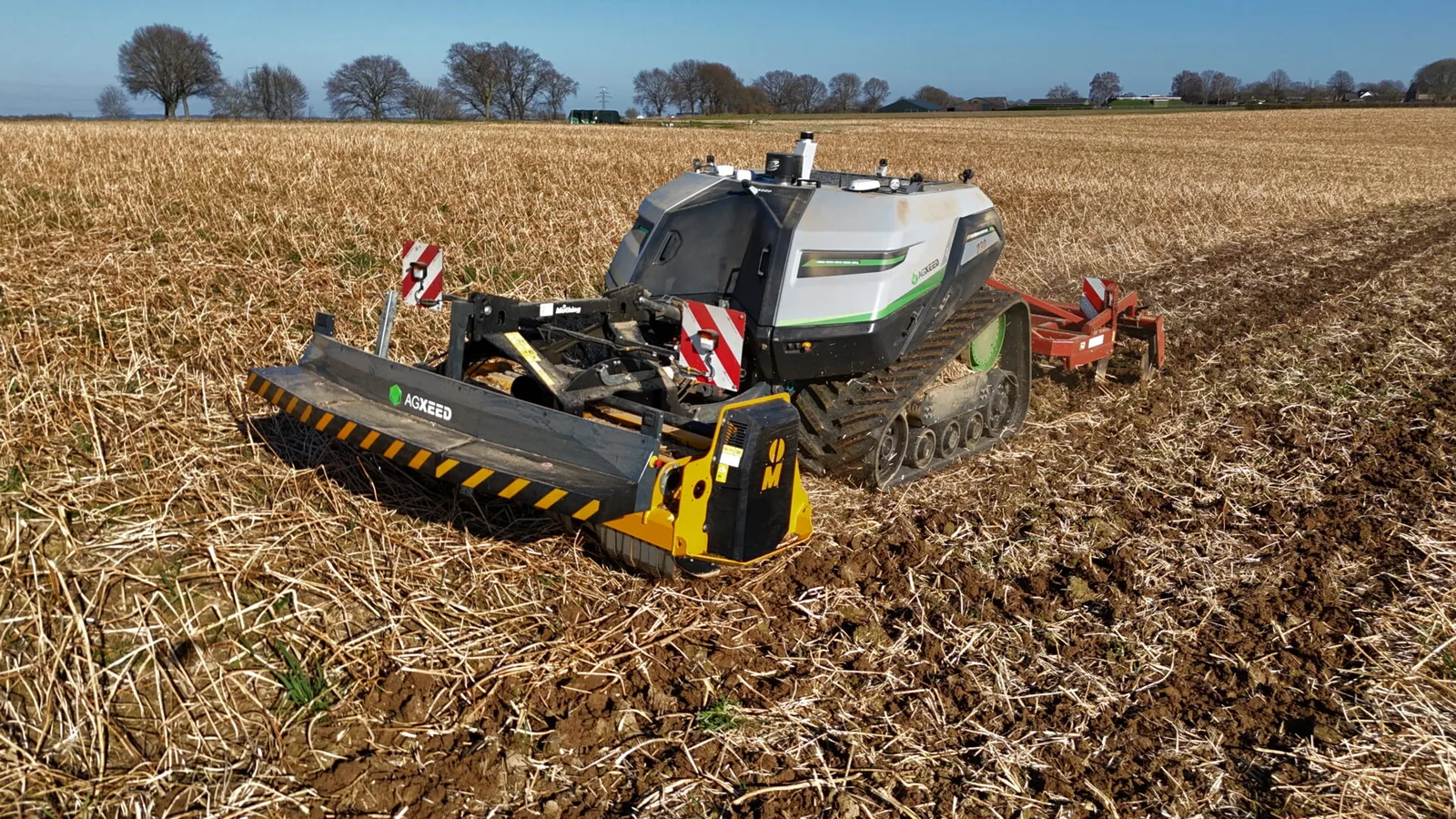
Manufacturer imagery: © AgXeed.
A farm robot can make economic sense when the work and spending it genuinely removes are worth more than the operating costs of the complete system, with enough surplus to justify the investment. Purchase price, hectares and advertised saving percentages cannot answer that question alone. Compare the same completed task, on time and at equivalent quality, including supervision, corrective work and periods when the machine is unavailable.
Define the work before comparing machines
“A robot for the farm” is not yet a cost category. Weeding onions, moving produce, milking and pushing feed have different outputs. Choose a completed treatment per hectare, a kilogram of marketable crop or service to a defined herd.
Keep the system boundary consistent. LaserWeeder G2 is a tractor-dependent implement; the self-propelled Robot One allocates vehicle costs differently. An implement-only price cannot be compared directly with the price of a complete autonomous vehicle. Carbon Robotics — LaserWeeder G2 200 specifications Pixelfarming Robotics — Robot One
Collect four groups of figures
| Group | What to include |
|---|---|
| Initial investment | Machine, implements, delivery, field or building changes, commissioning and training |
| Running costs | Energy, wearing parts, maintenance, subscriptions, connectivity, insurance and supervision |
| Spending actually removed | External services, paid hours, fuel or inputs that will no longer be purchased |
| Outcomes and constraints | Corrective work, downtime, crop losses, timeliness and remaining human tasks |
Recovered owner time can be valuable without becoming an immediate cash saving. Show the hours separately and explain how they will be used. Do not count a removed salary when the employee remains on the same payroll without replacing another paid requirement.
An illustrative euro example
The following figures are educational assumptions. They are not the price of a particular robot, a profitability forecast or a financing offer. This English example uses euros independently of the Polish example; it is not a currency conversion.
| Item | Scenario A | Scenario B |
|---|---|---|
| Total initial investment | €150,000 | €150,000 |
| Annual spending genuinely removed | €45,000 | €22,500 |
| Additional annual robot and supervision costs | €15,000 | €15,000 |
| Annual cash surplus | €30,000 | €7,500 |
| Simple payback period | 5 years | 20 years |
Annual cash surplus equals avoidable spending minus additional system costs. Simple payback divides the initial investment by a positive annual surplus. If the surplus is zero or negative, this model has no payback; a negative number of years would be misleading.
Halving the savings quadruples the payback period in this example. That makes complete labour and season records more consequential than a modest purchase discount. The simplified calculation excludes tax, financing costs, resale value and changing annual performance, so it is a screening tool rather than a complete investment appraisal.
A field hectare is not a treatment hectare
An illustrative 20-hectare field receiving six passes creates 120 treatment-hectares. With an illustrative annual system cost of €24,000, the result is €200 per treatment-hectare or €1,200 per field hectare for the complete programme. Both can be correct, but they answer different questions.
Always show the denominator. For harvesting, distinguish total picked mass from marketable output. Peak arm speed does not represent a complete working day once access, produce handling and quality are included.
Model a worse season
Reduce utilisation and increase corrective work or intervention time. Consider whether several customers would need a shared robot during the same weather window. Spare capacity can become valuable precisely when an annual-average plan looks efficient.
Compare ownership with a service and the present workflow. In a cash-flow model, do not add the full purchase price and all lease payments without clearly defining the financing treatment. Include a grant only after checking the relevant programme, eligibility and payment conditions in the country concerned.
Ask for evidence that fits the model
Request a complete configured quote, recurring charges and the support commitment. Ask for a comparable reference farm and work records covering conditions, treated area, supervision, corrective passes and downtime. A supplier claim should become a testable input, not an unexplained multiplier.
Use FarmDroid FD20 and AgXeed AgBot to see how different workflows change the assessment. Explore more applications in agricultural robots.
Define a realistic no-purchase case
Compare the robot with an operation the farm can actually continue. If present equipment needs replacement, include that in the alternative case. Where contracting is available, compare its scope and timing. Do not compare a complete new robot against an assumption that old machinery can run indefinitely without cost.
For a financed purchase, assess annual cash flow separately. Simple payback does not describe instalments, interest, tax or resale value. An attractive simplified result can still require working capital during a difficult season. The investment decision needs a model based on the quotation and the farm's own figures.
Measure the value of timely work
A machine may be useful because it enables work when people are unavailable. Avoid attaching an arbitrary cash value to that benefit. Record which jobs were delayed, how often and with what outcome. If evidence is missing, retain a qualitative benefit and examine it in a pilot.
Use the availability and service guide for comparable quotations. The weeding methods comparison explains why repeat passes and follow-up work change programme costs.
Illustrative inputs, not a robot price or forecast. Enter your own quotation and annual costs. Excludes financing, tax and resale value. Owner time saved is not automatically a cash saving.Calculate simple payback
Verified 13 September 2026. Documentation analysis; no RoboMorrow hands-on test.