SoftBank invests $225M in ASI and forms a JV for autonomous heavy equipment
NEWS + ANALYSIS | 24 September 2026
SoftBank Group and Autonomous Solutions, Inc. are formalising their relationship around autonomous heavy equipment. The companies are creating a joint venture to develop and commercialise autonomous construction machinery, while SoftBank is also investing $225 million directly into ASI. This is a material change from their earlier collaboration: there is now a dedicated business structure and substantial capital for scaling.
- SoftBank Group and ASI announced a joint venture focused on autonomous construction equipment for large infrastructure projects.
- Separate from the JV capitalisation, SoftBank invested $225 million directly into ASI.
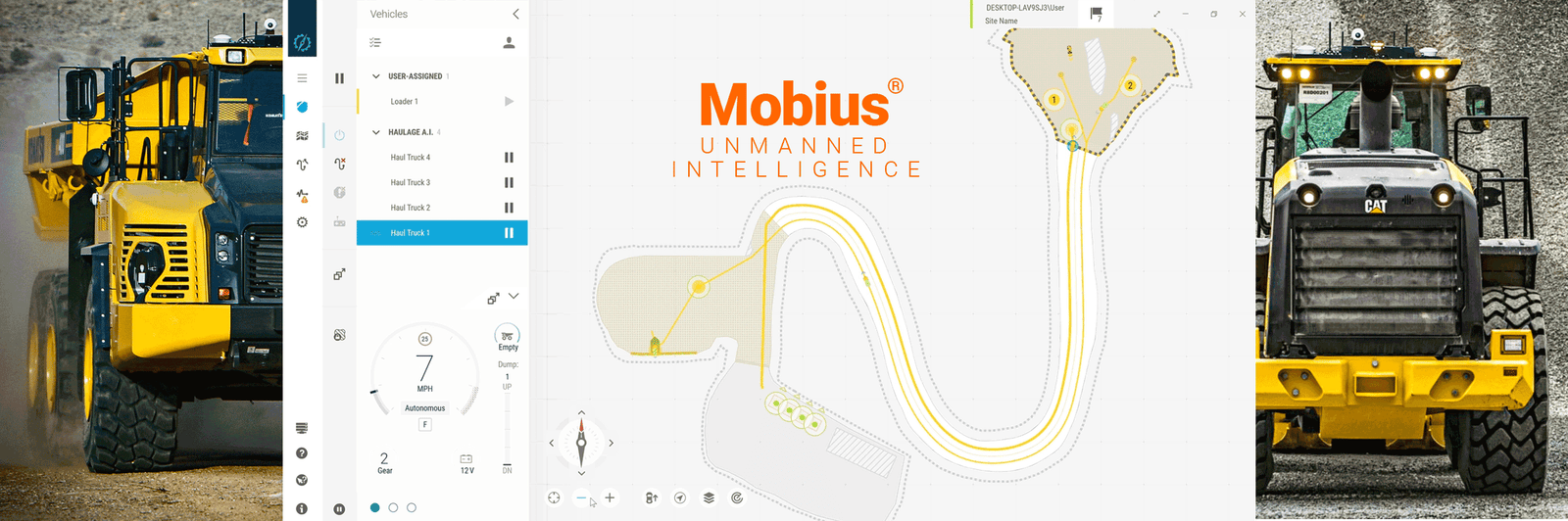
- The core technology is Mobius, which ASI positions as an OEM-agnostic autonomous fleet orchestration platform.
- ASI describes mixed fleets including haul trucks, dozers, loaders and compactors.
- Target markets include roadways, airports, rail, waste management and other major infrastructure projects.
- The companies have not disclosed ASI's post-investment valuation, the JV ownership split or a list of initial customers.
| Item | Confirmed | Status / caveat |
|---|---|---|
| Investor | SoftBank Group | Strategic capital |
| Direct ASI investment | $225M | Separate from JV capitalisation |
| Platform | Mobius | OEM-agnostic fleet orchestration, according to ASI |
| Equipment | heavy construction machinery | Mixed fleets, retrofit and integration |
| Customers | not disclosed | No public schedule for first major deployments |
Why this is bigger than the previous partnership
ASI and SoftBank entities had already collaborated on autonomous construction. Another press release mentioning the same companies would not, by itself, constitute a new event. The material changes announced on 24 September are specific: a formal joint venture and $225 million in direct investment into ASI.
That moves the story from technology partnership toward joint commercial scaling. The JV is intended to develop and commercialise autonomous equipment, while the direct investment gives ASI additional resources to expand its own business. For the market, that is a stronger signal than another single-machine pilot.
Why OEM-agnostic may matter more than "an autonomous excavator"
Large construction sites rarely run one manufacturer's equipment exclusively. Fleets are mixed across brands, generations, interfaces and levels of digitalisation. ASI positions Mobius as an orchestration layer that can coordinate autonomy across that reality rather than forcing an operator into one closed equipment ecosystem.
If that approach holds up in production, it could lower one of the main adoption barriers: replacing an entire fleet in a single capital cycle. That is especially relevant for heavy equipment with long service lives and high unit values. "OEM-agnostic," however, remains an ASI product claim and should not be interpreted as universal plug-and-play compatibility with every machine.
What still needs to be demonstrated
There are no named customers, public schedules for the first shared deployments, or operational KPIs comparing productivity, safety and cost with human-operated fleets. The JV ownership structure and ASI's post-investment valuation are also undisclosed. Funding size therefore does not tell us how quickly the technology will reach production construction sites.
Heavy equipment autonomy also has difficult edge conditions: dust, rain, mud, people moving through the site, unexpected objects, connectivity constraints and takeover procedures. The commercial value will come from sustained uptime and repeatable productivity, not from a successful demonstration run.
Why it matters for Poland and the EU
The retrofit and mixed-fleet model is particularly relevant to Europe, where major infrastructure contractors often operate Caterpillar, Volvo CE, Komatsu, Liebherr and other equipment side by side. An OEM-independent control layer could allow selected tasks to be automated without replacing the entire fleet.
There is no announced European customer or EU deployment date attached to this news. RoboMorrow therefore treats it as a strategic capital-and-technology move, not as a statement of Polish availability. The next meaningful news trigger would be a signed customer, a large production fleet or public operational KPIs from a real project.
What would prove the joint venture is actually working
The first commercial programs should be judged by completed cycles, operator interventions, recovery time, fleet availability, safety events and cost per unit of work. Mixed fleets will be especially important. An OEM-agnostic claim becomes valuable only if haul trucks, dozers, loaders and compactors from different manufacturers can be coordinated without rebuilding a separate autonomy stack for every brand.
This connects to two broader trends RoboMorrow is already tracking. ZINOVA is developing a Tool Intelligence layer across different robots and tools, while our guide to pallet-transport fleets shows why interoperability and fleet management can matter as much as the vehicle. SoftBank gives ASI capital; named customers, scale and measurable KPIs will show whether the model is repeatable.
What would justify an update
RoboMorrow will not create another story simply because a second publication covers the same event. A material update requires a real status change: commercial shipping or production, a new price, a signed customer, a major deployment, entry into a new market, independently verified performance data or a regulatory decision. Smaller clarifications should update this canonical owner instead.
Sources and methodology
RoboMorrow verification: 25 Sep 2026. Manufacturer specifications are treated as claims unless stated otherwise.