TrinaTracker launches BUILDEX and AURORA robots for solar construction and cleaning
NEWS + ANALYSIS | 24 September 2026
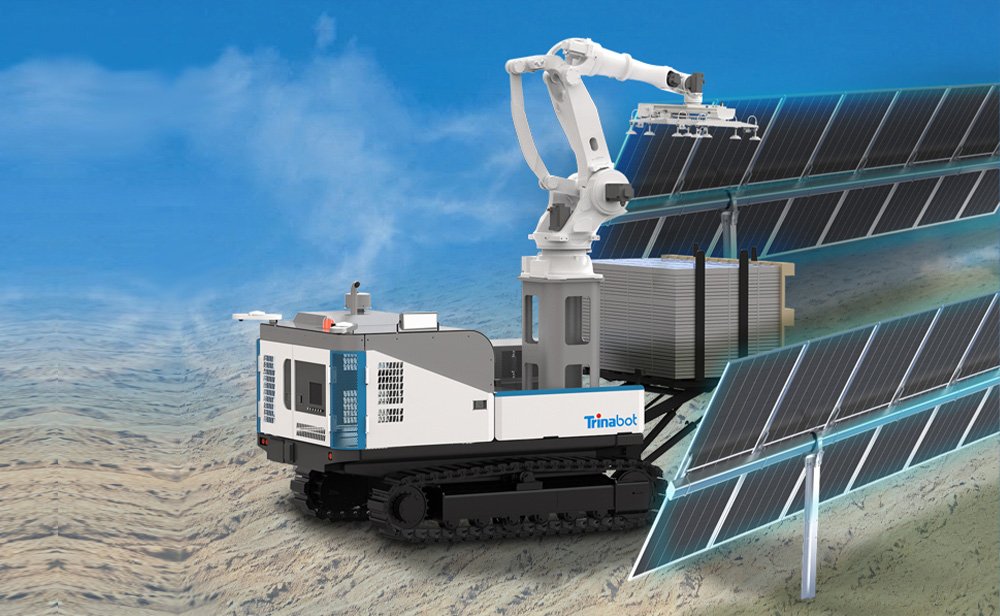
TrinaTracker, a Trina Solar subsidiary, has introduced two in-house robotic products for utility-scale solar: BUILDEX for module transport and installation, and AURORA for autonomous cleaning. The strategic move matters as much as the hardware itself. A major tracker supplier is trying to combine mechanics, AI, robotics, digital twins and O&M into one operating ecosystem.
- BUILDEX is designed to autonomously pick, transport, align and place PV modules using industrial 3D cameras, AI vision and precision mechanisms.
- TrinaTracker claims throughput of up to 90 modules per hour, described as 3-4x manual work; this is a manufacturer claim, not an independent benchmark.
- BUILDEX is designed for landscape and portrait installation, fixed and tracker systems, 1P/2P layouts, and platform levelling on terrain up to 17 deg.
- AURORA is an autonomous cleaning robot that plans routes using plant, tracker and environmental data.
- AURORA is designed to compensate height offsets up to 50 mm, operate cyclically with minimal supervision and use PV power.
- The company has not published pricing, a broad commercial shipping date or named customers for these exact two products.
| Item | Confirmed | Status / caveat |
|---|---|---|
| BUILDEX | PV module installation | Up to 90 modules/hour - manufacturer claim |
| AURORA | autonomous cleaning | Route planning + cyclical operation |
| BUILDEX terrain | up to 17 deg compensation | Manufacturer specification |
| AURORA offset | up to 50 mm | Manufacturer specification |
| Price / EU | not announced | No public price list or broad availability date |
PV robotics is moving from inspection into construction
Robots on solar farms are not new. Cleaning machines, inspection drones and specialised installation platforms have existed for years. What changes here is that a large tracker and PV-system supplier is putting robotics directly inside its product ecosystem rather than treating automation as a third-party add-on.
BUILDEX targets a labour-intensive stage: last-metre logistics and precise placement of large modules. If the claimed 90 modules per hour can be repeated on real sites, the robot could affect not only labour cost but also project construction speed and worker safety.
AURORA targets O&M, where the economics are different
Cleaning has a different business model from construction. It is a recurring cost throughout the life of a solar farm and becomes more important in dusty, low-rainfall regions. AURORA is designed for cyclical operation and route planning using tracker and environmental data, suggesting integration with the broader plant-management stack.
TrinaTracker highlights PV power and unattended operation. Missing, however, are energy-consumption figures, hectares-per-shift productivity, brush longevity, service intervals and performance in extreme dust. Those metrics will determine total cost of ownership far more than autonomous navigation alone.
A product launch is not "the first PV robot"
Trina and related robotics initiatives have worked on solar automation before. RoboMorrow therefore does not frame BUILDEX and AURORA as the invention of a new category or as "world-first" PV robots. The verifiable event is the launch of these named products and TrinaTracker's expansion toward a Smart PV and Robotics Solution Provider strategy.
The same caution applies to the 3-4x manual-labour productivity claim. It comes from the manufacturer's release and is not accompanied by an independent methodology describing the reference crew, module type or terrain conditions.
What it means for Poland and Europe
Europe is building large PV farms while labour costs rise and project schedules tighten. Installation automation may be most attractive on repetitive utility-scale sites. Cleaning robots, meanwhile, deliver their strongest economics in dry and dusty regions; in Europe the business case will depend heavily on climate, soiling patterns and service cost.
There is not yet a European price, service channel or named BUILDEX/AURORA customer, so it would be premature to describe the products as ready for Polish deployment. The next meaningful triggers are a signed project, public pricing, serial production and independently verified construction or O&M KPIs.
A material BUILDEX discrepancy: 90 or more than 60 modules per hour?
TrinaTracker's launch release says BUILDEX can install up to 90 modules per hour and claims a 3-4x improvement over manual work. Trinasolar's current product page instead describes "comprehensive installation efficiency" as more than 60 modules per hour and says double manual efficiency. Both are official sources, but they are not the same metric. Until the test conditions are clarified, RoboMorrow treats 90/h as the launch claim and 60+/h as the more conservative current product specification - neither is an independent benchmark.
That gap is exactly why job-level evidence matters. Construction robotics should be measured across the full cycle: module supply, positioning, error correction, safety and restart. We apply the same standard in our coverage of ZINOVA Tool Intelligence and our analysis of robotic task systems for construction.
What would justify an update
RoboMorrow will not create another story simply because a second publication covers the same event. A material update requires a real status change: commercial shipping or production, a new price, a signed customer, a major deployment, entry into a new market, independently verified performance data or a regulatory decision. Smaller clarifications should update this canonical owner instead.
Sources and methodology
RoboMorrow verification: 25 Sep 2026. Manufacturer specifications are treated as claims unless stated otherwise.