Ultra says its robots packed 500,000 orders. Now it has raised $50M
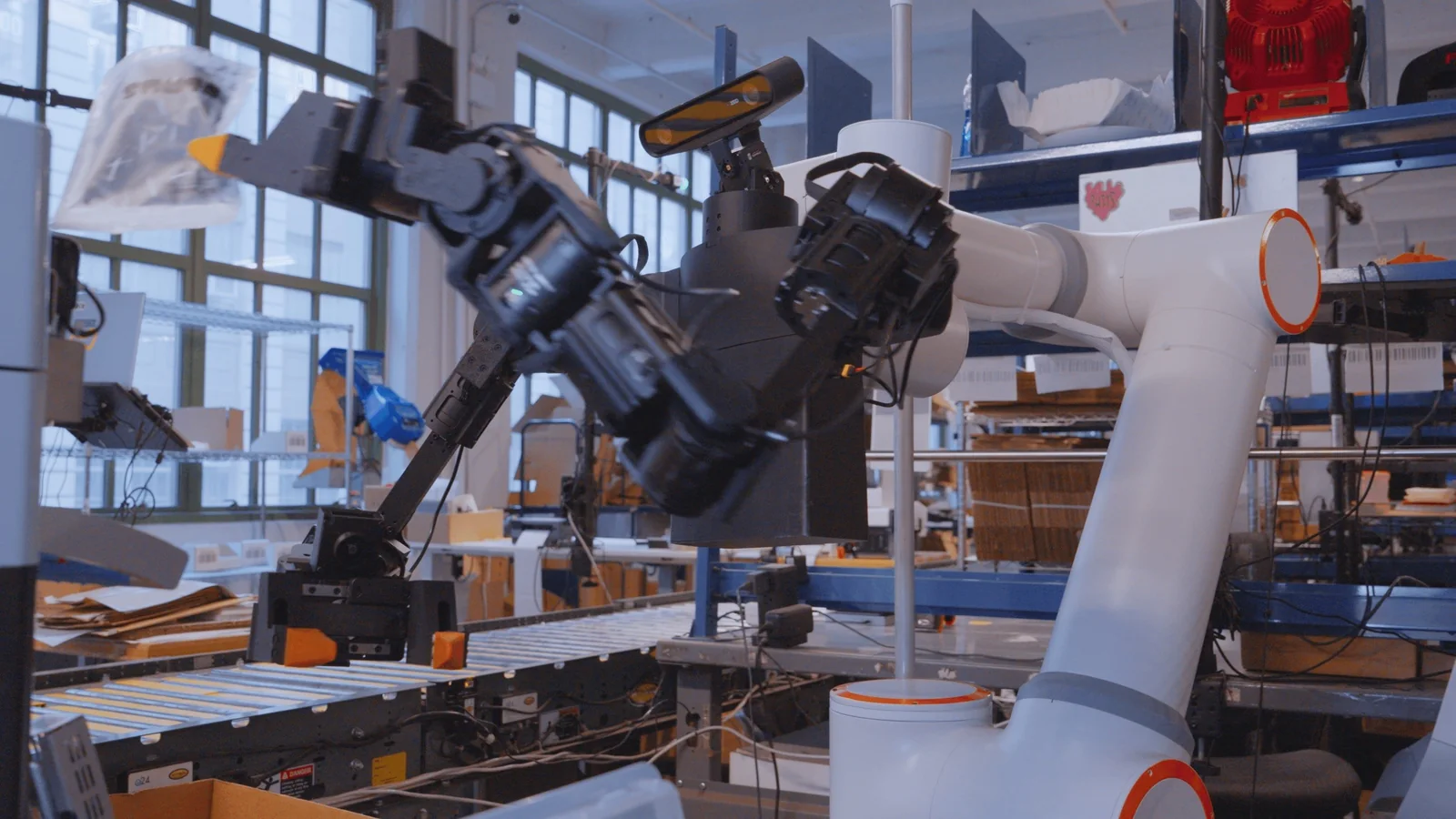
Ultra has raised a $50 million Series A to expand its OP1 warehouse-robot fleet. The company says its machines are already working in US warehouses and have packed more than 500,000 orders. This is not another humanoid teaser: the funding is going to a company offering operational packing, sorting and kitting stations as a service.
Event and source publication date: 9 October 2026 · RoboMorrow verification: 11 October 2026 · Order-volume and throughput figures are company claims, not an independent audit. RoboMorrow has not tested OP1.
$50 million of new capital, $62 million in total
The distinction between the two figures matters. The new Series A is worth $50 million and was led by Framework Ventures with participation from Y Combinator. The $62 million headline also includes an earlier $12 million seed round led by Y Combinator and NextView Ventures. Ultra did not receive $62 million of fresh funding in a single round; that number is the total across two rounds.
Ultra says it will use the capital for engineering and wider robot adoption. It has not disclosed its valuation, current revenue or the total number of machines in its fleet. Chief executive Jon Miller Schwartz told Fortune that the company has booked significant revenue and has been able to raise prices, but the absence of figures prevents an independent assessment of unit economics or growth.
OP1 instead of a humanoid: two arms at one station
Ultra OP1 is a stationary dual-arm workcell mounted on locking casters. It does not walk around the warehouse or attempt to reproduce the whole human form. Its job is to automate selected, repetitive line-side processes: packing orders, sorting items and kitting, where products from different containers are combined into one set.
Ultra’s website shows deployments in New York City, Atlanta, Carlstadt in New Jersey and Austin. In the Austin example, the company says six OP1 units run side by side. It also says the robots operate in warehouses year-round and that an installation can begin productive work within hours. Customer names and a fleet-wide deployment count remain undisclosed.
What does the published specification establish?
According to Ultra, OP1 has a roughly 5 × 5 ft footprint, can cover a work area up to 10 × 10 ft and reaches vertically from floor level to 10 ft. Each arm has a stated payload of up to 10 lb. The station uses a standard 120 V outlet with a 10 A peak draw and requires a dedicated 10 Mbps Ethernet connection. Its casters allow workers to roll it into position; the base remains locked during operation.
SiliconANGLE reports Ultra’s claim that one unit can process up to 1,000 items per day. The company does not publish the test method: the SKU mix, packaging sizes, shift length, uptime or human-intervention rate are unknown. The figure is therefore an indication of intended capability, not a benchmark that can be compared directly with another system.
Half a million orders is meaningful — and still a company claim
Fortune reported, citing Ultra, that the company’s machines have packed more than 500,000 orders for shipping. That is stronger evidence than a laboratory video because it refers to production activity. Yet the measurement period, robot count, error rate, average uptime and share of orders needing operator help have not been disclosed. The 500,000 figure cannot responsibly be converted into per-order cost or a productivity advantage over manual work.
The scope of the task is the most interesting part. OP1 does not try to automate an entire warehouse. It is placed where products already reach a station, allowing the robot to concentrate on manipulation and closing parcels. The same lesson appears in JD Logistics’ specialised Wolf Pack robots: scale often comes from dividing a process well, not from one machine that promises to do everything.
Physical Intelligence supplies part of the “brain”
Ultra is deepening its partnership with Physical Intelligence, a company developing AI models for robots. Fortune says Ultra builds and installs the hardware while Physical Intelligence supplies models intended to learn and adapt to each customer’s setup. This is a “body and brain” arrangement in which operational data from real stations can inform model development.
That does not establish unrestricted autonomy. Ultra describes OP1 as suitable for variable items and changing workflows, but it does not publish intervention rates, a catalogue of edge cases or recovery procedures after a failed grasp. A deployment must therefore be evaluated as a system of hardware, AI, integration, safety and fleet operations — the point of RoboMorrow’s analysis “A robot is not enough”.
RaaS lowers the entry barrier but obscures full cost
Ultra does not publish a purchase price. It offers OP1 through Robotics-as-a-Service: customers pay an upfront integration fee and an ongoing monthly charge covering hardware and software support. Its website offers a three-month trial. This can reduce initial capital expenditure, but total cost of ownership cannot be calculated without pricing, an SLA, the minimum contract term and rules for charging during downtime.
A warehouse operator should request results on its own product mix, the success rate without assistance, exception-handling time, network requirements, liability for damaged items and a recovery plan. It should also establish whether fees increase with volume and who pays for process changes after deployment.
What does this mean for Poland and the European Union?
OP1 is currently a US-focused offer. The public specification lists 120 V power, and Ultra’s site presents only American locations. The company has not announced euro pricing, an EU service network, European compliance or a Polish launch. A European warehouse should not treat the “Get a robot” form as proof of local availability.
The funding still matters in Europe because it shows capital moving towards tightly scoped systems with real operational data. A named EU customer, a European electrical configuration, local service partner or regional commercial offer would constitute a material update. Until then, OP1 is worth watching but should not be presented as available in the EU.
What is confirmed, claimed and still unknown?
- Confirmed: a new $50 million Series A, $62 million in total including the earlier seed, a RaaS model, operational US deployments and a partnership with Physical Intelligence.
- Company claims: more than 500,000 orders packed, up to 1,000 items per day per unit, deployment within hours and 24/7 operation.
- Unknown: valuation, revenue, total robot and customer count, monthly cost, SLA, intervention rate, errors and EU availability.
RoboMorrow assessment
The difference between a demonstration and a deployment matters. Ultra’s $50 million round is significant because the company is scaling robots that already handle real orders. European operators still need confirmed regional deployment terms, service pricing and independently assessed reliability before treating OP1 as a buy-ready European solution.
Sources and verification
- Ultra — official OP1 page, specifications and deployments
- Fortune — CEO interview and funding structure, 9 October 2026
- SiliconANGLE — independent OP1 and funding report, 9 October 2026
Image: OP1 at a packing station, official Ultra material. No language-specific overlay; this is not a RoboMorrow review or hands-on test.