America’s Robotics Map: 16 Companies, Five Business Models
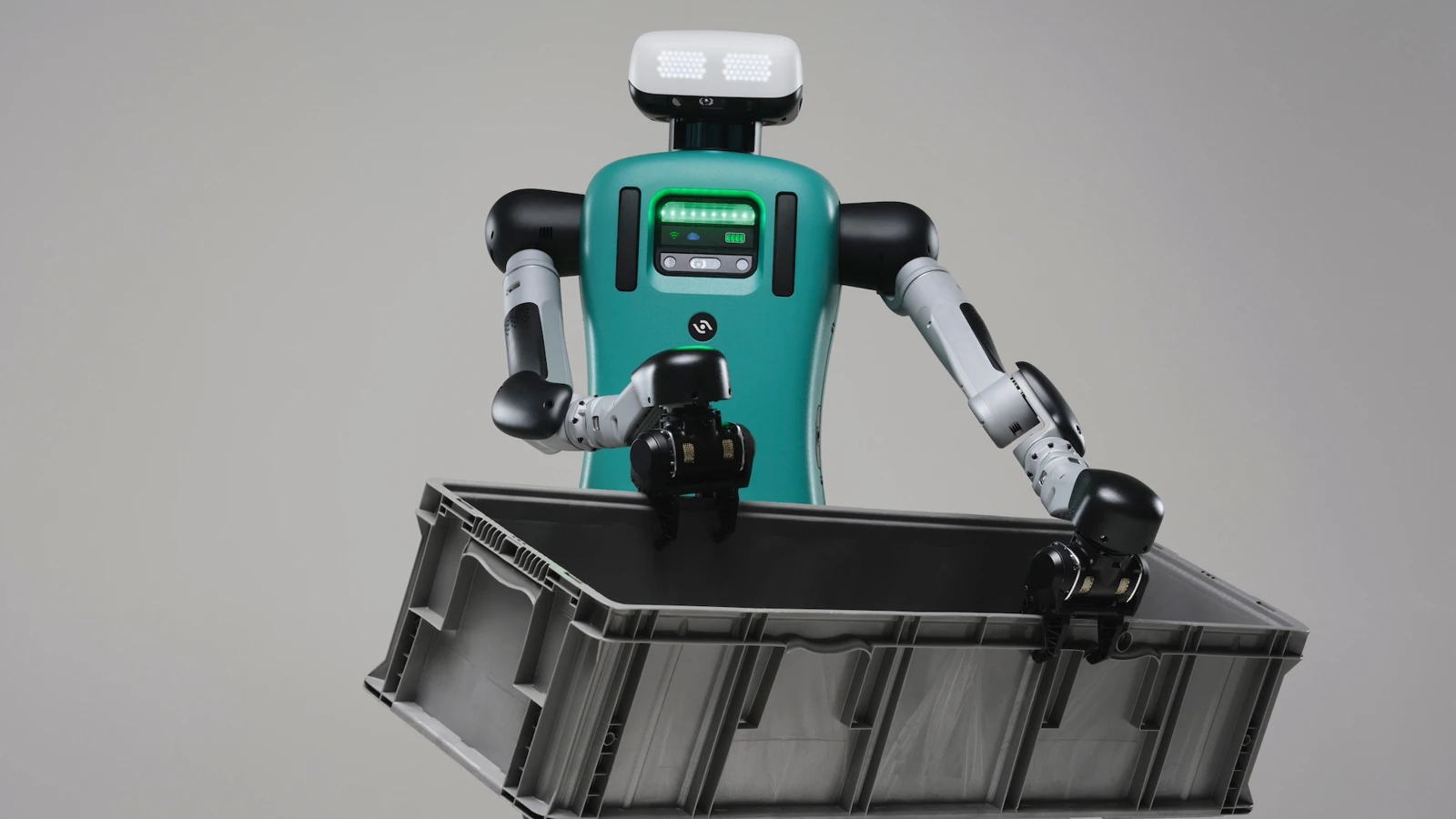
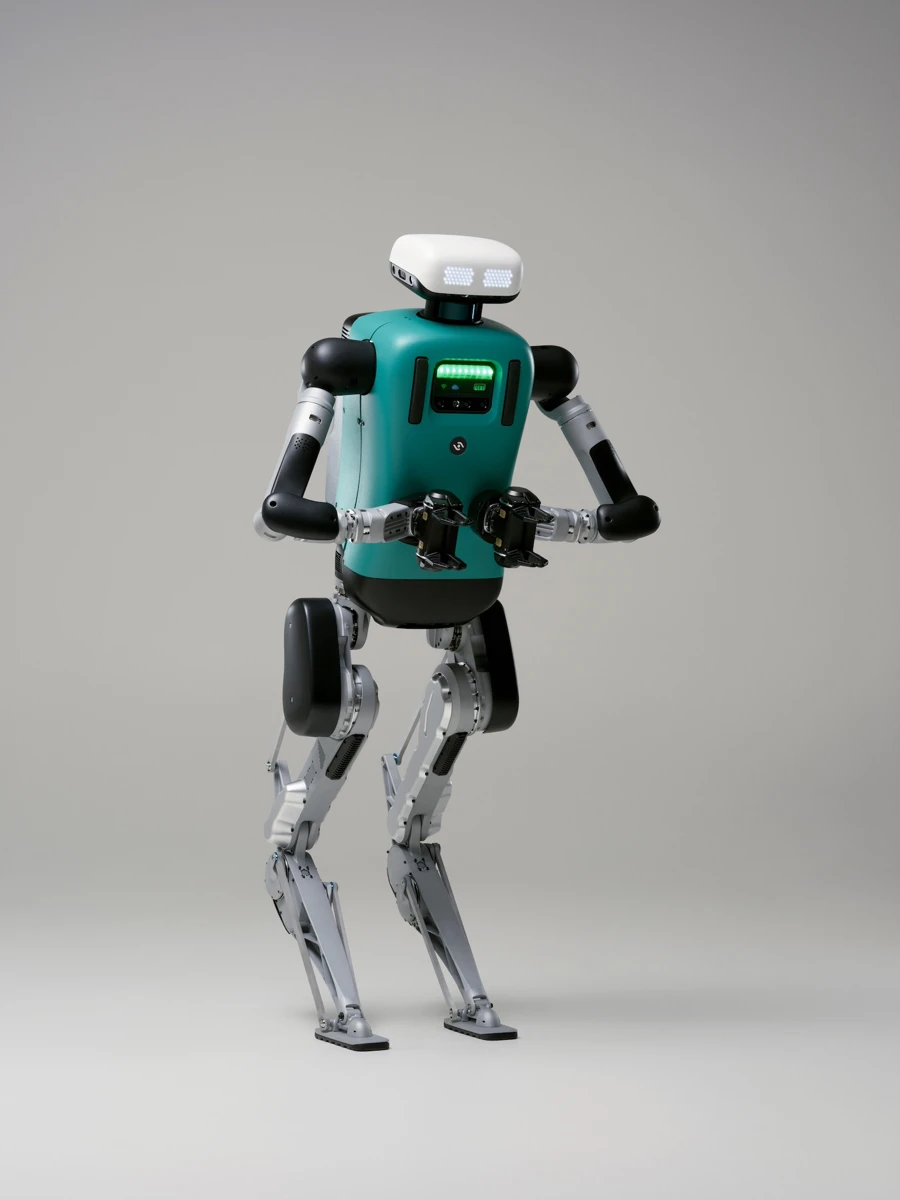
Lead photograph: Digit holding a tote. Official studio image from Agility’s press kit; product illustration, not a photograph of a GXO deployment. © Agility. Photo source.
ROBOMORROW INTELLIGENCE / 03 · 14.11.2026
16 companies • 13 cities • 6 map areas • 5 business perspectives
America’s advantage may sit in the connection between customers, machines and AI models. The key question: where is useful, repeatable work becoming an economic business?
Contents
- Three economies hiding inside one robotics market
- 38,500 installations measure buyer demand, not supplier value
- Angle 1: the strongest advantage may be an internal customer
- Angle 2: a humanoid has to win a specific task
- Angle 3: capital buys time; a customer buys an outcome
- Angle 4: the robot starts the relationship, not ends the sale
- Angle 5: who captures the value of robot intelligence?
- A capability map is not a deployment map
- What to check before a purchase, partnership or investment
Three economies hiding inside one robotics market
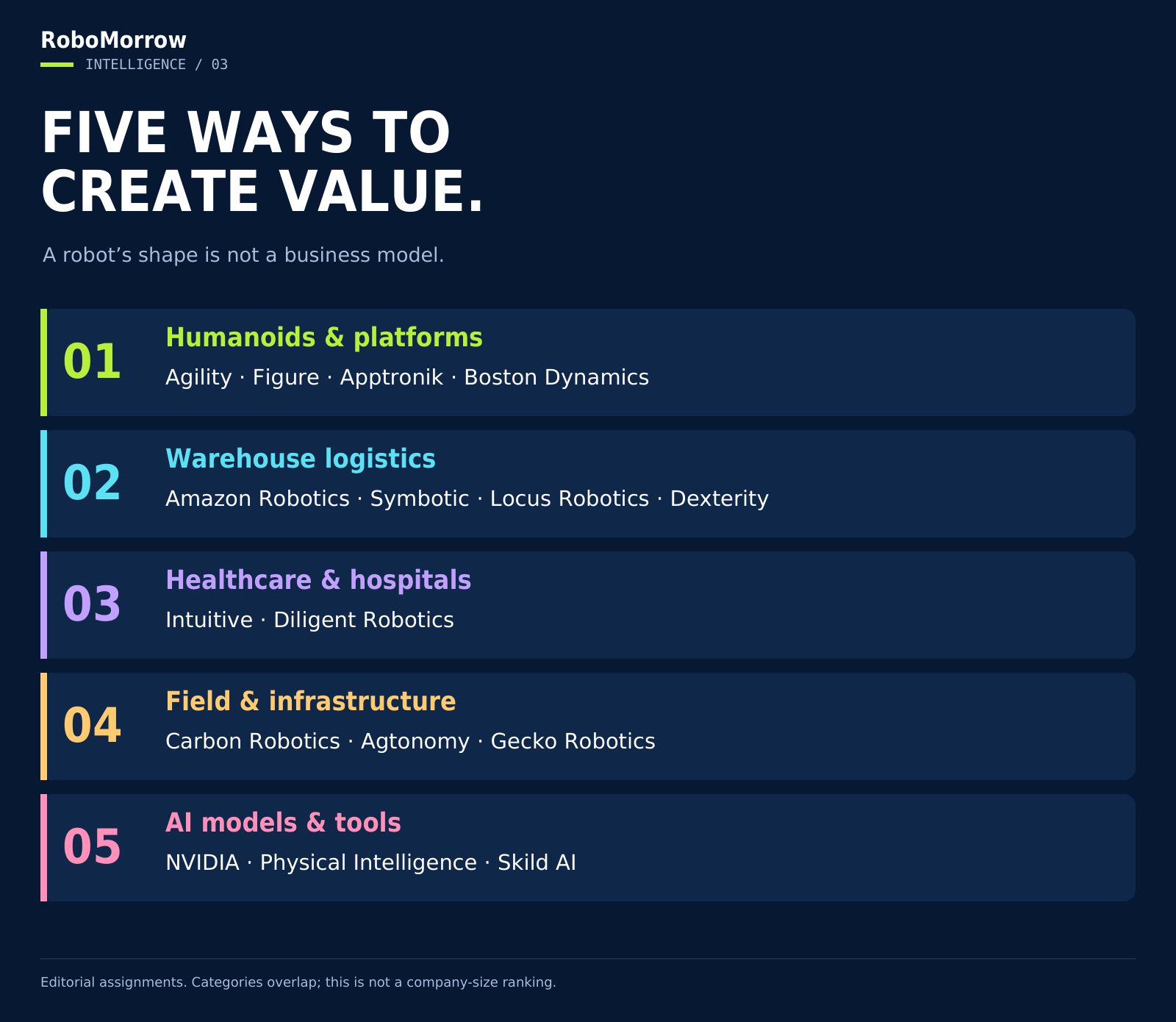
American robotics contains at least three parallel stories. One is automation with a measurable job: moving packages, assisting procedures or inspecting infrastructure. Another is humanoid development, where specific applications meet investor expectations. The third is an attempt to sell intelligence to machines built by other companies. Combining them into a single ranking of the “largest robotics businesses” obscures more than it reveals.
Our thesis: the US advantage is not simply its number of humanoid developers. The same ecosystem contains major robot operators, equipment suppliers, AI-model teams and companies specialized in one customer workflow. Their relationships can accelerate development, but a logo map cannot establish profitability or technological superiority.
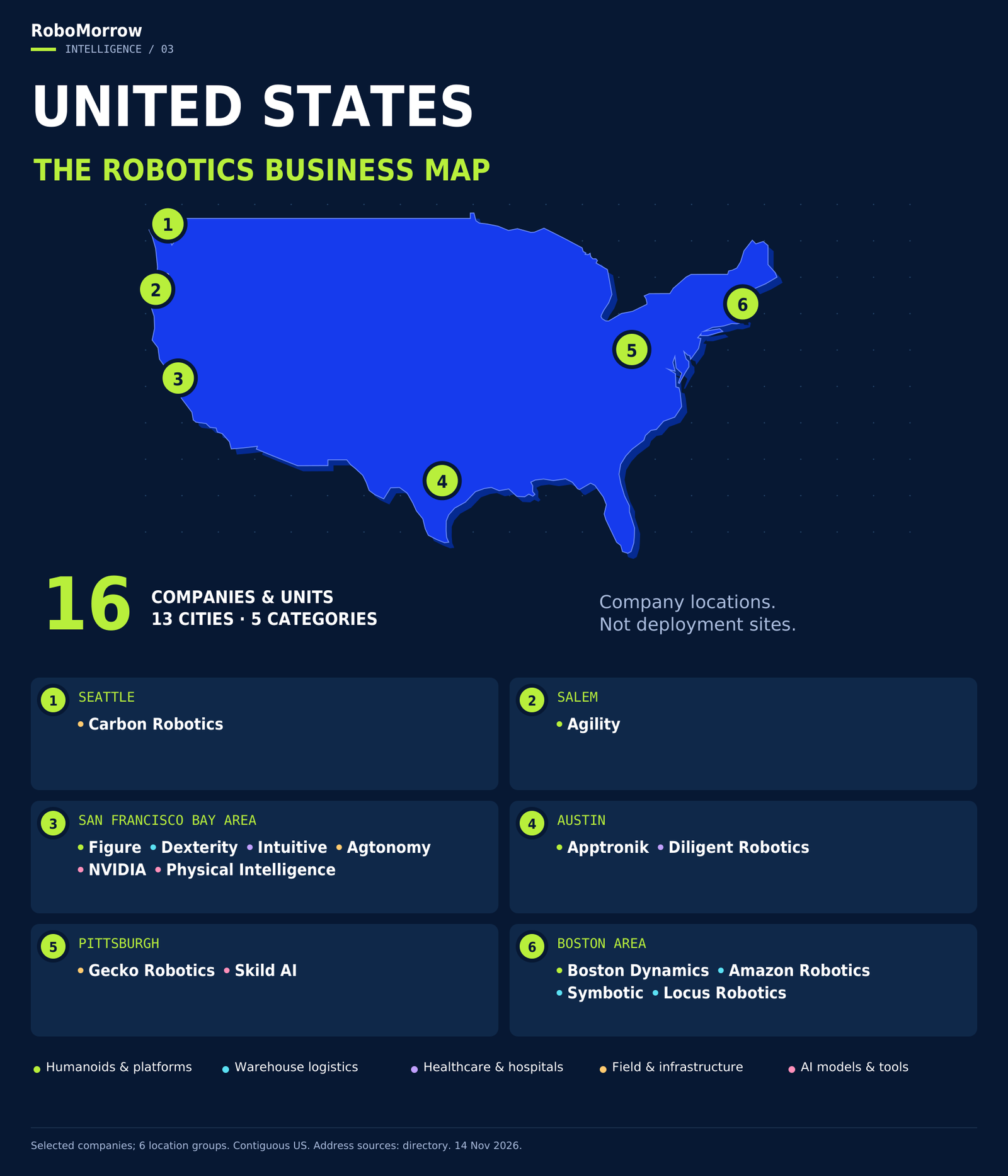
We selected 16 companies and business units in 13 cities, grouped into six areas on the map for readability. This is an analytical atlas, not a census. It excludes much of autonomous driving, drones, defense, integration and components. An omitted company is not necessarily unimportant. Each category illustrates a different way to create and capture value.
38,500 installations measure buyer demand, not supplier value
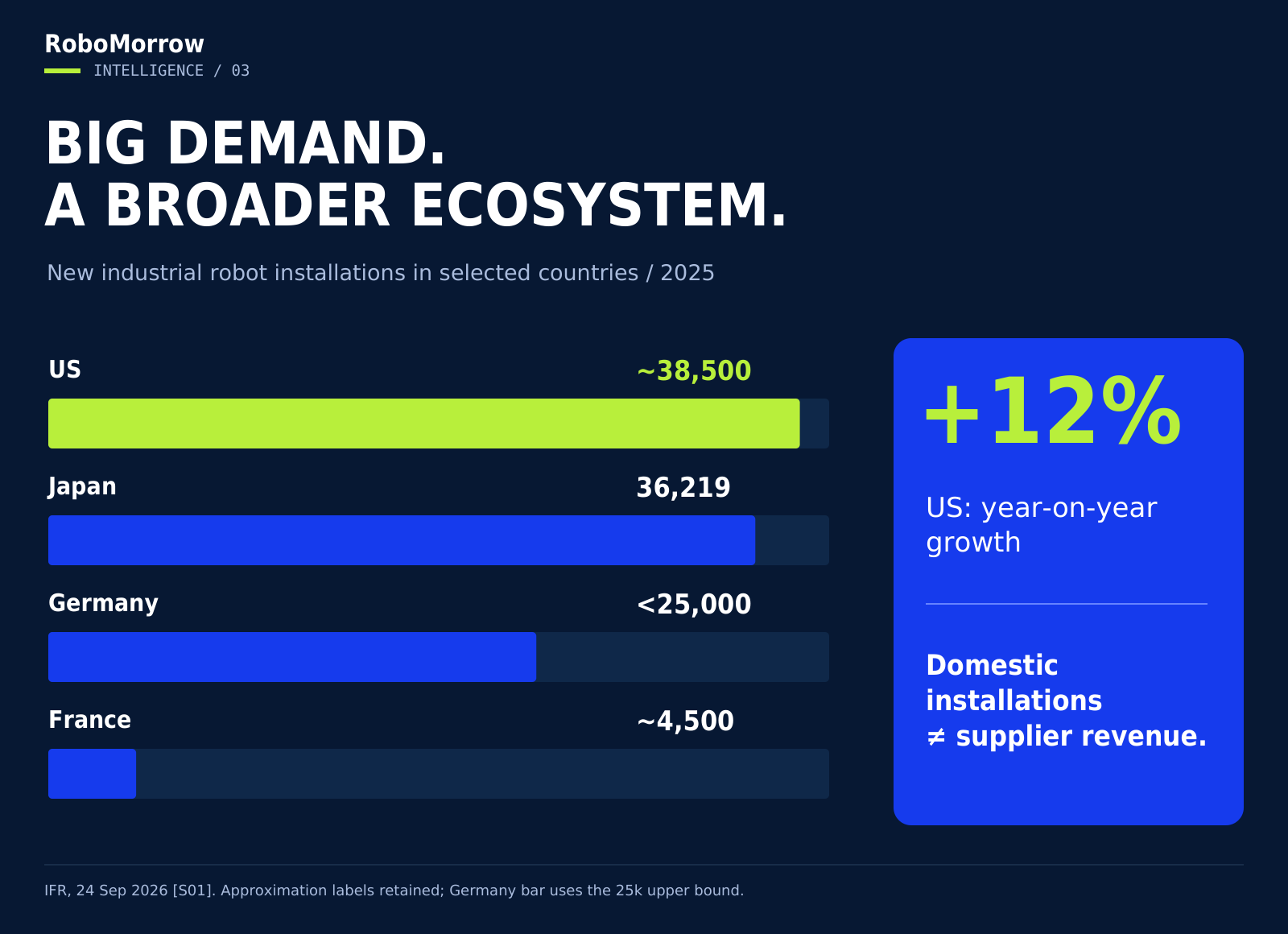
The September World Robotics 2026 release reports almost 38,500 new industrial robot installations in the US in 2025, up 12% year on year. The US overtook Japan in annual installations. Our chart compares selected countries: the US, Japan, Germany and France. It uses a common category and year, retaining approximation labels where required. [S01]
There is an important revision from earlier reporting: June’s preliminary figures were 38,000 and 11% growth. This edition uses the later release rather than mixing the two. Installations are counted by destination, irrespective of the supplier’s country of origin. A robot installed in a US factory can come from an overseas manufacturer.
The business implication is a substantial industrial customer base, but installation counts do not reveal how spending divides between robots, integration, software and maintenance. Nor do they automatically cover every medical and service-robot category. Estimating the entire American robotics economy would require separate segment definitions and safeguards against double counting.
Angle 1: the strongest advantage may be an internal customer
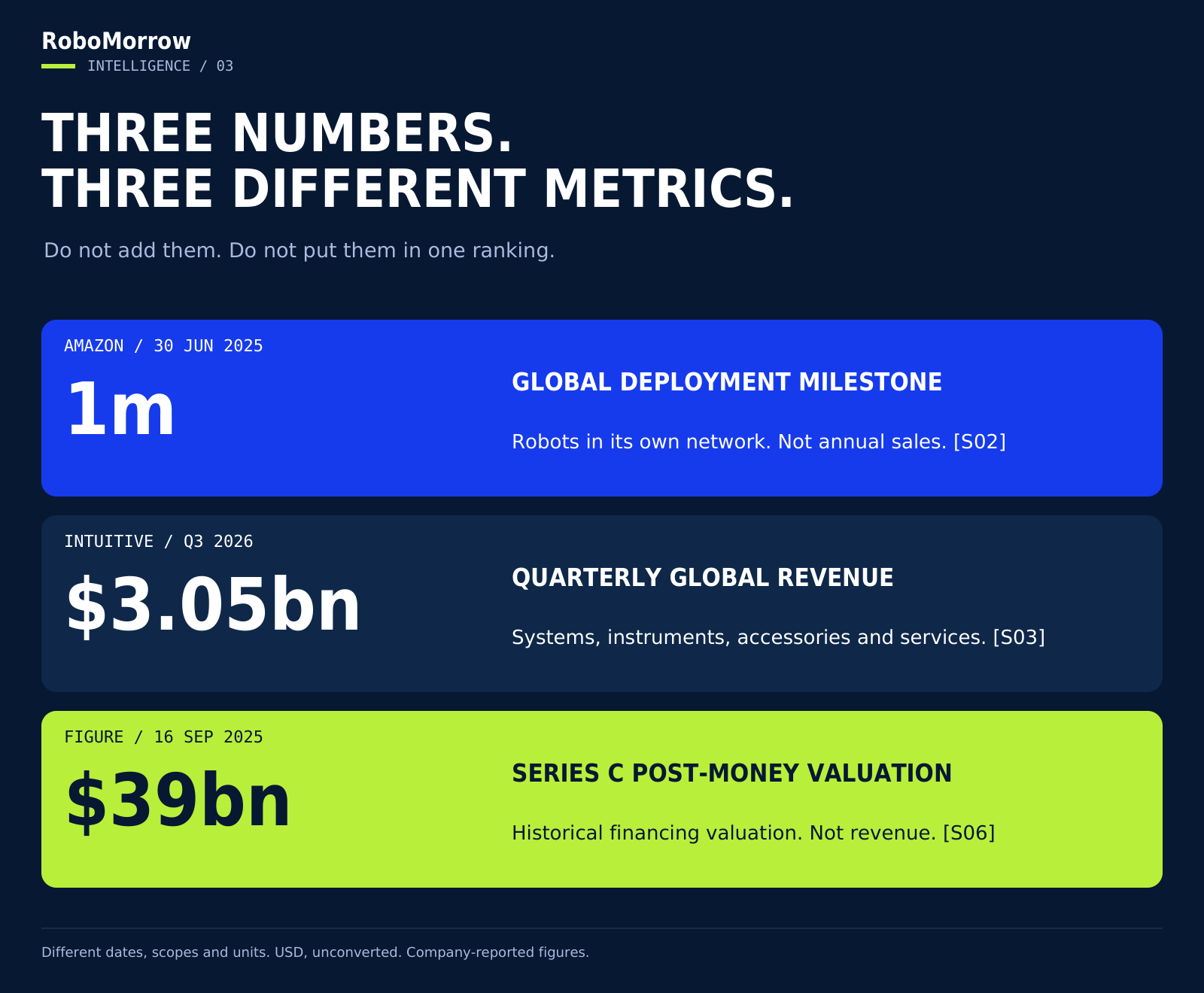
Amazon announced its millionth deployed robot on 30 June 2025. This was a milestone for its global operating network; the featured robot went to Japan. It was not a million US robots, a million humanoids or annual external sales. The example illustrates a model in which designer and operator belong to the same group. [S02]
Our interpretation is that this structure can shorten the route from operational problem to experiment and feedback. It also allows a robot to be evaluated as part of order fulfillment. An external supplier must additionally win the customer, pass procurement and connect to another organization’s IT environment. This does not prove that internal development always wins; it creates a different set of costs and constraints.
Symbotic, Locus Robotics and Dexterity illustrate different logistics propositions: warehouse systems, mobile picking support and manipulation. Their robot counts are not directly comparable without accounting for each machine’s role. Buyers should start with material flow, assortment variability, bottlenecks and the acceptable number of exceptions. [S17] [S18] [S19]
The most useful commercial discussion starts after a successful demo: who takes responsibility when the carton, order, warehouse layout or customer software changes? RaaS can spread payments over time, but it cannot remove the physical cost of support. Buyers need to establish whether on-site assistance, parts, updates and seasonal fleet expansion are included.
“We manufacture our robots in the United States”
Scott Dresser · VP, Amazon Robotics (at publication) · 2025-06-30. Excerpt from the published statement. [S02]
Angle 2: a humanoid has to win a specific task
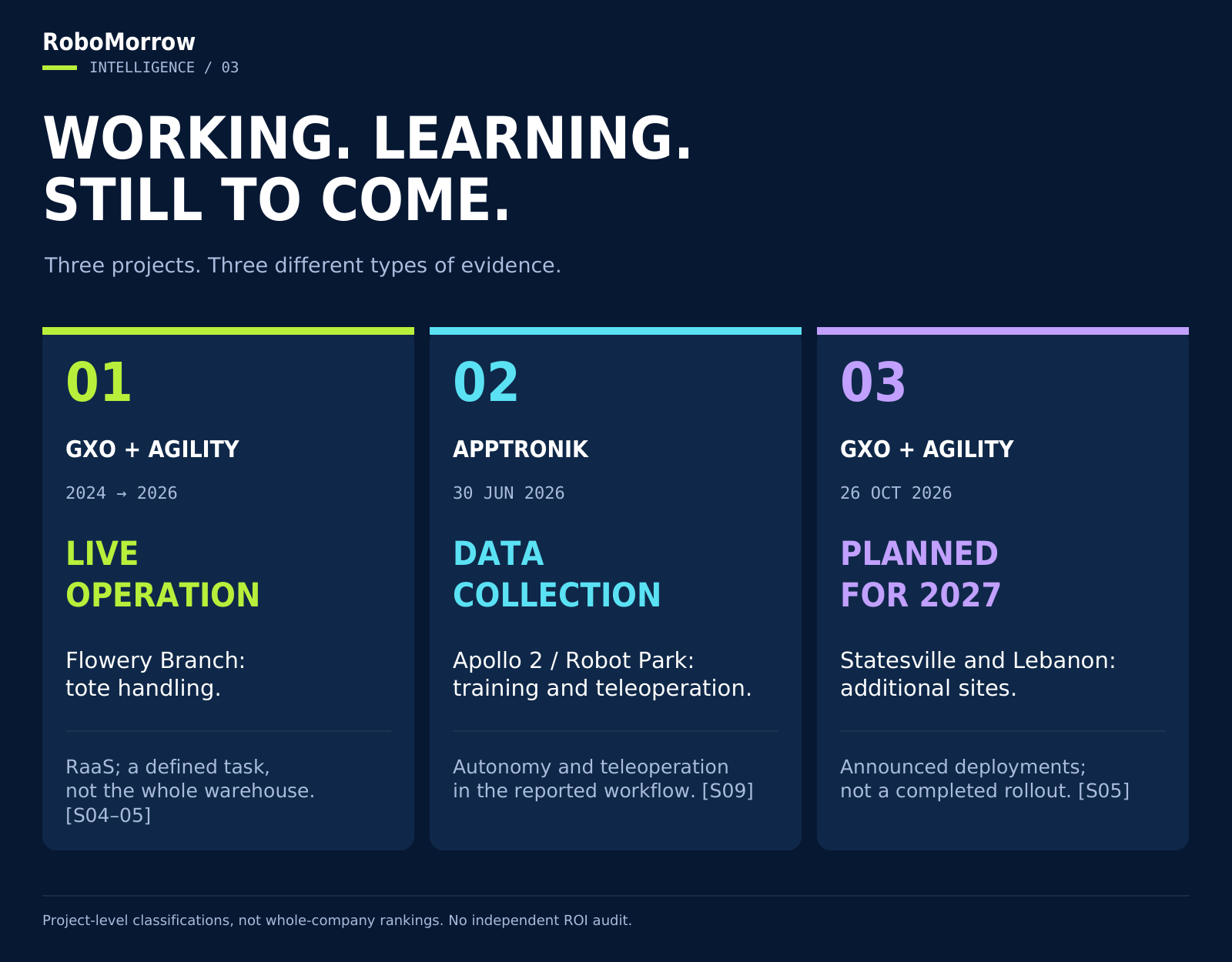
The June 2024 GXO–Agility agreement concerned Digit in a working warehouse, including moving totes onto conveyors. That is stronger evidence than a demonstration without a customer, but it still concerns a defined workflow. The 26 October 2026 announcement distinguishes existing work in Flowery Branch from additional sites in Statesville and Lebanon, scheduled to start in early 2027. [S04] [S05]
That distinction matters even in a short social post. An expansion agreement signals demand; it does not establish that the new site is already operating. Likewise, a factory’s stated production capacity is not the number of machines built, accepted or paid for.
In November 2025, Figure described Figure 02’s contribution to the production of over 30,000 BMW X3 vehicles. Its job was loading sheet-metal components. This does not mean the humanoid built those vehicles independently. The source’s targets for interventions and success rates must also be separated from documented outcomes. [S07]
Apptronik describes Apollo 2 and Robot Park as data-collection infrastructure using both teleoperation and autonomous execution. Robots at a customer location may therefore support model development as well as operational work. For buyers, task scope, intervention frequency, availability and cost per correctly completed operation matter more than the “humanoid” label. [S09]
“delivering value to our customers by putting Digit to work”
Peggy Johnson · CEO, Agility Robotics (at publication) · 2024-06-27. Excerpt from the published statement. [S04]
Angle 3: capital buys time; a customer buys an outcome
Figure announced more than USD 1 billion in Series C capital commitments in September 2025 at a USD 39 billion post-money valuation. We show historical terms of that round, not a current stock-market capitalization or revenue. Funding can support hardware, models, data, manufacturing and service infrastructure. It does not establish the cost of serving one customer. [S06]
The financial graphic also shows Intuitive’s USD 3.05 billion of revenue for Q3 2026 and Amazon’s global robot milestone. Each number has its own unit, date and scope. We neither add them nor create a ranking in which a startup valuation “beats” a medical company’s revenue. [S03] [S02]
When evaluating a supplier, ask for the bridge between capital and economics: installation cost, subsequent human support, replacement of wear components and the point at which customers reorder without another discount. Even rapidly growing orders can consume cash when manufacturing and deployment must be financed before acceptance. This is a business evaluation framework, not a judgment about any named company’s solvency.
Angle 4: the robot starts the relationship, not ends the sale
Intuitive demonstrates why a robotics business need not end with selling a device. In Q3 2026, instruments and accessories generated USD 1.80 billion against USD 3.05 billion of total revenue. That is approximately 59%, calculated from rounded release figures; it is not a margin. These are global company figures, not US-only sales. [S03]
Dave Rosa’s reference to over 10,000 procedures a day concerns the average during the reported quarter and use of the company’s platforms. It is not a count of autonomous operations performed without clinical teams. The business mechanism differs from a warehouse: system utilization, instruments, training and procedure-specific support matter.
Diligent Robotics serves the same broad customer sector, but Moxi handles hospital logistics. That changes both the decision-maker and the value metric. Transporting a sample or medication is assessed differently from assisting a procedure. This analysis does not assess treatment effectiveness or compare medical products using promotional material. [S13]
The transferable lesson is that recurring usage revenue can be attractive, but it needs recurring customer value. An underused subscription becomes harder to renew. Charging periodically does not turn service-intensive hardware into a business with pure-software costs.
“over 10,000 procedures per day throughout the period”
Dave Rosa · CEO, Intuitive (at publication) · 2026-10-20. Excerpt from the published statement. [S03]
Angle 5: who captures the value of robot intelligence?
NVIDIA, Physical Intelligence and Skild AI illustrate different technology layers. NVIDIA supplies compute, simulation and robotics tools. Physical Intelligence develops models and introduced a beta API for fine-tuning and inference in October 2026. Skild describes the ambition of one model across multiple embodiments. These are different propositions, not three interchangeable products. [S12] [S08] [S20]
An API can reduce entry costs for application builders, but it cannot complete deployment on its own. Sensors, safe motion execution, data, failure testing and operational accountability remain necessary. Physical Intelligence itself describes connectivity problems in some early applications. The boundary between local and cloud computation is consequently an operational decision, not just an IT architecture choice. [S08]
Our interpretation: long-term value capture may depend on access to operational data, the ease of changing model supplier and the cost of revalidation after updates. A partner list alone cannot establish who will capture most of the margin. Contracts should address data rights, model versions, reproducible tests and rollback procedures.
Look beyond warehouses as well. Carbon Robotics, Agtonomy and Gecko Robotics address crops, work machines and infrastructure. In our view, these provide a useful test of the entire Physical AI narrative: does the technology improve the economics of a specific field task? In seasonal agriculture or inspection, downtime, environmental conditions and service access may matter more than an impressive demonstration of flexibility. [S14] [S15] [S16]
A capability map is not a deployment map
On the map, the Boston area covers Waltham, Wilmington and North Reading; the San Francisco Bay Area covers six separate cities. Numbers locate company groups, not their customers. Amazon is marked at a Massachusetts robotics center rather than the parent group’s headquarters. Boston Dynamics belongs on a US capability map despite Hyundai Motor Group control. This definition does not measure the nationality of capital. [S11]
Directory locations link to official contact pages, releases or recruiting pages; Skild uses its company profile. We do not map every office of a multi-site business. Marker concentration partly reflects editorial selection and should not be interpreted as a region’s national market share.
Comparison with the earlier German and French atlases concerns business perspectives rather than complete company populations. In each edition, selecting 16 entities serves readability. The same number across three countries does not imply equal industry size or equal numbers of active manufacturers.
What to check before a purchase, partnership or investment
Start with one task and a baseline. What does the current process cost, where does downtime occur and how does demand vary? Then define success so that the robot cannot win only in the easiest scenario. Testing should include representative exceptions and the human labor needed to support the system.
Next, ask for evidence from a comparable application and a plan for the second deployment. If every new location requires almost a full engineering project, sales growth does not necessarily imply repeatability. Commissioning time, integration effort and service coverage form part of the product.
The third conversation concerns accountability: who owns the data, approves an update, fixes a fault and pays during downtime? There is no single correct answer across this atlas. A common set of questions nevertheless helps distinguish an impressive presentation from an offering that can be sustained in daily operation.
The most interesting American robotics company need not make the most human-looking machine. It may build a better control layer, provide dependable service or remove an expensive bottleneck. That is why this atlas connects humanoids with warehouses, healthcare, inspection and field work.
Directory: 16 companies and business units
16 / 16 companies and brands
Agility
Salem, ORHumanoids for tote handling. The 2024 GXO agreement covers live operation; additional sites announced in October 2026 are scheduled for 2027.
Agility brand; also Agility Robotics in sources. Headquarters: Salem, not the former Corvallis address.
Figure
San Jose, CAHumanoids and control models. We separate results on a specific BMW task from financing valuation and the ambition of general-purpose robotics.
Selected company; the editorial category may cover only part of its offering.
Apptronik
Austin, TXApollo humanoids and the Robot Park training facility in Austin. Production infrastructure and demonstrations are distinct from customer-confirmed deliveries.
Selected company; the editorial category may cover only part of its offering.
Boston Dynamics
Waltham, MAAtlas, Spot and Stretch address different jobs and maturity levels. The humanoid label is a map category, not a claim that the entire business is Atlas.
US operations, controlled by Hyundai Motor Group.
Amazon Robotics
North Reading, MAAmazon’s internal robotics and software ecosystem. Its million-robot milestone concerned the global network, not annual external sales or a US-only fleet.
An Amazon unit. Marker locates a robotics center, not the group headquarters.
Symbotic
Wilmington, MARobotic warehouse and material-flow systems. Evaluation should distinguish recognized revenue, orders and the stage of system commissioning.
Selected company; the editorial category may cover only part of its offering.
Locus Robotics
Wilmington, MAMobile robots supporting warehouse picking. Pick counts measure workflow, not robots sold; a service model changes the timing and allocation of costs.
Selected company; the editorial category may cover only part of its offering.
Dexterity
Redwood City, CAManipulation and physical AI for logistics. The relevant test is handling variable cartons, exceptions and the customer’s process rate.
Selected company; the editorial category may cover only part of its offering.
Intuitive
Sunnyvale, CASystems for assisted procedures. Revenue also includes instruments, accessories and services; it is not the size of the US robotics market.
Selected company; the editorial category may cover only part of its offering.
Diligent Robotics
Austin, TXMoxi performs hospital logistics. It is not a surgical robot; the appropriate value measure concerns deliveries and staff time.
Selected company; the editorial category may cover only part of its offering.
Carbon Robotics
Seattle, WALaser weed control. Economics depend on crop, season, throughput and machine utilization rather than resemblance to a person.
Selected company; the editorial category may cover only part of its offering.
Agtonomy
South San Francisco, CAAutonomy and software for work machines, including agricultural equipment. Enabling a partner’s machine differs from selling a proprietary humanoid.
Selected company; the editorial category may cover only part of its offering.
Gecko Robotics
Pittsburgh, PAInspection robots and infrastructure analytics. Value can sit in a data-informed maintenance decision rather than distance traveled.
Selected company; the editorial category may cover only part of its offering.
NVIDIA
Santa Clara, CACompute platforms, simulation and models for robotics. Total NVIDIA revenue is not robotics revenue; the company is mapped here as a technology supplier.
Selected company; the editorial category may cover only part of its offering.
Physical Intelligence
San Francisco, CARobot-control models and an API beta introduced in October 2026. Model access does not remove integration, testing or exception handling.
Marker locates San Francisco operations confirmed by the company’s recruiting page.
Skild AI
Pittsburgh, PAModels for different robot embodiments. Generalization should be evaluated on new tasks and hardware, with human support explicitly disclosed.
Marker: Pittsburgh per company profile; the company operates at multiple locations.
Continue exploring
Explore the whole Robotics Nations series
Three complementary perspectives on robotics companies and business models. Each map covers a selected group of 16 companies or brands, not a complete national market.
- Germany — company map
Industry, components and the route from pilot to deployment. Published 12.11.2026; research cut-off 11.11.2026. - France — company map
Warehouses, healthcare, agriculture and software. Published 13.11.2026; research cut-off 12.11.2026. - USA — company map
Humanoids, logistics, healthcare and AI models. Published 14.11.2026; research cut-off 14.11.2026.
Robotics Nations — all maps and earlier analyses →
Get future robotics market analyses in the RoboMorrow newsletter →
Methodology and limits
Research cut-off: 14 November 2026. Dated facts retain their publication dates; historical examples are not presented as new launches. Company sources record supplier and customer statements, not independent ROI audits. Analytical conclusions are labeled as interpretation. We have not tested these robots ourselves. Financial amounts remain in their source USD currency; these are not consumer offers and no exchange rate is applied. Missing data does not mean zero. Categories overlap; Boston Dynamics, Amazon and NVIDIA have activities beyond their assigned role. The map shows the contiguous US without Alaska or Hawaii because all selected locations fall within that area.
Sources and dates
- IFR — World Robotics 2026: global industrial installations — 2026-09-24.
- Amazon — millionth robot and DeepFleet — 2025-06-30.
- Intuitive — third quarter 2026 earnings — 2026-10-20.
- GXO — commercial RaaS agreement with Agility — 2024-06-27.
- GXO — Agility expansion, additional sites in 2027 — 2026-10-26.
- Figure — Series C capital commitments and valuation — 2025-09-16.
- Figure — F.02 production contribution at BMW — 2025-11-19.
- Physical Intelligence — Pi API beta — 2026-10-13.
- Apptronik — Robot Park expansion in Austin — 2026-06-30.
- Agility — official press assets — accessed 2026-11-14.
- Boston Dynamics — FAQ — accessed 2026-11-14.
- NVIDIA — robotics platform — accessed 2026-11-14.
- Diligent Robotics — Moxi hospital logistics — accessed 2026-11-14.
- Gecko Robotics — robotics and infrastructure data — accessed 2026-11-14.
- Carbon Robotics — LaserWeeder — accessed 2026-11-14.
- Agtonomy — equipment autonomy — accessed 2026-11-14.
- Locus Robotics — warehouse automation — accessed 2026-11-14.
- Symbotic — warehouse systems — accessed 2026-11-14.
- Dexterity — Physical AI — accessed 2026-11-14.
- Skild AI — general-purpose robot intelligence — accessed 2026-11-14.
Company addresses and offerings: sources in the directory cards. Maps and infographics: Redakcja RoboMorrow. Simplified boundary: world.geo.json (Johan Sundström), https://github.com/johan/world.geo.json.