Germany’s Robotics Map: 16 Companies and Their Business
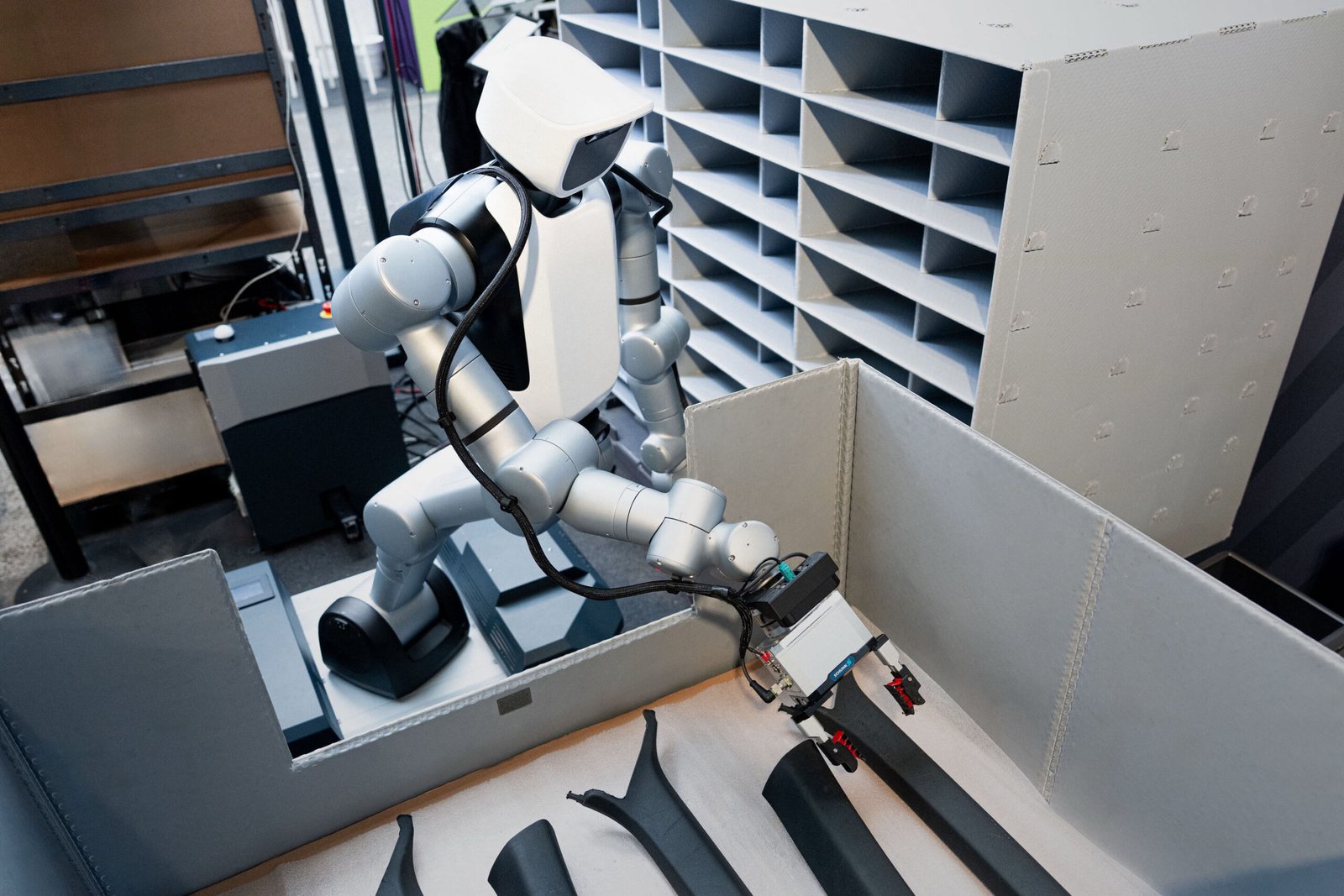
Featured photograph: © AUDI AG, Audi / Agile Robots project, 21 Oct 2026. Official press material; not a RoboMorrow test. Photo source.
ROBOMORROW INTELLIGENCE / 01 / GERMANY ATLAS
German robotics has more addresses than Munich, and more business models than selling humanoids. Hamburg brings intralogistics, Dresden software, and the Stuttgart region manipulation and components. This atlas organizes 16 selected companies and brands by location, product and role in deployment. It also explores why an established industrial base guarantees neither growing sales nor strong profitability.
Research cut-off: 11 November 2026 • Redakcja RoboMorrow • Annual figures refer to 2025; announcement dates are given separately. An editorial selection, not a market census.
Contents
The robotics map: from an address to the right conversation
This map is a starting point for finding a partner, technology or subject for further research. It covers robot manufacturers, AI and software providers, component companies and solutions for specific tasks. Selection is intended to show different business models; it does not measure market shares or regional cluster size. An absent company is simply outside this edition's selection.
[rmi01_figure id="map" lang="en"]Each entry has one primary category, even where its business crosses several segments. igus offers both components and robotic solutions; Agile develops hardware and software. This simplification makes an initial comparison easier, but should not define the limits of a company's activities. Locations identify the specified German headquarters or operational address, rather than every manufacturing site.
[rmi01_directory lang="en"]Using the atlas starts with the job to be done. Selecting a gripper supplier requires different criteria from selecting a programming platform, transport robot or returns-handling system. A useful question is therefore: which company supplies the missing part of my workflow, and who will be responsible for its performance once it is installed?
Angle 1: the largest market need not be the fastest-growing
IFR reports 24,800 industrial robot installations in Germany in 2025. Italy installed 7,800, France 4,500 and Spain 4,300. Germany represented 41% of EU-27 installations. These figures describe where robots were installed, not the nationality of their suppliers. [1]
[rmi01_figure id="demand" lang="en"]The 8% annual decline in German installations creates a tension between the long-term need for automation and near-term willingness to invest. [2] Our interpretation: a substantial industrial base offers access to customers, but a supplier must still justify the next purchase. A labor-shortage argument may be insufficient when a project requires extensive process redesign or a lengthy commissioning period.
A supplier could address this through a deployment that can be expanded in stages: one cell, one route or one type of operation. That allows integration, staff response and exception handling to be assessed before extending a contract. This is a suggested route to market, rather than a claim that every small deployment will prove profitable.
Angle 2: a large robotics business can have a thin margin
KUKA Group reported €3.8972 billion of revenue and €58.7 million of EBIT for 2025. Its EBIT margin was 1.5%, down from 2.0% a year earlier, despite revenue growth of 4.4%. These are global automation-group results, not German domestic sales or humanoid revenue. [3]
The figures challenge the assumption that an attractive sector automatically produces attractive economics. Integration, commissioning, service and repeatability across installations can matter in robotic projects. We do not attribute KUKA's margin decline to a single cause from these two indicators. The point is narrower: revenue scale and the ability to retain profit require separate assessments.
| Metric | Scope | What it tells us |
|---|---|---|
| 24,800 installations | Germany, industrial robots, 2025 | Annual unit demand. [1] |
| €3.8972bn revenue | KUKA Group, worldwide, 2025 | Recognized sales of a broad group. [3] |
| About €400m incoming orders | Schaeffler, humanoids, 20 Oct 2026 announcement | Announced order value; not annual revenue. [5] |
Funding rounds and valuations, when included in future editions, will receive separate comparisons. Funding measures capital raised. Revenue measures sales. A valuation describes the price placed on equity in a particular transaction or market. Combining these into one league table would reward the spectacle of announcements rather than clarify business performance.
Angle 3: a German supplier can participate in China's ecosystem
On 20 October 2026, Schaeffler opened a humanoid-related facility in Taicang, China. The company describes six humanoids at five stations and approximately €400 million of global incoming humanoid robotics orders. These are manufacturer disclosures, rather than independently measured utilization of the line. [5]
[rmi01_figure id="schaeffler" lang="en"]“a closed manufacturing loop where humanoids assemble components for humanoids”
Jochen Schröder, Schaeffler COO, 20 Oct 2026. Excerpt from a published statement. Source.
This is an important counterpoint to maps built only around national flags. A supplier's headquarters, production site and end customer can be in different countries. A motion-component company need not build the best-known humanoid to participate in its market. Equally, a partnership with a robot maker does not automatically grant exclusivity or a guaranteed share of its future orders.
Schaeffler, SCHUNK, Festo and igus represent this layer in the atlas. Their products and sales models differ; their shared relevance is their role in a larger automation system. Business analysis should ask about component qualification, series deliveries, relationship durability and the ability to serve several manufacturers. A logo on a partner slide does not answer these questions.
[rmi01_figure id="stack" lang="en"]Angle 4: the useful test of AI is a specific task
Audi and Agile Robots announced a mobile-humanoid parts-sequencing project on 21 October. The release calls it a proof of concept and includes a virtual twin using Dassault Systèmes and NVIDIA technologies. A mobile base does not imply a bipedal robot. [4]
“how successfully we combine industrial expertise with artificial intelligence”
Gerd Walker, Audi Board Member for Production and Logistics, 21 Oct 2026. Excerpt from his statement on manufacturing's future. Source.
CEVA, meanwhile, reported on 7 October that Sereact dual-arm systems were handling Zalando returns in live operations in Greven and Świebodzin. Delivery uses a Robotics-as-a-Service model. The release does not provide a complete dataset for independently calculating return on investment. [7]
“Returns are the hardest manipulation problem in fashion logistics.”
Ralf Gulde, Sereact CEO and co-founder, 7 Oct 2026. The supplier executive's assessment. Source.
A third example is Schaeffler's 22 October partnership with Wandelbots. It aims to standardize NOVA use and scale applications; it is not evidence of a completed deployment across every plant. [6] These stories describe different stages: an application experiment, live operation and a platform agreement. Classification should apply to the named project, rather than to an entire company.
[rmi01_figure id="evidence" lang="en"]Our interpretation is that software becomes valuable to a customer when it simplifies the next deployment or improves an existing process. Before purchasing, establish how much configuration remains specific to one site, how failures can be reproduced and who maintains the integration. Otherwise, a promising pilot may prove expensive to transfer to a second location.
Angle 5: a useful robot need not look human
Robotise presents JEEVES indoor deliveries, KEWAZO material lifting through LIFTBOT, and Magazino logistics workflows through SOTO and TORU. The linked websites establish the product offerings. We do not use them to announce current active-installation counts or compare the companies' profitability.
In an igus release published in February, Alexander Mühlens emphasized affordable integration without expert knowledge. This is a supplier's perspective, but it frames a useful purchasing question: how much work must a customer complete before the machine performs a useful job? [8] The hardware price alone does not answer that question.
For a hotel, elevator integration and delivery handover may matter. For a warehouse, container transfer and exception handling may be central. For scaffolding, lifting procedures and adaptation to the site may dominate. These are example evaluation criteria, not confirmation of particular features in every named machine. Their common requirement is a well-defined task and responsibility for the complete workflow.
What does this mean for Poland and CEE?
Poland appears here as an application location: Świebodzin is one of the two sites identified by CEVA. [7] It provides a specific starting point for discussing regional deployments. It does not establish that the same commercial terms are available to another warehouse, or that an open distribution program exists.
RoboMorrow business hypothesis: a local partner's opportunity may lie in application preparation, integration, training and service. Before discussing exclusivity, establish which tasks the supplier performs itself, which it assigns to partners and whether an existing relationship already covers them. Offering market entry without understanding the customer's buying process may provide insufficient value.
| Question | Evidence needed before scaling |
|---|---|
| What exact job are we selling? | Process definition, exceptions, required cycle time and acceptance conditions. |
| What is in the standard offer? | Hardware configuration, licenses, integration, training and service. |
| How much work does a second site require? | Reusable elements and tasks that must be repeated from scratch. |
| Who resolves a failure? | Accountability, spare parts access and an agreed response time. |
| How do we measure economics? | Total process cost, human interventions and comparison with an alternative. |
What to watch over the next 12 months
We assign no probabilities to these scenarios. The following signals help test whether individual projects are becoming repeatable businesses.
- Repeat orders: the same customer extends the scope after accepting its first deployment. This is stronger evidence than another letter of intent.
- Repeatability: an application works at a second site, with disclosed adaptation time and cost.
- Operational economics: published data covers interventions, availability and cost per correctly completed operation.
- Component revenue: orders are fulfilled and recognized in sales, with the reporting scope made explicit.
Find a partner for the process, rather than a winner on the map
Germany's ecosystem offers several entry points: a complete robot, gripper, drive, AI, fleet coordination or integration. The useful choice depends on the current constraint in a particular application. The atlas helps narrow the conversation; a purchasing decision requires checking the configuration and customer outcome. No color on a map replaces that work.
Related analysis: NEURA, Agile and Franka — Germany's Physical AI opportunity · Sereact and Zalando returns in Poland · Schaeffler's Taicang factory · Robotics Nations.
Explore the whole Robotics Nations series
Three complementary perspectives on robotics companies and business models. Each map covers a selected group of 16 companies or brands, not a complete national market.
- Germany — company map
Industry, components and the route from pilot to deployment. Published 12.11.2026; research cut-off 11.11.2026. - France — company map
Warehouses, healthcare, agriculture and software. Published 13.11.2026; research cut-off 12.11.2026. - USA — company map
Humanoids, logistics, healthcare and AI models. Published 14.11.2026; research cut-off 14.11.2026.
Robotics Nations — all maps and earlier analyses →
Get future robotics market analyses in the RoboMorrow newsletter →
Methodology and boundaries
This is a purposive selection of 16 companies or brands across five categories, with a documented German address and a public offering. It is not a statistically representative sample. Map points represent approximate city centers, not office coordinates. Related brands remain visible with their group relationships explained. We do not interpret regional brand counts as a measure of economic leadership.
Facts use reports and primary sources; interpretation is identified in the text. Quotations come from published releases, not RoboMorrow interviews. The Polish edition uses editorial translations. Photographs are press material, not evidence of an independent test. We do not have complete robotics revenue or comparable active-fleet data for every company. Missing information remains missing.
[rmi01_sources lang="en"]