AGIBOT G2 Max: 40 kg payload and the Worken productivity idea
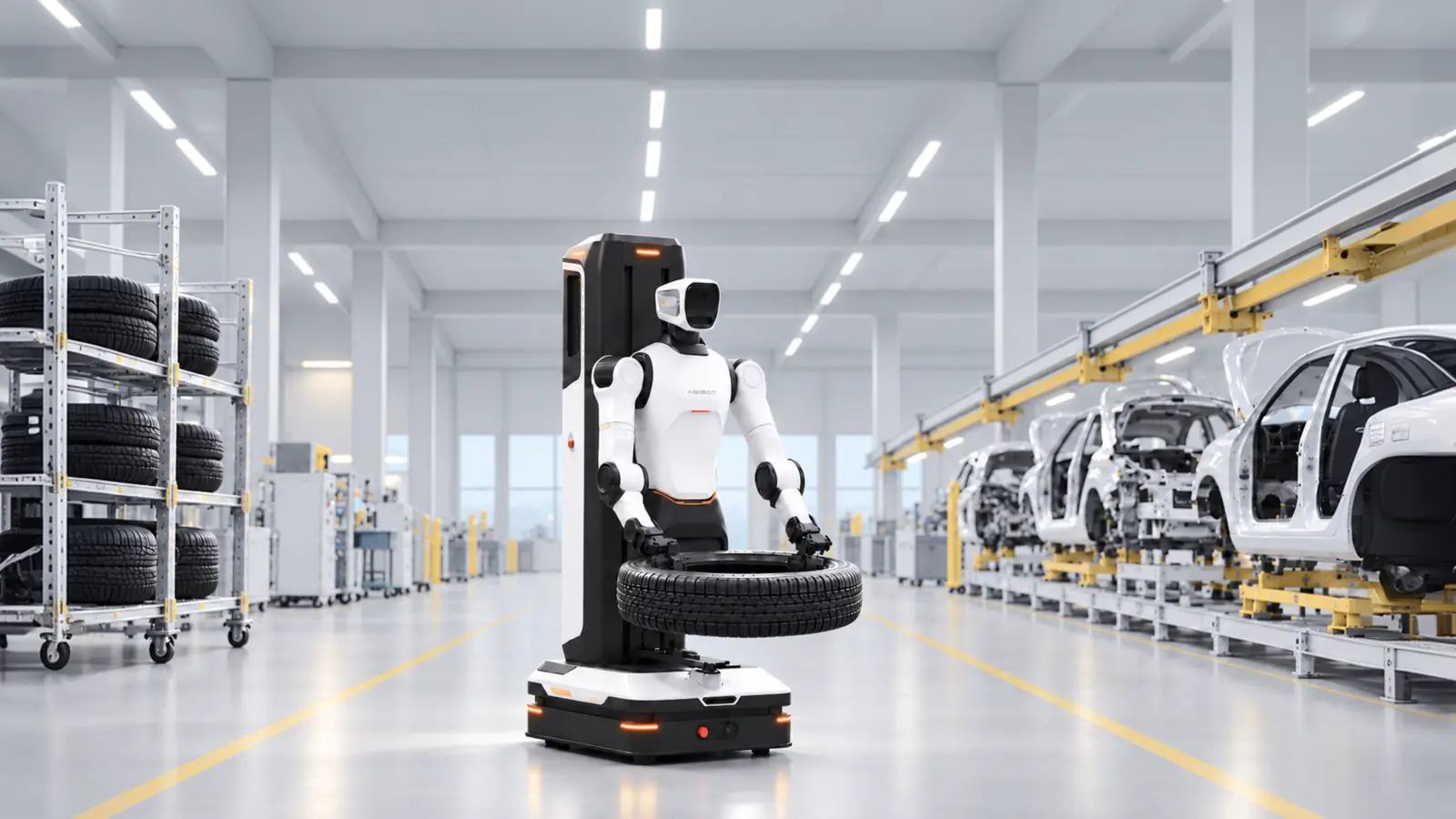
AGIBOT has unveiled the G2 Max industrial robot, claiming up to 40 kg of combined dual-arm handling capacity. At Innovation Day in Shanghai on 29 October 2026, it also introduced Worken — a proposed way to measure how much useful work robots actually complete. That could matter more than the number of machines manufactured. But will it be a metric that different factories can compare?
G2 Max: dual-arm handling on a mobile base
G2 Max is designed for manufacturing and logistics material handling. AGIBOT lists 21 degrees of freedom, up to 40 kg of total dual-arm capacity and a working-height range of 0.1–2.5 metres. The company also describes force-controlled manipulation, omnidirectional mobility and safety functions. This is not a bipedal humanoid like Digit; the presented industrial configuration uses a mobile base.
That choice may suit predictable industrial routes and heavier loads. Rather than solving the balance problem of walking on two legs, the system can focus on grasping, navigating between stations and fitting established workflows. However, there is no verified EU price, delivery timetable, local service offer or customer-level operating-cost data.
| Specification | Manufacturer claim | What a buyer still needs |
|---|---|---|
| Payload | Up to 40 kg combined, both arms | Grip conditions, reach, repeatability and cycle time. |
| Degrees of freedom | 21 DoF | Exact tool and gripper configuration. |
| Working height | 0.1–2.5 m | Stability and load capacity across the range. |
| Autonomy | Use cases and AI capabilities outlined | Intervention rate, accepted cycles and multi-shift uptime. |
Worken: count useful robot work, not stage demonstrations
AGIBOT's proposed Worken framework — a combination of “work” and “token” — multiplies active robot count by autonomous hours and an output-efficiency ratio measured against a defined task reference. It is a proposal by one manufacturer, not an independently adopted international standard.
Worken = active robots × autonomous working hours × output efficiency ratio.
A purely illustrative calculation: ten robots working autonomously for six hours at an output factor of 0.8 would yield 48 effective work-hours under that definition. This is our arithmetic, not AGIBOT factory performance. The challenge is the benchmark. Moving tyres, packaging electronics and assisting hotel visitors cannot automatically be compared as though they were one identical task.
What could make a productivity metric misleading?
A robot can remain switched on for eight hours while spending much of that time waiting, charging, retrying grasps or requiring human recovery. Even the output ratio can be inflated if tasks are unusually easy or the baseline is poorly defined. Worken would be more credible alongside failure rates, rejected operations, operator time and cost per correctly completed task.
Our guide to the full cost of humanoid deployment makes the same distinction: value is measured at the end of a process, not by an attractive catalogue specification. The principle also applies to wheeled mobile manipulators.
AHA3, GO-3 and Link-U OS: this was more than a hardware launch
AGIBOT also outlined its AHA3 hardware architecture, GO-3 Preview model for reasoning and actions, WITA-Omni for interaction and Link-U OS 1.0. The company plans to make Link-U OS fully open source by the end of 2026 and currently describes trials with selected ecosystem partners. That does not mean the full platform is already freely released.
Its release cited deployments involving the broader G2 family in Longcheer tablet production, CNC machine tending and logistics. Those examples are context for the family, not proof of measured G2 Max performance. In another segment, RoboMorrow has covered AGIBOT and Chimelong's entertainment and guest-service plans. A factory handling robot and a hotel-service robot need entirely different task benchmarks.
Company shipment scale needs similar care. Our analysis of reported humanoid shipments explains why units delivered should not be equated with productive, autonomous factory shifts.
RoboMorrow verdict
The biggest story is not the 40 kg number alone. AGIBOT is trying to shift industry attention from robot shipments to successfully completed work. That is directionally valuable, but Worken still needs common definitions and independently auditable data. G2 Max is a noteworthy industrial launch; its economics and European availability remain unverified.
Sources and method
- AGIBOT — official Innovation Day release, 29 October 2026.
- AGIBOT via PR Newswire — distributed manufacturer release, 29 October 2026.
- Humanoids Daily — independent event recap.
Redakcja RoboMorrow · checked 1 November 2026 · imagery and specifications are manufacturer statements. No independent hands-on test, confirmed EU pricing or retail offer; no affiliate link.