Epson launches AX6, its first collaborative robot
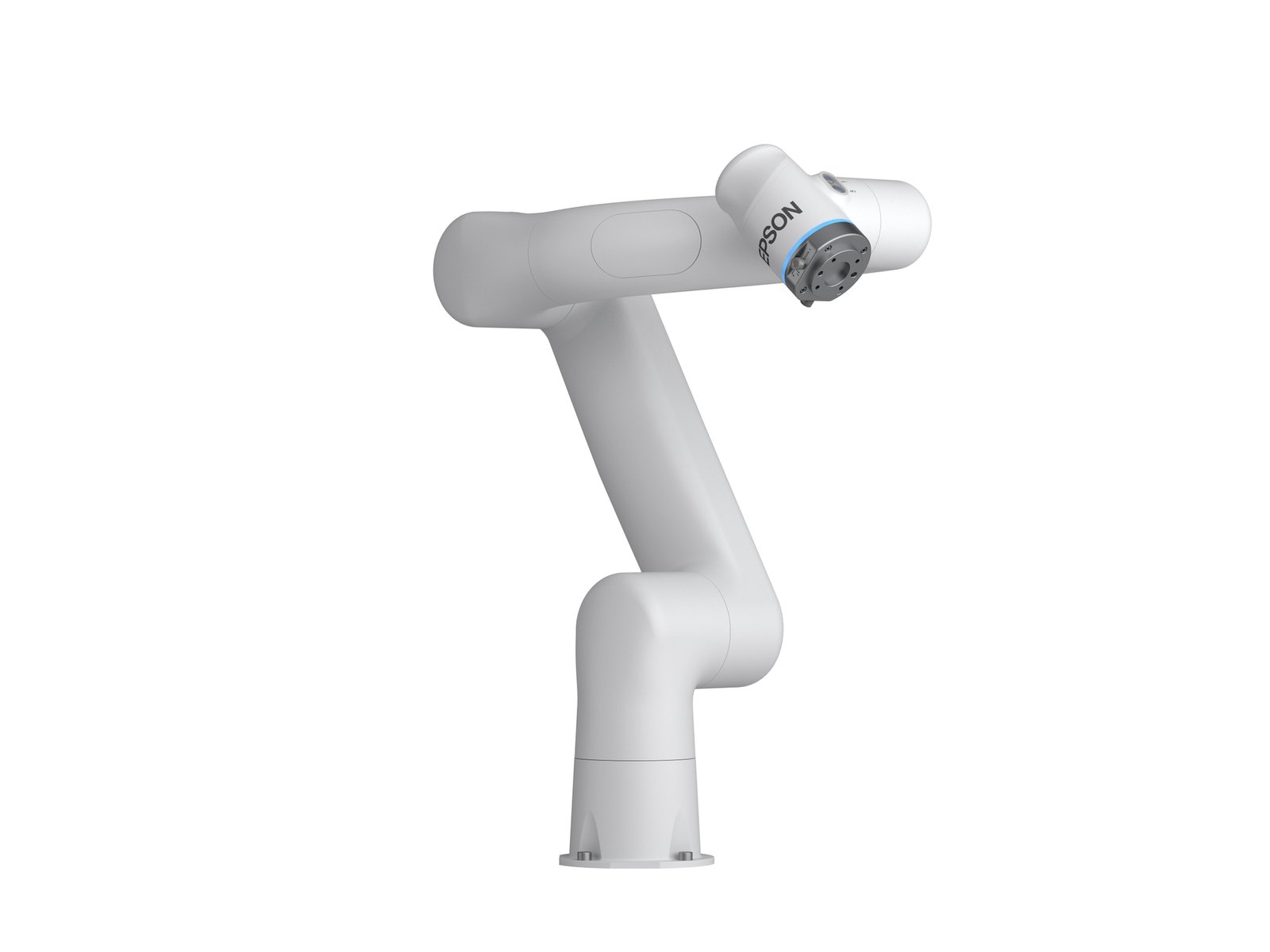
Epson introduced the AX6 on September 22 as its first collaborative robot. It is now available through Epson distributor partners in the U.S. Epson lists a 6 kg payload, 900 mm reach, +/-0.03 mm repeatability, 18 kg robot weight and maximum TCP speed of 2,000 mm/s. Public EU pricing and Polish commercial availability are not confirmed.
Epson is entering the cobot segment with the AX6, a six-axis arm designed for closer human interaction and easier programming. The move matters because Epson is not a startup building its first industrial channel. It has decades of SCARA and six-axis automation experience. The AX6 fills a portfolio gap in a category that often wins small and medium-sized manufacturers through redeployability, simpler integration and fast changeovers.
The AX6 specification in context
Epson lists a maximum 6 kg payload and 900 mm reach measured from J2 to the wrist center. Repeatability is +/-0.03 mm, robot mass is 18 kg and maximum linear TCP speed is 2,000 mm/s. The arm can be installed on a tabletop, wall or ceiling. It is IP54 rated and Epson says it meets ISO Class 5 cleanroom requirements.
That places the AX6 in the useful middle of the light-cobot market. It is not designed for heavy palletizing, but the numbers fit machine tending, assembly, light pick-and-place, dispensing, laboratory work and inspection. It belongs beside the products in our 2026 small-business cobot comparison, although a fair value comparison needs pricing and deployment evidence that are not yet public.
No-code on one side, Python on the other
Epson emphasizes AX Portal, a no-code environment intended to reduce the programming barrier. Users can also hand-guide the robot and teach positions using buttons near the tool flange. At the same time, a customizable Python environment can load additional libraries and modules. That combination is sensible: simple cells do not require traditional programming, while advanced users are not trapped inside a visual wizard.
The arm also provides Ethernet and pneumatic connections at the end of arm, configurable buttons, a multicolor status ring and a 3D simulator for testing programs before execution. For smaller integrators, this tooling matters because engineering hours can easily exceed the cost difference between two otherwise similar arms.
"Without barriers" still requires a risk assessment
The most important caveat is safety. Epson says the power- and force-limiting design can allow operation without traditional safety barriers with a proper risk assessment. That condition should never be removed from the sentence. A collaborative arm is not automatically safe in every application. Tooling, payload geometry, sharp edges, pinch points, speed and the surrounding process all change the risk.
Companies therefore have to evaluate the complete cell rather than treating the robot as a safety certificate. Our guide to cobot cost, safety and ROI explains why the arm is only part of deployment cost: tooling, fixtures, sensors, integration, validation and training still matter. AX6 may simplify parts of that work, but it does not eliminate them.
What is actually new for Epson
The new element is a full collaborative robot in Epson's portfolio. The company already has industrial safety technologies and a broad automation line, but AX6 is a direct answer to a market led by Universal Robots, FANUC, ABB, Techman, DOBOT and others. In this class, software, integrator availability, service and end-effector ecosystem often matter as much as payload and reach.
Epson can potentially leverage its existing industrial channel and precision-automation reputation. The missing piece is public price. Epson says the AX6 is available through distributor partners, but the release is U.S.-focused. RoboMorrow has not verified a Polish list price, EU launch date or local stock.
Why European SMEs should watch it
For European SMEs, the combination of low robot mass, multiple mounting options, no-code workflows and Python extensibility is attractive for short runs and changing tasks. A cell that can be redeployed without a major engineering project can create more value than a faster industrial robot that stays dedicated to one process.
That does not make AX6 an automatic recommendation. European buyers still need price, local service terms, accessory compatibility and real application references. The software layer is evolving quickly too: the releases covered in our ROSCon 2026 software-stack analysis show that integration increasingly depends on the broader robotics ecosystem, not just one vendor interface.
RoboMorrow take
AX6 looks like a well-balanced first cobot from an experienced automation vendor: 6 kg payload, 900 mm reach, compact 18 kg mass, no-code plus Python and cleanroom capability. Its strongest advantage may become the combination of hardware, Epson's channel and a lower-friction programming workflow rather than one standout specification.
We are not adding a ranking score based on a press release. A meaningful comparison needs EU pricing, availability, integrator feedback and evidence from working cells. Once those data arrive, AX6 is a strong candidate for an update to our cobot guide.
For buyers, the key comparison will therefore be total deployment effort rather than headline payload alone. The 6 kg and 900 mm class already contains many capable arms. Epson is trying to differentiate through no-code setup, Python, simulation and utilities routed to the wrist, but those features only become an economic advantage if integrators can commission real cells faster and maintain them with less custom work. Independent projects and European pricing are still needed before that advantage can be measured.