Beyond Tesla and China: four French robots worth watching
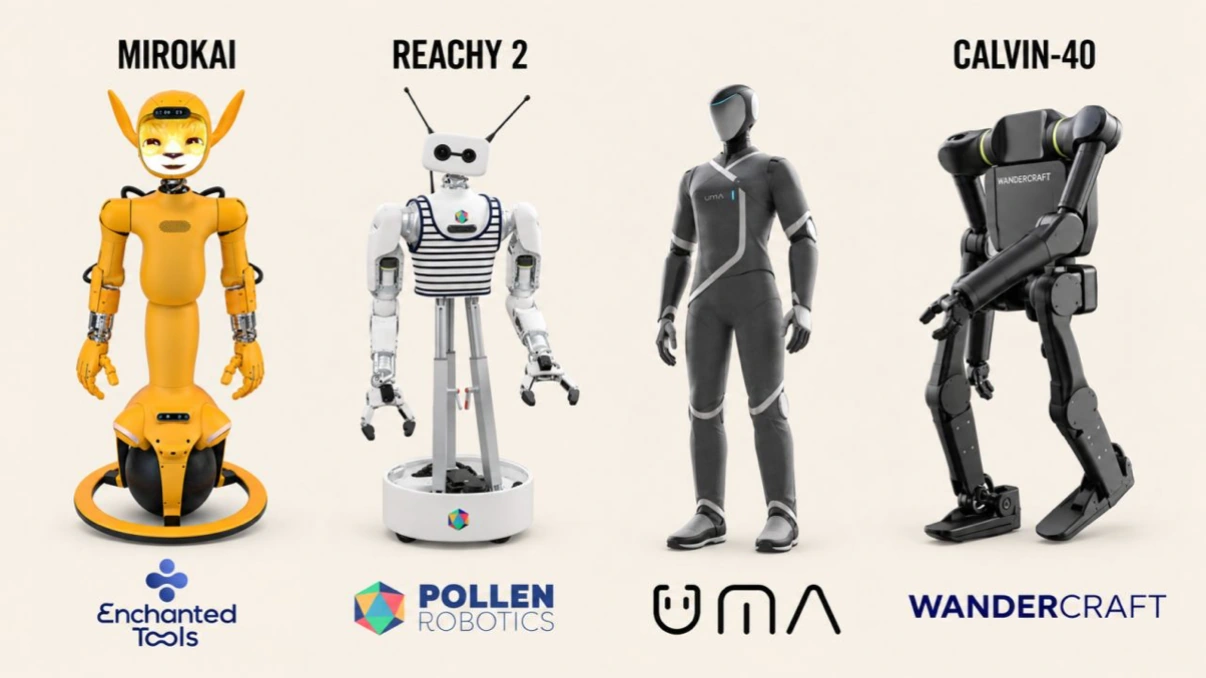
Mirokaï, Reachy 2, Northstar and Calvin-40 are not competing for exactly the same market. Together, however, they show why the robotics conversation should not stop at the US and China. We examine the technology, the evidence and the business case behind each approach.
A humanoid handling tyres. An open platform for robotics research. An expressive character built around human interaction. A design for a machine intended to use our tools. Put them together and you do not get four versions of the same product. You get four answers to a more interesting question: what useful work will somebody actually pay a robot to do?
That is the strongest reason to look at French robotics. There is no need to declare that France has beaten Tesla, or to judge the companies by whose machine looks most human. Enchanted Tools, Pollen Robotics, UMA and Wandercraft describe different priorities: interaction, research infrastructure, general-purpose dexterity and demanding physical work. [1][4][9][11]
Our argument is straightforward: the value of this selection lies in its diversity, not in a national leaderboard. A company can succeed without first delivering a robot that performs every human job. But each company has a different test to pass before an attractive proposition becomes a repeatable business.
Four companies, four propositions: the quick comparison
| Company and robot | Core proposition | What the sources establish | What they do not establish |
|---|---|---|---|
| Enchanted Tools — Mirokaï | Interaction and assistance in public-facing settings | Described social applications; nearby supervision still specified for 2026 [1][2][3] | Full autonomy across every advertised scenario |
| Pollen Robotics — Reachy 2 | An open, two-armed research platform | Documentation, SDK, teleoperation and hardware specifications [4][5][6][7] | A turnkey, unattended hotel or factory employee |
| UMA — Northstar | A design for a dexterous general-purpose humanoid | A design announcement and a pilot-programme roadmap [9][10] | A production product with independently validated performance |
| Wandercraft — Calvin-40 | Material handling and repetitive physical work | The manufacturer's Douai account and a 12-customer announcement [11][12][13][14] | Twelve large production fleets or 350 machines already operating |
The word “humanoid” can obscure more than it explains. A laboratory manipulator and a material-handling machine may share a recognisable body layout while having different customers, operating conditions and definitions of success. We therefore do not award points for appearance. We ask what each architecture is supposed to achieve.
1. Mirokaï: a robot does not have to look human to engage people
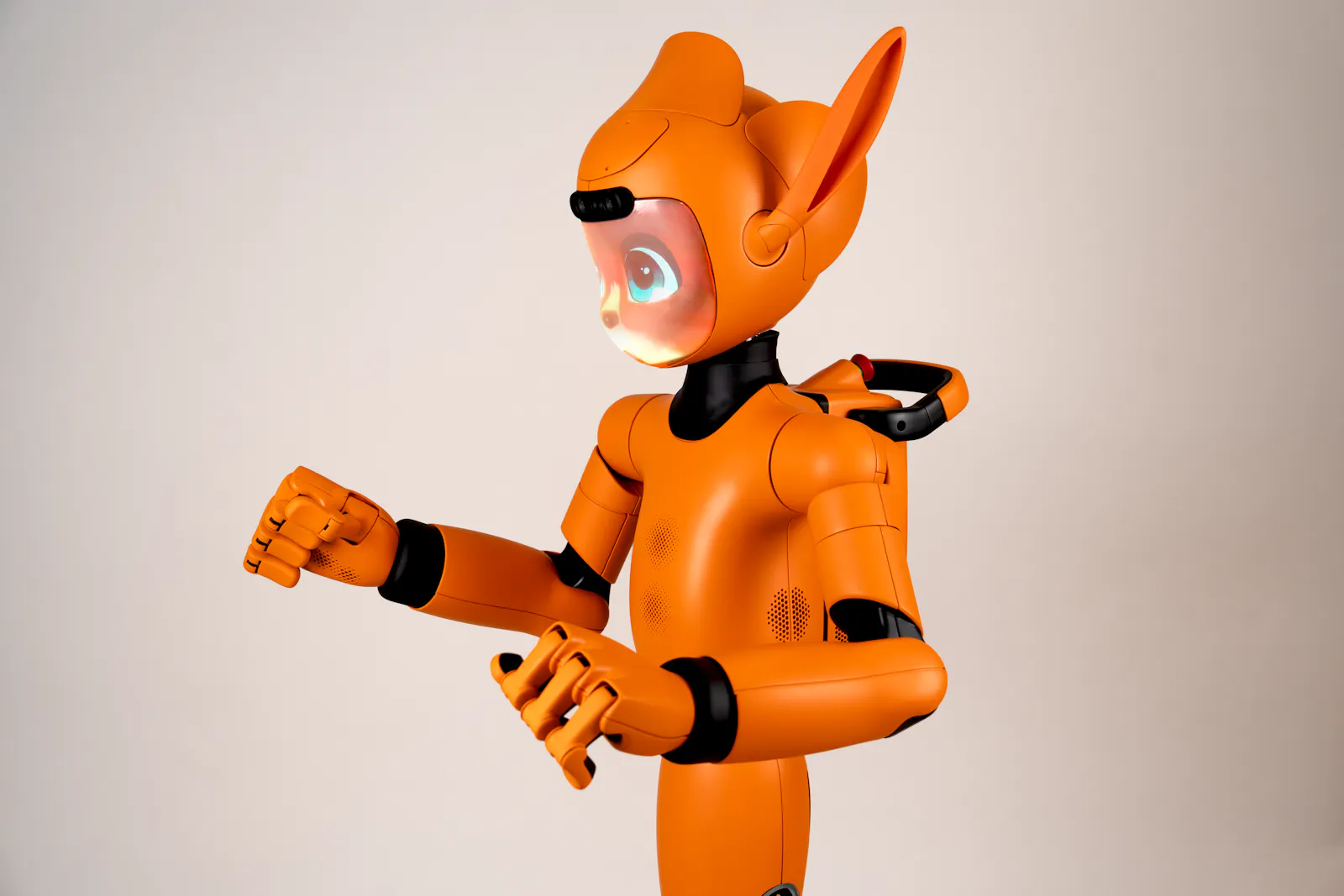
Enchanted Tools presents Mirokaï as a family of robots for social interaction and assistance. Its material covers care, hospitality, retail and airports, combining mobility, expression and object manipulation. The company also describes Miroki's involvement in a paediatric radiotherapy project at the Institut du Cancer de Montpellier. The intended role is companionship and support for the patient experience, not autonomous medical treatment. [1][3]
The design communicates a distinct philosophy. Rather than reproduce a human face, Mirokaï creates a recognisable fictional character. In our view, that is not simply a styling decision: it is a hypothesis about how people approach a machine. Could an obviously fictional character make interaction easier than an imperfect imitation of a person? Could it set more appropriate expectations of the robot's capabilities? Those are questions for real deployments, not conclusions that follow from a photograph.
The important qualification is in the FAQ
Enchanted Tools' purchasing page states that a handler should remain nearby in 2026. It places autonomous recharging on its fourth-quarter 2026 roadmap, with broader autonomy planned for early 2027. These are manufacturer targets, not functions that RoboMorrow has independently tested and confirmed. [2]
That changes how a reader should interpret a short description such as “autonomous navigation and charging”. Navigation under specified conditions does not necessarily mean an autonomous service from beginning to end. A machine may move between locations while still needing help with an unusual situation, a visitor's behaviour or recovery from an interrupted task.
For a buyer, the difference is substantial. A feature label tells you what the system is trying to provide. A deployment specification should explain the conditions under which it works, the exceptions it cannot resolve and the human support it requires. The second document matters much more when staffing a real service.
What could make the purchase worthwhile?
In a hotel, we would measure the requests genuinely resolved, not the number of guests taking photographs. In a care setting, we would separate first-day interest from regular engagement several weeks later. In healthcare, clinical benefits require appropriate evaluation; the presence of a robot in a hospital does not, by itself, establish clinical effectiveness.
There is also a practical economic test. If an employee accompanies the robot, what additional service becomes possible, which aspect of quality improves or what burden is removed? Human supervision does not automatically eliminate value. It does invalidate the assumption that the machine replaces an entire employee from the first day.
A useful pilot would therefore begin with a limited purpose and an explicit comparison. What happens without the robot? What changes when it is introduced? How much support is required to sustain that difference? This avoids confusing enthusiasm about the technology with evidence that an organisation should expand the installation.
RoboMorrow view: Mirokaï is an interesting bet on useful interaction, not a French answer to every proposed Optimus capability. Its strongest proof would be sustained value for people and staff after the novelty wears off.
2. Reachy 2: less talk of replacing people, more infrastructure for building AI
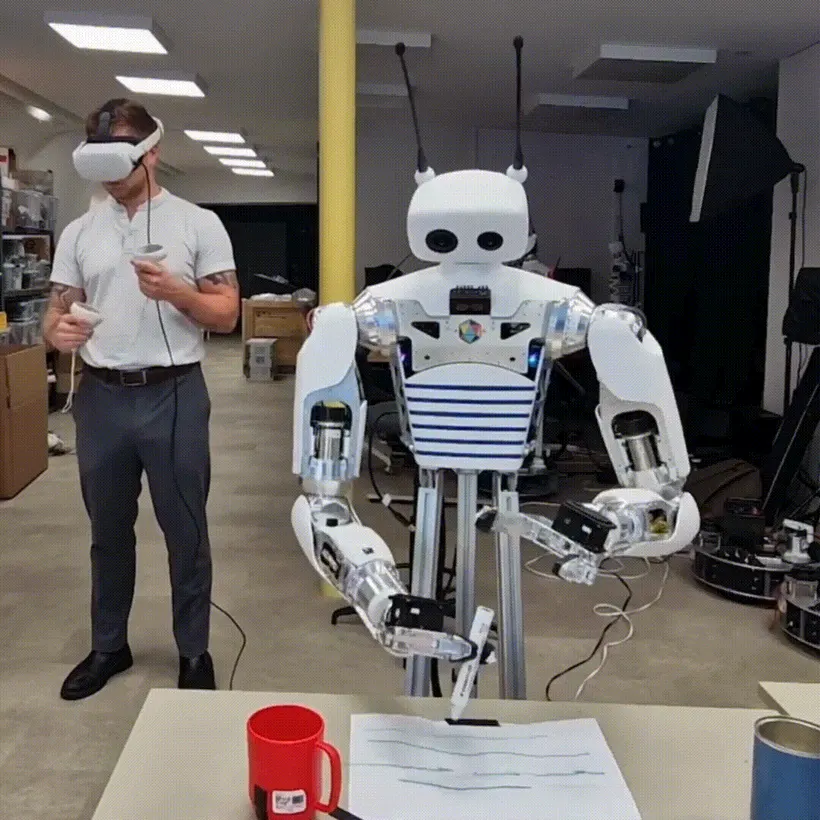
Pollen Robotics positions Reachy 2 as an open platform for robotics and embodied-AI laboratories. It provides documentation, a Python SDK and VR teleoperation, using ROS 2 Humble. Published hardware figures include a height of 136–166 cm, a full-configuration weight of up to 50 kg and approximately 3 kg payload per arm. [4]
The hardware documentation specifies two seven-degree-of-freedom arms, a three-degree-of-freedom neck and manual height adjustment. An omnidirectional base provides mobility. These are useful descriptions of mechanical capability, but none is a measure of intelligence. [5]
Eight hours of battery is not eight hours of autonomous work
The mobile-base documentation lists eight hours of battery life. We do not interpret that as a guaranteed eight-hour shift for an entire application with intensive arm movement. A meaningful comparison would require a specified workload, operating pattern and treatment of downtime. [6]
The safety documentation is even more consequential. Pollen instructs users to observe the robot and remain ready to use the emergency stop. It also warns that the documented system lacks automatic collision detection. That should discourage anyone from presenting a research platform as an unattended machine ready to work among untrained retail customers. [7]
A laboratory's ability to control the environment is part of the proposition. It should not be silently removed when an impressive experiment is retold for a broader audience. A robot performing well in a supervised workspace may still need substantial development before the same task is suitable for a public setting.
Why a research platform can be a compelling business
A laboratory does not always buy a finished answer. Sometimes it buys the ability to ask better questions more quickly: how to learn a new grasp, collect demonstrations, compare control models or reproduce another team's experiment. The commercial value can come from shortening the path between an idea and useful data.
Open interfaces can support that objective, but they do not eliminate engineering costs. A team still needs expertise, computing resources, procedures and time. A sensible purchasing decision would consider not only hardware cost, but also how much integration effort the platform avoids and whether the resulting experiments can be reproduced reliably.
Teleoperation is not an embarrassing secret in this context. It is a tool. The problem would arise if human-controlled behaviour were presented as autonomous operation. For a research user, clearly recording how the robot was controlled and how the data can be reused matters more than pretending there was no operator.
There is also a distinction between learning a task and delivering a service. A platform can help researchers make progress without already being suitable for commercial deployment in every environment that research might eventually address. Confusing those two roles makes both the engineering achievement and the remaining work harder to understand.
French roots, an international corporate structure
Pollen Robotics SAS is based in Bordeaux, but its current legal notice identifies Hugging Face as its parent company. In this article, “French robotics” refers to origins and an engineering ecosystem. It does not imply that every business listed is independently French-owned. [8]
RoboMorrow view: Reachy 2 is worth following as infrastructure for teams developing robotic AI. That is a different promise from a machine that arrives at a business, receives an instruction and immediately takes over a job.
3. UMA Northstar: the broadest ambition needs the clearest evidence
UMA describes a programme of mobile robots and humanoids with advanced dexterity. Its website announces logistics and manufacturing pilots for 2026. Its official Northstar announcement, meanwhile, introduces a design: a body intended for human environments and hands intended to use our tools. [9][10]
The distinction matters. A design presentation is not public evidence that a production robot is ready. The material reviewed for this article did not establish a verified Northstar price, general customer availability, productive operating time or independently measured performance. That is a limit of our verification, not a claim that the team has done no further work.
The tools matter more than the outfit
The idea of using ordinary tools leads to an attractive proposition. Instead of rebuilding every workstation around a specialised machine, a developer tries to adapt the machine to the workstation. If that can be achieved at an acceptable cost and level of reliability, flexibility could become a meaningful advantage.
However, a photograph of a hand does not tell us whether the robot can complete a task. Holding a drill is only one part of an operation. The robot must position the tool, control its orientation, respond to the material, recognise an error and stop safely. The relevant unit of evaluation is the complete process, not its most visually impressive component.
The most informative Northstar demonstration would not necessarily contain a spectacular movement. It might show the same useful operation repeated many times, with different object positions, small disturbances and a visible recovery process. That would make robustness easier to evaluate than a sequence of selected highlights.
Another useful test would be the effort required to change the task. If a supposedly flexible robot needs extensive engineering whenever the workstation changes slightly, the business should account for that support. General-purpose ambition becomes commercially interesting when flexibility is demonstrated, not simply when multiple use cases appear in a launch presentation.
What evidence should come next?
We would first look for a clear separation between physical hardware, visualisations and any human control. Next would come a named task, documented conditions and an explicit account of what the robot handles independently. A reference deployment with results collected over time would carry more weight than additional superlatives.
This is not an argument against ambitious projects. It is a way to recognise a real breakthrough when one appears. If the evidence threshold is set at an attractive render, it becomes difficult to distinguish better engineering from better presentation.
It is also unfair to a development team to assign capabilities that it has not demonstrated. The engineering challenge deserves to be described accurately. Doing so leaves room for both optimism about the approach and uncertainty about its eventual performance, cost and delivery timetable.
RoboMorrow view: Northstar deserves attention for its direction. Based on the material reviewed, it should not yet be described as a ready-made universal worker. It is a programme to watch, not a directly comparable purchasing offer.
4. Calvin-40: the clearest question is how much useful work it can do
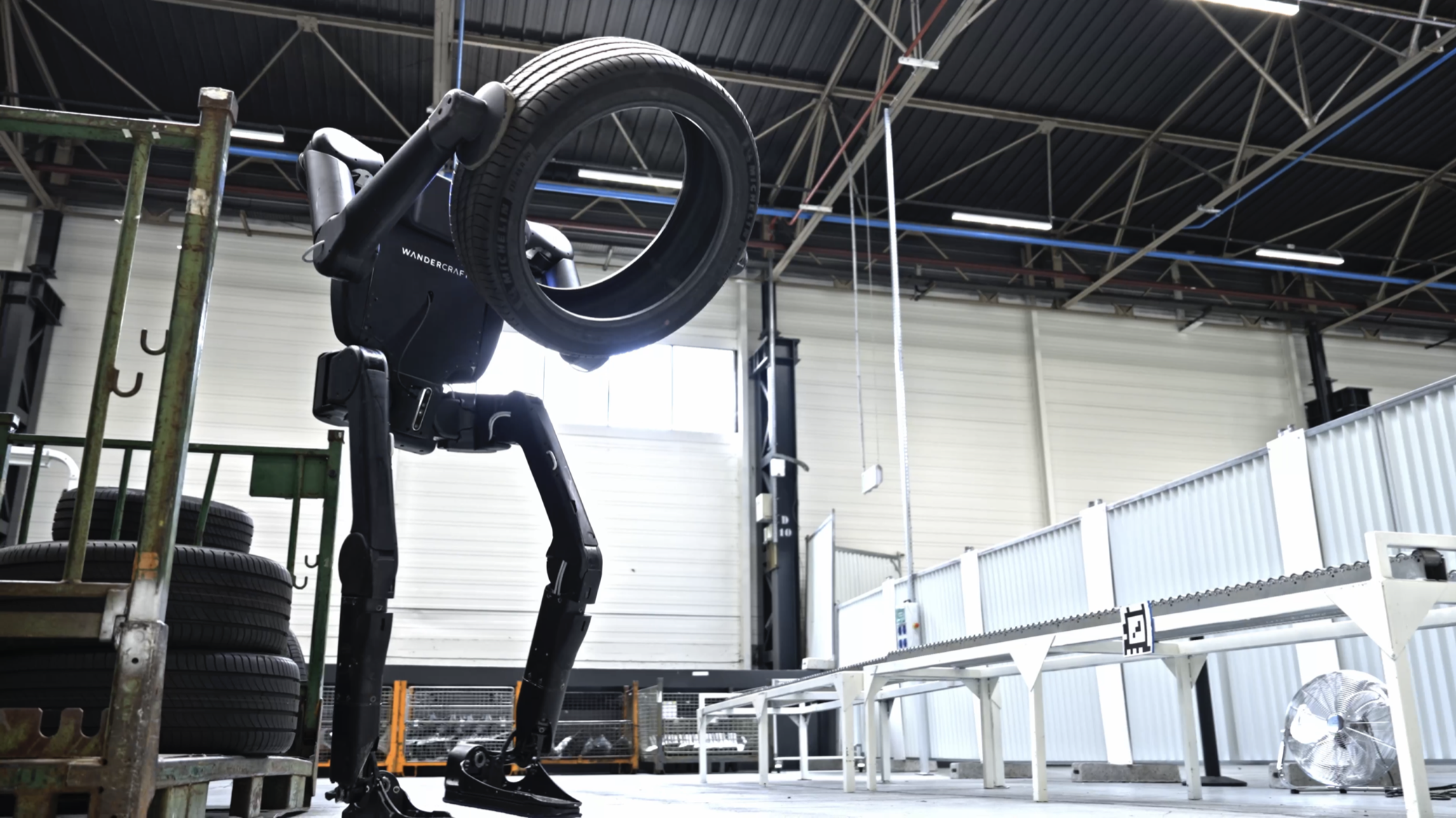
Wandercraft presents Calvin-40 as a material-handling robot for repetitive, physically demanding work. Its announcement of 4 September 2026 says it has secured 12 major customers. The company identifies tyres, parcels, panels and carts among its application areas, with finer manipulation continuing to develop. [11]
Wandercraft's own company timeline describes Calvin operating at Renault's Douai plant. Its Renault partnership, announced in 2025, also includes a minority investment and industrial development. The publicly described relationship therefore extends beyond a shared demonstration to manufacturing and cost reduction. These remain accounts from organisations involved in the programme. [13][14]
Twelve customers are not twelve large fleets
The announcement does not provide complete order quantities, contract values or comparable operating results across every customer. The product page places first series deliveries in the first half of 2027. There is no necessary contradiction: development or pilot machines can operate before regular series deliveries begin. [11][12]
Likewise, statements about a future 350-robot programme should not be transformed into a count of machines already working. Planned programme size, delivered units and robots productively operating on a shift are different measurements. We explore that distinction in our analysis of how the humanoid market is counted.
The strongest advantage: a concrete test can be designed
A material-handling process can have a defined beginning, end, acceptable damage level, cycle time and set of exceptions requiring assistance. That makes the value proposition easier to evaluate. The initial challenge is not to prove that a robot can work in every factory. It is to show that it solves a defined problem sufficiently well in a particular factory.
Humanoid form does not automatically provide an advantage over a mobile transporter, a fixed manipulator or a redesigned workstation. Those are alternatives the buyer should compare. Legs earn their place only when flexibility and compatibility with the environment justify the additional complexity of the complete system.
The relationship with a vehicle manufacturer is interesting for this reason. Building a demonstrator raises one set of questions. Repeatable manufacturing, quality control, maintenance and spare-parts availability raise another. In our assessment, navigating those less spectacular stages will be as consequential as improving AI.
There is also a scale test that a single pilot cannot answer. A team may make one site work through close attention and rapid engineering responses. A commercial fleet needs a support model that can be repeated. The relevant question is whether each new installation becomes easier, or whether every site remains a bespoke development project.
RoboMorrow view: Calvin-40 provides the most concrete starting point for industrial analysis in this selection. That is an assessment of the evidence disclosed, not a declaration that it leads on performance or cost. Sustained operating results and delivery execution remain the decisive milestones.
For the announcement in more detail, see our earlier Calvin-40 customer analysis.
Wheels or legs? This is not a maturity ranking
Mirokaï and Reachy 2 do not lose their rationale because they do not walk like a person. Calvin does not automatically become a better purchase because it has legs. The correct question is: which obstacles, workstations and objects must the robot handle, and what does the chosen architecture cost to support?
On a flat route between defined points, additional legged capability might go unused. In another setting, reach and body positioning might make it more valuable. Without testing the application, there is little basis for declaring a universal winner.
The same applies to hands. A multi-fingered hand may expand the range of possible grasps, but a simpler gripper may be sufficient for a specific object. For a buyer, the most human-like construction is not necessarily the most economical. For a researcher, extra freedom may be precisely what the experiment requires.
It is useful to maintain that distinction when reading our Tesla Optimus analysis as well. The goal is not to identify a one-for-one national equivalent. It is to establish whether a particular architecture helps deliver useful work under real constraints.
What does “deployment-ready” actually mean?
We use five levels of evidence: a design, a functioning prototype, a user pilot, repeatable operation and fleet economics. This is an editorial framework, not an official standard or certification. We do not assign numerical company scores without comparable measurements.
Progress between levels should be supported by new evidence. A design explains the intention. A prototype demonstrates that certain functions can be realised. A pilot tests the system against a real environment. Sustained operation reveals failures, maintenance needs and unusual cases. A larger fleet begins to show whether deployment can grow without an equivalent increase in human supervision.
We would therefore ask a supplier three questions. How is a completed task defined? How often does a person intervene? What happens to performance after several weeks, a software update or a move to another workstation? These answers may be less striking than a promotional video, but they are much more relevant to planning an installation.
Recovery deserves particular attention. Stopping a robot may be necessary, but the business process still needs to resume. Who responds, who diagnoses the problem and how long does safe recovery take? Performance measured only during successful cycles leaves that part of the operational picture unresolved.
The same principle applies to demonstrations. A compelling clip should be the beginning of the evidence trail, not its end. Understanding the setup, attempts, human assistance and excluded conditions makes the achievement more meaningful, rather than less impressive.
The robot's price is only the start of the calculation
We do not invent a price comparison for these four machines. The reviewed material does not provide comparable verified offers covering equivalent configurations, support and application scope. A real project should be priced after the task and operating conditions are agreed.
A simple comparison model is annual cost of the complete solution divided by correctly completed operations. The numerator should include hardware or rental, integration, software, infrastructure, training, supervision, maintenance and downtime. The denominator should not count assisted attempts as if they were wholly autonomous successes.
For a social robot, operation counts alone may be a poor measure of value. Service quality and the user's experience need separate definitions. For a research platform, experiment setup time or the cost of collecting useful data may be more relevant. That is another reason not to place every robot into a single “best buy” table.
The model should also be tested against a realistic alternative. Comparing a robot with an inefficient process that could easily be improved in another way risks overstating its benefit. A credible proposal should explain why this particular machine is preferable to simpler automation, changes in layout or a different division of work.
We have not inserted unrelated Amazon purchasing buttons. This is an analysis of technology and deployment models, not a consumer shopping list. Linking to an educational kit because it is available online would blur the distinction between the robot under discussion and a different product.
French robotics extends beyond humanoids
Two additional companies broaden the picture: Exotec and Shark Robotics. Exotec describes concrete Skypod installations, including CSP / Bleu Libellule in France. Shark Robotics develops machines for emergency-response and protective tasks, including the Colossus firefighting robot. Their products address different needs from the four systems at the centre of this article. [15][16]
These examples are useful because a human silhouette is a poor definition of robotics success. A machine does not need a face to support warehouse material flow. It does not need a human-like hand to assist in a hazardous environment. The relevant shape follows from the job and the conditions in which it must be performed.
In our view, the combination of specialised systems and broader ambitions makes the French ecosystem interesting. Specialisation can generate experience in reliability and deployment. More general platforms can explore new applications. There is no need to endorse one narrative and dismiss the other as a dead end.
That broader lens also helps avoid overstating the maturity of humanoids. Evidence that one specialised robotic system works commercially does not automatically validate a different architecture. Each product still needs its own operating evidence, customer proposition and support model.
What this means for Poland and the rest of Europe
For integrators and businesses considering automation, the useful question may not be “which robot wins?” but “where could we contribute to a viable deployment?”. Potential areas include local integration, training, service, workstation preparation, software connections and credible measurement of results. These are business hypotheses to discuss with suppliers, not confirmed partnership opportunities offered by every company listed.
Selecting the first task is particularly important. Starting with “we want a humanoid” reverses the decision process. It is better to identify a problem that the current organisation of work does not solve well enough, then examine the available architectures. A robot in this article might fit. Simpler automation might fit better.
European origins may help with some conversations or project logistics. They do not automatically guarantee safety, compliance, local data processing or service availability in Poland. Those conditions need to be checked for the specific device, configuration and contract. A flag beside a company name is not a substitute for documentation.
There is also an opportunity for better evidence rather than simply more distribution. A partner that can define a useful pilot, measure outcomes honestly and explain why a deployment should not expand can be more valuable than one that only produces a persuasive demonstration.
The next milestones: what to watch without assuming success
For Mirokaï, watch the delivery of its autonomy roadmap rather than describing the roadmap as complete. For Calvin, look for confirmed series deliveries and accounts of sustained customer operation. For UMA, a documented pilot with a defined task would be a meaningful next step. For Reachy 2, we would focus on research tooling and reproducible applications rather than impose the same commercial timetable. [2][4][9][12]
None of these milestones should be marked complete solely because a new video appears. A named user, operating conditions and limitations would be stronger evidence. Future updates to this analysis should change in response to those developments, not simply to louder language in an announcement.
The conclusion: France does not need four copies of Optimus
The strongest story is not “here is the French Tesla”. It is this: four approaches to useful robotics, with four different things still to prove. Mirokaï needs to demonstrate lasting interaction value. Reachy 2 must serve teams developing robotic AI. Northstar needs measurable capability beyond the vision. Calvin-40 needs repeatable work and convincing deployment economics.
Within this selection, Calvin currently provides the clearest industrial evidence to examine, Reachy 2 the clearest research proposition, Mirokaï the most distinctive interaction strategy and Northstar the broadest open-ended ambition. That is a comparison of strategies and disclosed evidence, not the result of a hardware benchmark.
France is worth following because these projects help frame a better question for the entire industry: not “how human is this robot?”, but “who will it help, with which task, and under what conditions?”. The answers will be more informative than another contest between national flags.
FAQ: French robotics without the shortcuts
Can all four robots already be bought as ordinary products?
They should not be treated as four equivalent retail offers. A research platform, a supervised service solution, a humanoid development programme and an industrial rollout have different access models. Current terms need to be established with each supplier. [2][4][9][12]
Is Reachy 2 the same product as Reachy Mini?
No. This article covers the larger Reachy 2 platform with arms and an optional mobile base. Pollen lists Reachy Mini separately. Pricing and capabilities should not be transferred from one to the other. [4]
Does the Northstar image prove that the robot works?
No. The official design presentation illustrates the intended product. A visualisation does not establish performance or autonomy. [10]
Does Mirokaï replace a doctor or caregiver?
That is not the role established here. The ICM project concerns support for interaction and the experience of young patients. It is not evidence of autonomous treatment or a reason to remove human care. [3]
Do Calvin's 12 customers prove mass production?
No. The customer announcement does not disclose the complete scale of delivery or operation. It must be read separately from the first-series timetable. [11][12]
Which robot is the best?
Without a defined task, that is the wrong question. A laboratory, hotel and factory have different requirements. What should remain consistent is the quality of the evidence, not a score in an artificial all-purpose ranking.
Sources and verification scope
Manufacturer documents describe their own products and plans; they are not independent audits. Sources reviewed on 27 September 2026.
- Enchanted Tools — Mirokaï: product presentation
- Enchanted Tools — purchasing FAQ and autonomy roadmap
- Enchanted Tools — Miroki at Institut du Cancer de Montpellier
- Pollen Robotics — Reachy 2
- Pollen Robotics — Reachy 2 general specifications
- Pollen Robotics — mobile-base specifications
- Pollen Robotics — Reachy 2 safety guidelines
- Pollen Robotics SAS — legal notice
- UMA — company and pilot-programme presentation
- UMA — official Northstar design announcement
- Wandercraft — 12 Calvin-40 customers, 4 September 2026
- Wandercraft — Calvin-40 product page
- Renault Group and Wandercraft — partnership announcement, 6 June 2025
- Wandercraft — company timeline
- Exotec — CSP / Bleu Libellule customer case study
- Shark Robotics — company and product portfolio